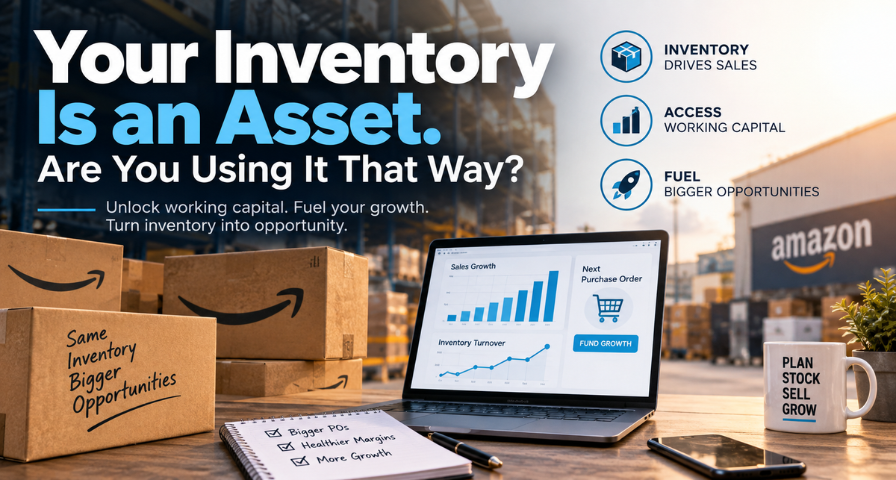
Your Inventory Is an Asset. Are You Using It That Way?
haven't
Ask a seller doing seven or eight figures a year where their money actually is, and they won't point at a bank statement. They'll point at a warehouse. For most Amazon sellers, inventory isn't just a cost of doing business. It's the business, and growth only makes that truer. A company can be profitable, growing, and still short on usable cash, simply because so much of its money is sitting in products that hasn't sold yet. Understanding inventory financing, and how it fits into the way Amazon businesses actually operate, is where a lot of experienced sellers start to think about capital differently.
The Inventory Trap
A trend that keeps repeating itself among Amazon sellers when they expand is sales increase and subsequent order quantities increase, leading to a purchase order increase as well, since larger purchase orders mean lower unit prices and better margins. But it's not like everything happens immediately. There is always a period of time between when the money leaves an Amazon seller and gets paid to the manufacturer until the product sells and the money is returned. That period of time will depend on production times, shipping methods, customs, the Amazon payout policy, and product velocity. Depending on the seller, that period can range from a couple of weeks to almost four months.
Imagine the case of a seller with an inventory of $500,000 and earning $150,000 per month from sales. The supplier gives the buyer a discount in a purchase order of $200,000, but the previous inventory still remains unsold. At face value, the company looks good and profitable. However, in reality, there is not enough cash to pay for the purchase order. This example perfectly illustrates the concept of the inventory trap in one frame: a successful business limited not by demand or profit, but by time.
Why Profit Doesn't Solve the Problem
This is the part that catches a lot of sellers off guard, because it runs against the usual assumption that profitability fixes cash problems. It doesn't, at least not on its own. Strong margins, rising revenue, and a growing customer base can all be true at once, and a business can still hit a wall simply because the cash isn't in the right place at the right time. That's a liquidity problem, not a profitability problem, and the two get confused constantly.
Sellers typically respond in one of a few predictable ways. Some slow-down reorders, risking stockouts and losing shelf space to competitors that's hard to win back. Some lean on personal credit cards or short-term loans with high rates, which quietly erode margins built up over months. Others bring in outside investors earlier than they'd like, trading equity to solve what is really a timing issue rather than a flaw in the business itself. None of these approaches are automatically wrong, but when the actual problem is capital temporarily trapped in inventory, they're often not the best fit, because they aren't built around the asset causing the squeeze in the first place.
Inventory as an Asset, Not Just an Expense
This is the turning point for merchants who have experienced several business expansion cycles. Rather than thinking about their inventory as a cost which needs to be covered before generating profit from sales, they start thinking about their inventory as collateral that can facilitate obtaining capital, not just as something that absorbs capital.
To be precise, this assumption is sometimes oversimplified. Just having $500,000 of inventory does not equal to having $500,000 of borrowing capacity. Lenders consider many factors when assessing the inventory as collateral, such as the sales rate, concentration in the number of SKUs, age of the inventory, liquidation value, sales history on Amazon, margins, and overall financials of a seller. Thus, instead of saying "my inventory is equal to my borrowing capacity," one should say, "healthy and quick-moving inventory can release some of its value into capital." " Financing against inventory as an asset is a well-established practice in traditional retail and manufacturing, and it has been going on for decades. What is different today is the increased visibility, which allows Amazon to report sales velocity, sell-through, and the amount of the inventory so that the lending against the inventory becomes reliable.
Why a Revolving Structure Tends to Fit Better
As far as inventory financing is concerned, there are several options available; however, a revolving line of credit seems more compatible with the nature of operation of an Amazon business compared to a term loan. In a term loan, the borrower gets an amount of money in one go and pays it back at a scheduled pace, which suits a single transaction, such as purchasing equipment, perfectly well; however, it does not adjust with the repetitive cycle that takes place in a few weeks or months.
eCapital's Liquid Inventory program is one example built around this idea, offering a line tied to inventory value that grows as inventory grows and frees back up as product sells through. Program terms vary by lender, but the general structure tends to offer a few practical advantages. Interest is often charged only on the amount drawn rather than a full balance sitting untouched. The credit can be reused as inventory turns, instead of requiring a fresh application each cycle. And it can consolidate what might otherwise be several separate funding sources, a credit card here, a short term loan there, into one facility that's easier to manage and track. For a business running on a buy, stock, sell, replenish rhythm, that structure removes friction that builds up when cash flow and inventory needs fall out of sync, and it means the available capital tends to scale in step with the business rather than staying fixed at whatever amount made sense a year earlier.
What Sellers Should Actually Weigh Before Using It
Inventory financing is a useful tool, not a fix for every cash flow problem. It doesn't solve poor product market fit, slow moving inventory, weak margins, unprofitable advertising spend, or forecasting that consistently misses the mark. A seller with $500,000 in inventory that isn't moving doesn't solve that problem by borrowing against it, and doing so can add pressure rather than relieve it. Financing should accelerate a healthy inventory cycle, not disguise an unhealthy one. A seller with strong sell through and a track record of turning stock into revenue is exactly the profile this kind of financing is designed for. A seller carrying excess or aging inventory because of a forecasting miss is in a different situation, and the right move there is fixing the inventory problem first, not adding debt on top of it.
The Q4 Example
The fourth quarter makes this dynamic especially visible. More expected demand means more inventory needs to be ordered, which means cash goes out earlier, which raises the working capital requirement right when a business can least afford to be constrained. The dilemma runs both directions. Under order, and there's real risk of stockouts during the highest demand weeks of the year, losing sales and ranking position built up over months. Over order, and cash gets tied up in stock that might sit past the season. Financing doesn't make that forecasting decision for a seller. What it can do is give a seller with a sound, well forecasted plan the flexibility to actually execute it without order size being dictated purely by whatever cash happens to be sitting in the account that week.
The Bigger Shift
Inventory will always be one of the largest uses of cash in an Amazon business. What can change is whether that inventory is treated purely as a cost sitting on a shelf or as an asset that helps align available capital with the pace the business actually needs to reorder, launch, and restock. That's a more accurate way to frame this than simply borrowing more. It's about making sure the financing a seller uses moves at the same speed as the inventory itself, rather than working against it.
For sellers who've felt the tension between a growing top line and a shrinking bank balance, it's worth examining whether the inventory already on hand, assuming it's genuinely moving and priced well, could be doing more than sitting there waiting to sell. Working capital for Amazon sellers doesn't have to mean choosing between slower growth, expensive short-term debt, or giving up equity. In many cases, the constraint isn't the product or the business model. It's that the capital and the inventory cycle haven't been aligned yet, and for a seller with healthy, well-managed stock, that's a solvable problem rather than a permanent ceiling.
Ready to Grow on Amazon?
Let our experts help you scale your Amazon business with proven strategies.
Get a Free Consultation