Why Your Amazon Main Image Is Quietly Losing You Sales
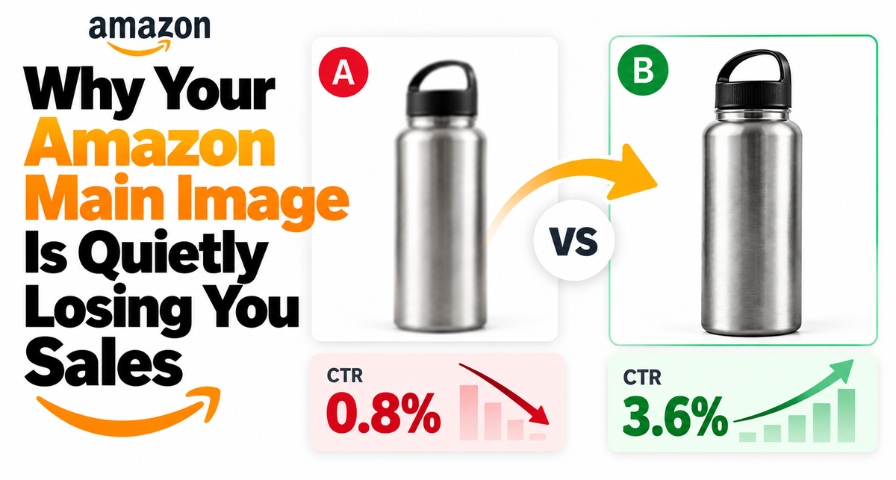
All sellers think about price, customer reviews, and keyword ranks. On the other hand, the sole image that is displayed on top of your listing, which the customer sees in a split second when deciding whether to click on it or not, is fixed forever. It is a huge mistake, and it costs you much more than you can imagine.
During a panel discussion on the strategies for Amazon selling, one of the speakers began his speech with a very intriguing sentence people do not buy products on Amazon; they buy photos. This particular statement set the tone for the entire discussion of several e-commerce specialists, who devoted 90 minutes to discussing one thing, which is usually ignored by most sellers split testing of the main product image. The findings of this discussion were remarkable.
What the 80% Challenger Win Rate Actually Means
That was the statistic around which the whole discussion revolved. According to one of the experts, based on all the tests that they've conducted, if the seller split-tests the current main image with a challenger one, 80% of the time the challenger beats the main image.
Now it is essential to point out what this statistic means and doesn't mean. It doesn't mean that there is a guarantee that four out of five Amazon sellers will definitely have an image that needs improvement, and it also doesn't imply that this is a universal metric for all categories on Amazon. What it says is that this is the result of the tests conducted by this particular team, where the challenger image beat the current main one about 80% of the time. That said, it is a very good reason to do some testing instead of assuming that everything is okay.
Once you have set up a primary image, most sellers tend to leave it alone unless there is a sudden decrease in your sales figures. The primary image does not just fail spectacularly; it fails silently. Your CTR may degrade slowly each month as your competition continues to improve their listing and thus your competition on the search results page; there is nothing in Seller Central that will signal this decline to you. You will only become aware of this when it becomes too late.
Why Your Amazon Main Image Has Such a Big Impact on CTR
It is worth considering the significance of this one image. When you look at a jam-packed search results page, the only thing that is under your control is the main image until someone clicks to go into the listing. Yes, titles, bullets, A+ content, and reviews all count for something but nothing counts if someone doesn't click in the first place. This is where the main image becomes the gatekeeper for all other optimizations that you have done.
They mentioned in the panel the disparity that was seen in terms of CTR where a poorly optimized main image would lose out by 2x to 5x when pitted against the right main image. Again, this is the range of disparity that was found as a result of some experiments, and not the guaranteed disparity that everyone who uses PPC will get, but the fact is that if you are spending money on PPC and yet your main image is underperforming, you are making those dollars work in vain.
The Testing Cadence the Experts Recommend
So what should you actually do with this information? The panel was specific about cadence, and it's more structured than what most sellers currently do. Retest your main image at minimum every three months. That's not a one-time project you check off and move on from, it's a recurring line item, the same way you'd revisit your PPC bids or your pricing strategy.
There's a second habit that matters just as much, and it costs nothing beyond attention. Look at your search results page every week. Not your own listing in isolation, the actual page a shopper sees when they search your main keyword. Competitors are reshooting their images constantly, adding lifestyle shots, size comparisons, and bold callouts that weren't there a month ago. If you're only benchmarking against your own historical performance, you can hold steady while the competitive bar rises underneath you. Your image hasn't changed. The market around it has. A main image that converted well in January can look dated and unpersuasive by April, not because it changed, but because everything around it did.
The Mistake Most Sellers Make When They Finally Do Test
Here's where the conversation became genuinely useful, because most sellers who do decide to test their main image test the wrong things first. They'll run several variations that are essentially the same photo with tiny adjustments, a badge moved from the left side to the right, a slightly warmer white balance, and a different font on a callout. Then they're surprised when the results come back flat and inconclusive.
One expert's framework splits image testing into two distinct categories, and understanding the difference is probably the most actionable takeaway from the entire discussion.
Angles Versus Variations, and Why the Order Matters
An angle test compares fundamentally different concepts for how to present the product. Packaging-forward versus a person actively using the product. A hangtag shot versus a dramatic demonstration of the product in action. A clean studio shot versus one that includes a visual size reference so shoppers immediately understand scale. These aren't small tweaks, they're different stories about the same product, and they carry real risk because a bold new concept can flop. But that risk is precisely why angle tests tend to produce the biggest wins. According to the discussion, the largest lifts are more likely to come from testing fundamentally different angles, with the panel citing potential 2x to 3x improvements in that category of test.
On the other hand, a variation test occurs in an angle that has already been proven to win. If you have discovered that your winning idea is packaging forward, you can now try a color for your USA flag graphic, slight variations in copy, or just rearrangement of the same components. These are important and cumulative, but their lifts will be incremental.
The sequencing error most sellers make is jumping straight into variation testing without ever running an angle test first. It's the equivalent of A/B testing font sizes on a headline you haven't validated is even the right headline. You end up optimizing details inside a concept that was never your strongest option to begin with.
How to Run an Amazon Main Image Test
The overall strategy that was explained on the panel involved performing an angle test. Combine several unique angles for your primary image and make sure that they are unique concepts, not iterations of a similar idea. Test them against each other through a single split test using a split-testing platform where different creatives can be shown to different segments of your audience and their clicking and converting behaviors are measured.
After having selected a winning angle out of those angles that you've tested, then comes the time for a variation test. The winning concept has to be refined, colors have to be changed, copy adjusted, badges moved around, and so on. Each iteration should be based on the previous one, and here comes the advantage of the three-month retest interval even the winning angle should be refreshed periodically.
Test Creativity Without Breaking Amazon's Rules
Another important aspect to consider is compliance. Coming up with new angles such as the usage of the product, the performance of a demonstration, or a size comparison picture is a valid method of testing, which is usually highly effective, but it still must conform to the core image policies of Amazon in your category. In most cases, the main image must contain the product only, without any additional texts, graphics, badges, or any kind of claims that can be found on top of the picture. A size reference picture or a lifestyle-style composition can be a good angle to test, but it must meet your category's standards. It is always a good idea to check what the rules are for main images in your category before testing any radical ideas to make sure that the winning creative won't be marked or even suppressed after the test.
What This Means for Sellers Who've Never Tested Before
If you've been running the same main image since launch, the case for testing is straightforward even without turning the numbers into a precise calculation. We don't have enough detail about sample size, category mix, or test methodology to combine the reported 80% win rate and the 2x to 5x CTR range into a reliable prediction for your own listing. What we can say is that a high reported challenger win rate, paired with potentially large CTR differences, makes image testing worth taking seriously. The only way to know whether your own listing has similar upside is to test your creative against a meaningful challenger and see what the data shows.
This isn't a nice-to-have optimization reserved for sellers with massive catalogs and dedicated creative teams. It's one of the higher-leverage things a seller can do, because unlike ad spend or inventory decisions, it doesn't require ongoing capital, just a willingness to test concepts you haven't tried yet.
It's also worth noting what this implies about Amazon as a platform more broadly. As more sellers professionalize their image strategy and treat their main image as a living, testable asset rather than a static requirement, the competitive bar keeps climbing. Sellers who treat their main image as finished the day they launch are effectively opting out of one of the few remaining levers that isn't dependent on ad spend or algorithm changes. Amazon image optimization has increasingly become a game of incremental creative testing, not just keyword strategy or bid management, and the discussion among these experts makes clear why.
Key Takeaways
The key takeaway from this entire conversation is fairly straightforward and something you should be able to put into practice this very week. Your Amazon main image is not an asset that is fixed; it's an asset that is variable. Making assumptions about it being fixed and not testing alternative images will cost you clicks that you didn't even know you were losing. Challenge your existing main image with an image at a truly alternative angle, not a slightly modified version of the same angle, and see who comes out on top. From there, fine-tune the winner by testing variations until you are optimizing within the image requirements for your product category, and then make sure you are getting into the habit of monitoring your search results page once per week.
The bigger picture is that many sellers are missing valuable CTR improvements simply by not running the tests. There is no additional budget needed to make it happen, and there is certainly no additional supplier needed. All you need is the test itself.
Ready to Grow on Amazon?
Let our experts help you scale your Amazon business with proven strategies.
Get a Free Consultation