Why Vine Reviewers Tank Your Rating (And the Simple Fix Most Sellers Miss)
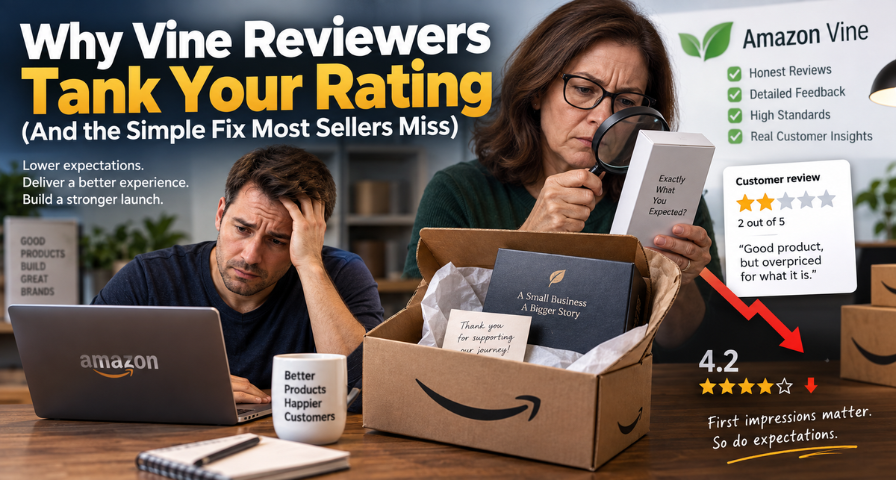
Ask an expert Amazon vendor about the Vine program and you will definitely get to know their two completely conflicting views. For some, the Vine Program is the quickest way to establish credibility for a new item. But others have witnessed firsthand how a great product launch ends up with poor reviews even before its introduction to buyers.
It is not about Vine reviewers being biased either. It is about the fact that they pay attention to the discrepancy between what they ordered and what was written in the listing. The product that seems amazing based on the title, pictures, and bullets sets certain expectations even before the box arrives. If the received product is somewhat worse than expected, even if it is an excellent one, it will get a low score from a Vine reviewer, and this score will stay at the top of the listing for several months to come.
This brings us to another very important question that most of the vendors ignore. Are you preparing your product for a Vine review or simply your listing for sales? This is critical, since when the first reviews appear, you do not just collect opinions and scores. You discover whether your product, your presentation, and expectations of your customer match. This article will look into the reasons behind this mismatch, attempts made by some sellers to solve it, and at what point these attempts become risky.
The Expectation Gap Is the Whole Story
All other things stripped away, there is only one thing to compare in a Vine review what the reviewer thought about something before seeing it and what they really got after trying it. This difference, whether positive or negative, affects nearly all of the review. If the reviewer expected little and got something good, they will be pleasantly surprised, and this will most likely be reflected in their high rating. On the contrary, if the reviewer expected something spectacular based on its marketing and then got something that works but not much else, they will be disappointed despite the product being perfectly fine.
This isn't unique to Amazon. It's the same psychology behind customer satisfaction in almost any industry, and it's why "under-promise, over-deliver" has stuck around as advice for so long. It applies just as much to a Vine reviewer scrolling through your listing as it does to a client waiting on a project deadline.
An illustrative example clarifies the point. Imagine the copy of a listing that features military-style boot socks saying, "Premium military-grade socks with exceptional durability, comfortability, and moisture control technology." The customer creates an image of tough and durable socks. In the event when the customer receives socks that are comfortable enough and well-suited for being worn in boots, yet they are considerably thinner than those described in the listing, he/she is not necessarily mistaken in believing that he/she was tricked into buying the products. The remedy in this case should not be in trying to reduce the appearance of strength of the product through the description. Instead, the description should match the actual appearance of the product, as, for instance, "cotton-rich crew socks for regular use with boots, hiking, and outdoors."
One Seller's Approach, With a Caveat
A seller who leads a group inside Titan Network built a launch strategy around closing this gap deliberately. He describes his last eight launches opening between 4.7 and 4.8 stars after Vine units were redeemed, a result well above the roughly 4.2 average that seems to be common industry experience. Other sellers in his network report similar outcomes using the same general approach.
It's worth being upfront that this is one seller's account, not an independently verified benchmark. There's no public data here on sample size, product category, or how those ratings compared to similar launches that didn't use this method. That doesn't make the underlying idea worthless, but it does mean the 4.7 to 4.8 figures should be read as an interesting individual result rather than a guaranteed outcome for any product in any category. With that in mind, here's what the approach actually involves.
Aligning the Listing Before Vine Units Go Out
What I am proposing is ensuring that the listing does not hype up the product more than the reviewer will really receive it. This begins with the image of the product. Rather than using a low-quality image on purpose, one could use an image that depicts the product as it really is without any exaggeration or fancy lighting or surroundings that may suggest more than there is actually in the product. The idea is to have someone (the buyer as well as the Vine reviewer) see the product for what it is without any confusion. The downside of using a low-quality picture is that it might lower the expectations, but it would also mean that people are getting less of a feel of what they are buying.
The same is true of the written copy. The marketing claims contained in the headline and in bullets are promises made that the Vine reviewer is going to verify. "Ultimate Premium" and "Unmatched Performance" are just some examples of the type of terminology used that will be taken under scrutiny because they are vague enough to be criticized but specific enough to come across as a guarantee. Replacing grandiose terminology with factual language does not mean removing marketing from your copy. It means removing claims that cannot be backed up.
The issue of pricing is important here as well; however, the statement "price it low" is a bit oversimplified. Price definitely influences the perceived value of the product, and "great product, but expensive compared to what it does" is a fairly frequent customer comment that may downgrade a good review. But the price is not the only aspect that goes into the consideration of a reviewer when writing an evaluation; quality, package, and competitor prices are taken into account as well. To prevent such problems, some vendors opt to sell three to five pieces of the item at the regular price first to establish a regular price history for the product and then lower the price to fit into the Vine window. Whether this particular number prevents getting into Buy Box issues cannot be confirmed by the article, so let's treat it as just one vendor's practice. What is true in this case is to select a launch price based on the value of the product itself which would still stand when the initial discount is over.
Can a Better Unboxing Experience Influence Reviews?
The most discussed element of the strategy includes packaging. When selling to FBA, some sellers package the first two cartons differently, more elaborately than any unit visible in the listing photos. The idea is that when the reviewer is expecting to receive a simple box and gets something more elaborate, the pleasant surprise takes their focus away from scrutinizing the product.
It might be true, and there is a lot of research that confirms that people make their decisions based on the first impression. However, the article does not present any evidence to prove this point it remains just a hypothesis, and sellers need to understand that. There is one very important point to mention: improving the packaging is always good for the business, but creating the premium package for the product that is sent to the reviewers is something else. Selling the products with a certain packaging requires presenting them in the listing as they really are. If the premium packaging is created just for the purpose of sending the product to the Vine reviewers, the seller needs to think twice.
Two exceptions matter regardless of which approach a seller takes. Anything that's eaten, applied to skin, or otherwise put in or on the body should always include a clear ingredients photo. That's a safety and transparency issue, not a marketing decision, and it shouldn't be treated as optional. And if a product already ships in genuinely nice packaging as a normal part of the supply chain, there's no need to hide that, it can simply be added back into the listing photos once the Vine window closes.
An insert card introducing the seller and the brand's story is a reasonable addition on top of all this. People often feel more forgiving toward a product when they sense an actual person or small team behind it rather than an anonymous listing. That said, the card should stay focused on the brand story itself. It shouldn't ask for a five-star review, offer any incentive tied to leaving feedback, or nudge reviewers toward the seller instead of leaving honest public feedback. Once a card starts doing that, it stops being a brand touch and starts being something closer to review manipulation.
What Vine Reviews Actually Reveal
Remembering that Vine reviews aren't just something that needs to be managed but also something that needs to be analyzed is important. Several reviewers highlighting the same thing separately isn't something that should just be ignored. While a few complaints about socks being small-sized can be just an expression of personal expectation of the customer, it's more likely an indication that there actually is a problem with sizing and it should be addressed. Complaints about towels feeling thin or about the sealing system of a reusable bag not working properly also usually show that the problem lies with the item itself, and not with how it was described in the listing.
Where Expectation Management Goes Too Far
There's a meaningful line between managing expectations honestly and creating a misleading experience, and it's worth being explicit about where that line sits. Using accurate, unembellished product images and honest copy is good practice for any listing, Vine or not. Consistent packaging and real product improvements based on feedback are good practice too. What crosses into riskier territory is deliberately withholding information a shopper would want, building a packaging experience that exists only for reviewers and never for regular customers, leaning on claims that aren't backed by the actual product, or making price changes large enough to meaningfully alter what customers believe they're paying for. None of these necessarily violate a specific rule, but they start to drift from expectation alignment into expectation manipulation, and that distinction is worth sitting with before adopting any of these tactics wholesale.
The Real Lesson From Vine Reviews
Amazon Vine can be an effective tool in launching a new product; at the same time, it will reveal instantly and rather painfully any discrepancies between the information provided by the listing and what a customer receives. The discrepancies do exist, and the most important reason for successful launches and the others failing is their existence.
A more sustainable approach does not involve lowering expectations of the reviewers for the sake of it. It means ensuring that everything said in the listing, priced for, and promised to a customer should correspond to his experience. The straightforward listing can decrease exaggerated expectations without even concealing anything from a potential buyer. The improved packaging may indeed contribute to customer satisfaction without being aimed primarily at making an impression on the reviewers.
Getting good Vine reviews is desirable; however, getting consistent positive feedback from paying customers long after the Vine period ends means building a solid Amazon business. This is possible only if the expectation set forth in the listing and the experience delivered through the box match each other.
Ready to Grow on Amazon?
Let our experts help you scale your Amazon business with proven strategies.
Get a Free Consultation