Why an Amazon Ranking Drop After Stockout Hurts More Than You Think (And How to Fix It)
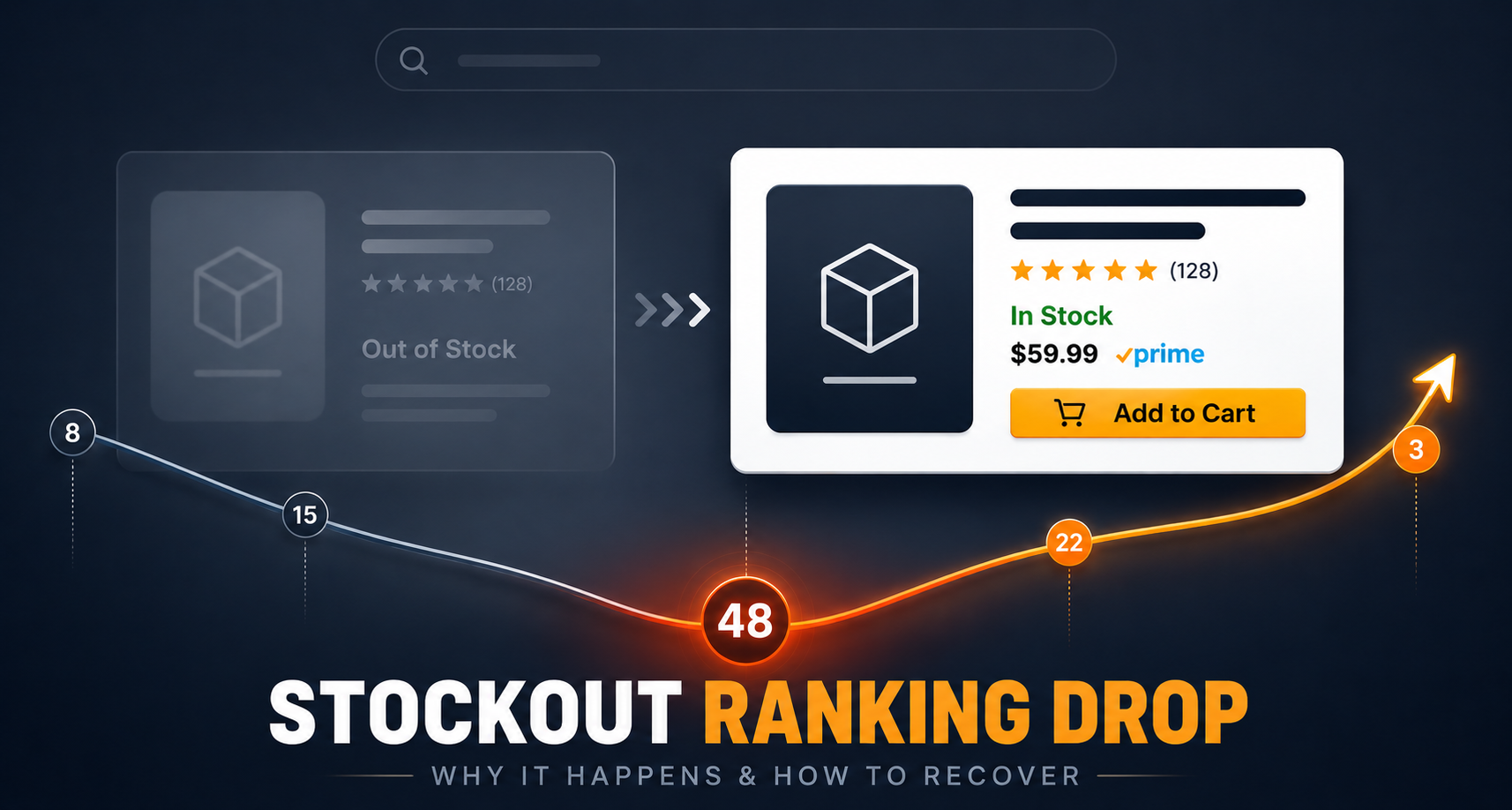
Being out of stock on Amazon seems to be a mere logistical issue, but when you look at your rankings a week later, you understand that it's actually a more severe situation than that. Being downranked by Amazon after being out of stock means losing sales while not having any inventory available, but what is crucial is that after becoming back in stock, your rankings continue to suffer. This issue doesn't end as soon as you have replenished your inventory, and most likely, there needs to be an effort made specifically for recovering from such situations.
How a Stockout Quietly Resets Your Search Position
The Amazon algorithm isn't interested just in what you sell but also in how often you do so. As soon as a listing becomes out of stock, there are no more sales; thus, silence is interpreted as a sign that there is no longer any interest in the product.
This is very important as the large majority of purchases on Amazon are made by products ranked among the top results of a search query. Even the fall of a few places on the list may result in the loss of a very considerable amount of traffic as people rarely go further than the first page. And it is exactly why the sudden drop in rank after the stockout becomes such a serious issue for Amazon sellers.
The 180-Day Window That Quietly Shapes Your Fate
One of the least understood parts of Amazon's ranking logic is the rolling 180-day sales history it uses to evaluate performance. This isn't a fixed scorecard, it's a moving average that constantly recalculates based on recent activity.
When your product sells zero units for days or weeks at a time, those empty days don't just sit there neutrally. They actively pull down your overall performance average and weaken your competitive standing against listings that never stopped selling. In simple terms, Amazon doesn't remember what you used to sell, it ranks what you are selling right now.
This is why timing matters so much during recovery. If your stockout falls within that 180-day window, which it almost always does, every day without sales works against you twice: once by losing the sale itself, and again by diluting your historical performance data. However, the best news is that the process works both ways. Active selling after the replenishment of inventory will change the rolling average in fairly quick succession, which is precisely why an active approach to fixing the problem of Amazon stockouts is usually better than the passive one.
Why the Length of the Stockout Changes the Recovery Math
Not all stockouts are created equal, and sellers often misjudge how much trouble they're in based on how long the gap lasted. A short outage of a week or two typically causes minimal damage, since recent sales history still carries enough weight to cushion the blow.
Once you cross into the two-to-twelve-week range, the picture changes. Sales velocity starts to visibly erode, and competitors who maintained steady availability begin closing the gap or overtaking your position entirely. Stockouts stretching toward six months start to look like a different problem altogether. At that point, so much of your 180-day sales history has been replaced by inactivity that Amazon's algorithm essentially forgets your historical advantage.
You're no longer recovering a position, you're rebuilding one from a much weaker starting point. This is why sellers who treat a three-month stockout the same way they'd treat a three-week one often end up disappointed, throwing modest effort at a problem that actually requires a full relaunch mentality to recover Amazon ranking effectively.
Rebuilding Sales Velocity the Moment Inventory Returns
In terms of recovering after an Amazon ranking fall caused by stockout, the number one priority should be speeding up sales velocity as soon as possible. The initial couple of days following the restock will be crucial, as Amazon will be paying close attention and trying to figure out if the demand has been revived or if the product is doomed.
This is not the time to take things slowly. In such cases, using coupons will probably be the most efficient solution. They do not involve any preparation, and conversions will occur right away. In case a seller's account has deal placement options, using a deal will create a beneficial spike in sales, showing the renewed interest in the product.
Promotions targeted specifically at previous customers will also come in handy if a seller has enough clients. However, promotions will lose their efficiency around ninety days after their start.
Letting Amazon PPC Recovery Do the Heavy Lifting
After this initial promotional effort is set into motion, Amazon PPC Recovery takes center stage. Of course, it's natural for an advertiser to think about slowly easing back into the process after a stockout. After all, nobody likes to waste money on their listings when they haven't quite gotten off the ground yet.
Unfortunately, this strategy rarely pans out. A slow increase in ad spend simply allows other advertisers more time to secure their position in the wake of your absence. Instead, it's better to target those keywords that have been the driving force behind your biggest conversions, bidding on them as fiercely as possible — typically increasing bids by 25 to 50 percent above usual values.
Combining this with top-of-search placements ensures that your listings are shown to highly intentional users during the time frame when conversions matter most. This is not an attempt to run your ads indefinitely with higher-than-average spend. Instead, it is a way to speed up the entire recovery process by maximizing the conversion rate of traffic.
The Recovery Mistakes That Quietly Sabotage Sellers
It’s surprising how many recovery campaigns fail not because the method itself is wrong but due to minor mistakes done regularly. The fact of waiting too long with the start of the advertising campaign after restocking becomes very common because each day of silence only gives more chances to the competitor.
The second mistake often made is an assumption that sales without ads will recover the listing. Without support of demand from paid traffic, the system has no reason to lift it up. It happens that during the campaign sellers switch to new keywords, forgetting those that were working.
Moreover, the increase in advertising budget without the account of the inventory will lead to starting all over again, just because the increase in demand was followed by the lack of products. Not organizing any promotions during the relaunching campaign also becomes one of such mistakes.
What to Do Next If You're Dealing With a Ranking Drop Right Now
If you're currently staring at a listing that's lost its position after a stockout, don't treat this as a wait-it-out situation. Start by checking your inventory status and confirming a restock date, then prepare your promotions before stock actually lands so you can launch a coupon or deal the same day inventory goes live.
Pull up your historical search term report and identify the keywords that drove the most conversions before the stockout, then plan to raise bids on those terms by 25 to 50 percent for the first two to three weeks after restocking. Monitor your sales velocity daily during this window rather than weekly, since early signals matter more than long-term trends right now.
If you've been out of stock for more than six weeks, set your expectations accordingly. You're not nudging a ranking back into place, you're relaunching the listing, and your ad spend and promotional plan should reflect that reality. An Amazon ranking drop after stockout doesn't fix itself, and every day you wait is a day your competitors keep the shelf space you used to own. Restock, relaunch, and push hard from day one, because in this game, hesitation is the only mistake you can't recover from.
Ready to Grow on Amazon?
Let our experts help you scale your Amazon business with proven strategies.
Get a Free Consultation