Why Amazon Sellers Should Stop Chasing High Search Volume Keywords
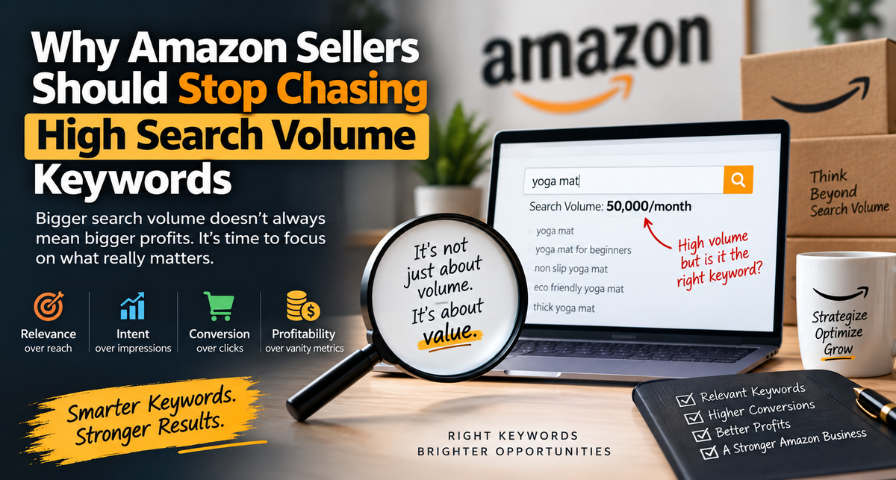
This is a situation that all Amazon sellers face. They open up their keyword research tool and sort their keywords on the basis of the number of searches. There is always that one keyword sitting right at the top with thousands of searches per month. It looks promising, and it makes sense to invest in a keyword that can make a difference in your business. You create your listing around that keyword, spend all of your PPC budget on it and just wait for the sales. Weeks pass, and you end up with a listing that has a good number of impressions but a very high ad budget and no conversions whatsoever.
Search volume will tell you how many individuals put a certain phrase into the search box. This metric doesn’t say anything about who these individuals are, what kind of purchase stages they are at, or what exact product they may be looking for. To view search volume as the primary value of a keyword is like evaluating a candidate for a job based on how many other people applied for the same position. It’s a figure, but not a result. And the point of good Amazon keyword research is not to find the largest figure but the keyword that will most effectively make a customer out of a stranger.
What Search Volume Actually Tells You
Search volume is a measurement of demand but an untainted measurement nonetheless. Everyone who has ever searched for a particular keyword is included, irrespective of their intent, which can be purchase intent, option evaluation, or even curiosity. The search volume of "yoga mat" is huge because it is such a broad term, with many intentions bundled in one term. A person could be searching for a cheap yoga mat, an expensive one, an eco-friendly yoga mat, a portable yoga mat, or even just checking out without knowing yet what he or she is going to buy. No matter how good your product is, you cannot be the solution to all the intents. Search volume is more of a weather report than a sales prediction.
Who Is Actually Behind the Search
Instead of asking, "How many people search this?" you should be asking, "What is this person trying to do?" That’s the intent behind the search query, and that’s where most of the true keyword selection value is found. The more general terms can usually be found at the beginning of the sales cycle the stage where buyers are still in the research phase. The more specific ones usually appear during the later stages of the sales cycle because the buyers already know exactly what they are looking for. Searching for “running shoes” might indicate a buyer looking for some inspiration. On the other hand, searching for “wide-width running shoes for flat feet for men” indicates a buyer who already knows exactly what he wants.
Does Your Product Actually Satisfy the Query
After you've understood intent, comes the relevance filter, and here's where sellers often justify themselves by going after keywords that are not appropriate for their product. The keyword should describe your product's features, target audience, and competitive advantages, rather than simply being loosely related to the product type or category. If your company sells a stainless steel water bottle specially crafted for children with a leak-proof spout and a cartoon character printed on it, then your competition for the keyword "water bottle" will be thousands of different products trying to get traffic from one generic phrase. Trying to compete for "kids leak-proof water bottles with straws" reduces your competitors significantly but at the same time places the very product you offer right in front of parents searching for exactly this product. Amazon's search engine ranks listings based on their ability to meet the query rather than their relevance to the keyword itself. This is why targeting keywords with which your product isn't really related can bring you many clicks that won't convert, hence affecting your rankings for important terms negatively.
Can You Realistically Win the Competition
Even an interesting and well-meaning keyword is not necessarily one that needs to be chased, since there is also the matter of being able to win visibility for this keyword. This is the step at which many sellers often underestimate their efforts. The keyword may sound good in theory, but when the first page is occupied by several big brands having thousands of reviews, huge amounts spent on advertising, and long-term sales history, it does not promise to be easy to get through soon. It is also important to remember that the number of competitors does not always tell the whole story, since ten smaller listings competing for the keyword will be much easier to deal with than three strong players having a high conversion rate and enough funds to advertise. In other words, the number of competitors is not as important as the strength of them.
Does the Traffic Actually Convert
It is the segment of the equation that ought to be weighted the heaviest, and yet something that search volume never tells you anything about: conversion rate. The true value of a keyword comes in only when you find out just how many of the searches of that term are actually buying your product. A listing that has an eleven percent conversion rate on a more niche keyword is going to perform far better, in terms of revenue and profit, than a listing with a two percent conversion rate on the largest possible keyword. There is also a compounding effect at play here that it is worthwhile to be aware of. Good conversion and sales performance, along with relevance and other factors such as click through rate and customer satisfaction, can help to increase your organic visibility. It follows that the best route to earning a good place on a very broad keyword in your category is through building sales history on more niche keywords first.
Does the Economics Make Sense?
Now we get to the meat of the matter, when the abstract becomes concrete. Let's take an example of two keywords that can be picked by a seller. The first one, Keyword A, has a monthly search volume of fifty thousand, the cost per click of about $2.50, and the conversion rate of roughly two percent. The seller spends an equivalent of about $125 of the ad budget before taking into account the cost of the product itself in getting one single order from the keyword. The second keyword, Keyword B, has a monthly search volume of five thousand, a cost per click of about $1.20, and a conversion rate of about twelve percent. It takes an amount of about $10 for the seller to get one single order through this keyword. Even though Keyword A has ten times the search volume of Keyword B, Keyword B has much better unit economics, and that at scale would mean a different budget on ads and a different profit margin for the seller.
What Happens After the Click
However, there is one dimension that lies above keyword research software that more advanced sellers are interested in, and it is the actual user behavior regarding the search queries when the potential customer is already inside Amazon. The number of impressions, clicks, adding the product to cart, purchase rate, and the percentage of purchases of the listing compared to its competitors for the given search query tell another story that the numbers about the search volume cannot reveal. For example, two keywords may have a comparable estimated volume in the research software and demonstrate absolutely opposite behavior when being used by actual consumers. One of them can receive many clicks but few purchases, which means that the query attracts browsers rather than purchasers. At the same time, another search term can receive fewer clicks but significantly more purchases, which means that the users searching with that term are more likely to buy a product. This information about the query-level performance, when it is available via Amazon reports, is often much more reliable than any search volume estimate made by a third party, since it describes the behavior of the actual consumer rather than his possible search behavior.
Long-Tail Keywords, Used Correctly
It would also be worthwhile to give some attention to long-tail keywords, those longer and more specific search phrases with lower individual volume, within this discussion. However, the main quality of such phrases is frequently exaggerated by proponents of long-tail keywords. For instance, while it can hardly be denied that a five-word keyword may be better than a two-word one, it is not necessarily true in general. In fact, an extremely specific search phrase that does not have good relevance and potential conversion for its associated product cannot be considered a good keyword at all, despite the specificity of this phrase. It should rather be said that the real importance of long-tail keywords stems from the fact that they are normally more relevant, closer to purchase intent, and less competitive. What matters is relevance, then purchase intent, then potential conversion, then competitiveness, then economics, and only then volume.
Building the Strategy Around Value, Not Vanity
But none of this takes away from the importance of high search volume keywords for brand awareness and for those sellers with the means and history necessary to succeed in this domain. It is simply not the place to start. In fact, it should never be used as the sole focus when optimizing listings. Rather, the first step should begin with identifying the true value propositions of the product and working outwards from there to identify the language people will actually use when they already know what they want. Review comments, both your own and your competitors', may be one of the most underutilized resources, as they contain the precise phrases people use when describing the problem and the solution. Even customer questions and return reasons can point out keyword possibilities that will never be flagged by any keyword tool based on search volume. From there, a well-crafted listing will include a mix of realistic mid-volume keywords and an abundance of long-tail keywords.
Conclusion: Value Over Vanity
There seems to be productivity in going after keywords with high search volumes due to the huge numbers, but that doesn’t mean that high numbers mean huge gains. Amazon’s search and ranking algorithms take much more into consideration than the search volume, and whether the pursuit of such visibility will be profitable or not will ultimately determine the viability of any search. Those sellers who stop thinking about "how many people search this" and start focusing on "what happens after they search it and does it even make sense financially" usually develop much stronger and sustainable businesses on the platform.
In your next search through the jungle of keywords, forget about the temptation of going towards the biggest number on your screen. Think about whether it is a true purchase intent, whether your product satisfies that search, whether you are capable of competing in that keyword space, and whether the economics make sense when you account for cost-per-click and conversion. You didn't need to rank on the keyword that everybody searched for. You needed to be that product they were searching for.
Ready to Grow on Amazon?
Let our experts help you scale your Amazon business with proven strategies.
Get a Free Consultation