Why Amazon Ads Optimization Should Never Happen in Isolation
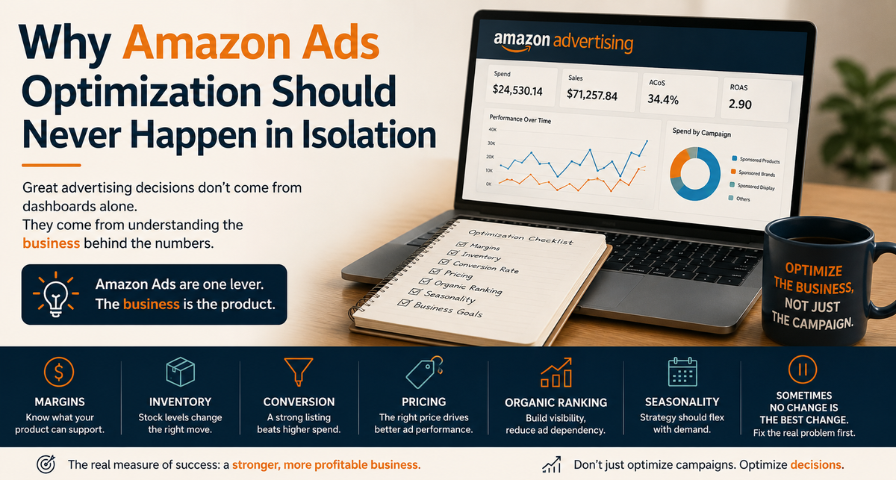
Almost every seller and agency will tell you that Amazon Ads optimization is a self-contained process. Change the bid, adjust the keyword, reduce ACoS, and do it again and again. While this seems like an easy thing to do, this very ease is the reason for all the disappointments that come from working with Amazon Ads. The fact is that any ad performance on Amazon is never only about the data in the dashboard. It is always about everything else that is going on under the surface: margin, inventory, price, conversion rate, organic ranking, and the season of your business.
The Illusion of the Isolated Campaign
Opening Seller Central and working on changing bids according to only ACoS targets means making a decision based on the part of the big picture. A campaign may look ineffective, but if the same campaign helps in maintaining organic ranking and getting rid of the old inventory ahead of storage fees, stopping such a campaign will result in harm more than anything else. Contrarily, a profitable campaign that seems like it is generating good revenue for the business can in fact be eating away the profit margins due to unchanged price of the product. This is because Amazon ads optimization performed in isolation will not take into account the connection between ads and product performance.
That is why most businesses end up focusing on reducing ACoS without even bothering to find out whether there is any need for doing it at all. ACoS is a strategy, not a target. An ACoS of 35% during product launch where the objective is building organic ranking and review is something totally different from ACoS of 35% on an established product, which should be generating good profits. Numbers without context lead to bad decisions made in isolation.
Margins Decide What "Good" Even Means
Before anything related to the bid happens, the key question that needs to be asked is, what margin does this product support? If we have a product with a 60 percent margin, then we have plenty of room to be aggressive with our Amazon PPC and test different keywords, fight for search position #1, and accept high ACoS in the beginning. However, if we have a product with 15 percent margin, then there is no way to run such a strategy regardless of sales volume potential.
This is also where a lot of sellers get surprised. They see rising revenue and assume the advertising is working, without realizing that referral fees, FBA fees, and ad spend combined have quietly erased the profit. Amazon Ads optimization that ignores margin isn't optimization at all. It's just spending with extra steps.
Inventory Changes the Entire Calculation
The inventory position is one of the least considered elements in developing a PPC strategy for Amazon, yet it should receive much more consideration than it does now. With products that are approaching stock depletion, increasing spending on them will create a stock-out situation that will hurt organic search rankings and take weeks to restore. In such cases, the best course of action would be to consciously reduce spending despite excellent campaign performance figures.
The opposite is true too. If a product has too much inventory sitting in a fulfillment center, increasing ad spend, even at a less efficient ACoS, can make sense to avoid long-term storage fees and free up capital. These are business decisions disguised as advertising decisions, and they require someone to look beyond the campaign metrics and into the inventory dashboard before making a call.
Conversion Rate Tells You Whether Ads Can Even Work
Any optimization done on Amazon Ads will not save you if your listing does not convert. The first thing you must check is whether the images are strong enough, whether the bullet points answer the customer's questions, or whether the price is in line with your competitors’ prices. It’s one of the biggest mistakes that many brands make assuming that their issue is the ads campaign when it’s actually the listing.
Before touching bids or keywords, it's worth asking whether the product page itself is doing its job. Sometimes the right move is pausing aggressive testing altogether and fixing the listing first. Once the conversion rate improves, even by a couple of percentage points, the exact same ad spend can produce noticeably better results, because Amazon's algorithm rewards listings that convert well with more organic visibility too.
Organic Ranking Is the Real Long-Term Prize
A lot of sellers focus so heavily on advertised sales that they forget organic ranking is the actual asset being built. Ads can accelerate ranking, especially in the early stages of a product's life, but the end goal should always be reducing reliance on paid placement over time. This is why accepting a higher ACoS temporarily can be the right call. If a campaign is driving organic rank improvements that will lower ad dependency six months from now, that short-term inefficiency is actually an investment.
This is also why judging Amazon advertising strategy purely by short-term ACoS is misleading. Two products with identical ACoS numbers can be in completely different positions if one is steadily climbing in organic rank and the other is stagnant. The dashboard won't tell you that difference. Only a deeper look at the account will.
Seasonality Changes What "Winning" Looks Like
What works as a good outcome during November won't work during February. When sales are at their peak, it's easy to understand why the brand will invest more in terms of budget and ACoS since the competition is high, and the value is greater. In off-months, using the same strategy might lead to a waste of budget when there's nothing to support that expenditure.
This is where a lot of static "target ACoS" strategies fall apart. A number that made sense in Q4 might be completely wrong in Q1, and sellers who don't adjust for seasonality often end up either underspending during high-demand windows or overspending during quiet ones.
Sometimes the Right Move Is No Move at All
One of the least recognized actions in Amazon PPC tactics should be avoiding making any changes to the campaigns. The fact is, when the true problem is connected with pricing, packaging, reviews, or shipping delays, no adjustments to the bids would do anything about it. This means that one has to put on hold all the modifications on the advertising side until the business problem itself gets resolved.
This is a difficult point for many marketing managers to understand, since there is always a feeling that there has to be some activity going on in the accounts. However, inactivity might also be viewed as a strategic decision sometimes.
The Real Measure of Success
Amazon Ads is one lever in a much larger machine. The product, the pricing, the operations, and the brand's actual goals are what the business is built on, and advertising exists to support that structure, not replace it. Judging performance by ACoS or ROAS alone misses the point entirely. The real question is always whether the business is becoming stronger and more profitable over time.
That's the shift worth making. Stop asking whether a campaign performed well in isolation, and start asking whether the decision made the business better. Sometimes that means spending more. Sometimes it means spending less. And sometimes it means leaving the campaigns alone while fixing something else entirely. That's not a lack of optimization. That's what real Amazon Ads optimization actually looks like.
Ready to Grow on Amazon?
Let our experts help you scale your Amazon business with proven strategies.
Get a Free Consultation