Voice Search SEO: How to Optimize Content for AI Assistants
The Way People Search Has Quietly Changed
Consider the last time you used voice command on your phone rather than typing out a query. It could have been because you were driving and needed to find directions, or you were in the kitchen using your smart speaker asking for a replacement for an ingredient. This seemingly small act of convenience has become one of the reasons why voice search SEO has become such an important topic in the field of digital marketing. It is not simply a matter of typing in fragmentary phrases into the search engine anymore. Users are talking to their devices like they are talking to a person, and the voice assistants (Siri, Alexa, Google Assistant, but also many others including ChatGPT Search, Gemini, Copilot, and Perplexity) are supposed to answer with a single answer.
Why Voice Search SEO Matters More Than Ever
Voice search was thought to be a secondary tool that could help to set alarms and get weather updates. But not now! As smart speakers, mobile voice assistants, and vehicle assistants enter our daily life, lots of customers are starting to use voice search on a daily basis to find information, compare products, and seek nearby businesses. So, why does it matter for SEO? The explanation is quite obvious. When a person asks a question aloud, the voice assistant will read one response to him or her, not show ten blue links as we are used to seeing on SERPs. There is no scrolling and comparison between the links. It either gets you as the one response or leaves you out of the picture.
Voice Search and AI Search Have Become the Same Conversation
This is the aspect of the change that is worth exploring more thoroughly. The era of standalone voice assistants with their peculiar algorithms is coming to an end. Siri, Alexa, Google Assistant, and Copilot route much of their queries through large language models similar to those used for text AI search, which makes the difference between "voice SEO" and "AI search optimization" largely redundant. When you ask something to Gemini through Gemini Live, or when you make a voice search through ChatGPT Search while wandering on the street, you are not employing any specific voice technology. You speak to a complete AI system which is capable of analyzing your request, gathering information from diverse sources, and answering you in informal English. This is precisely how voice search by Perplexity operates; for it, voice search is just another input type into the same answer engine it uses for text searches. For all of you involved in voice search SEO, there is one trend that is critical to understand. If you optimize your content for AI search optimization, then at the same time you optimize it for voice search.
How Voice Queries Are Different From Typed Searches
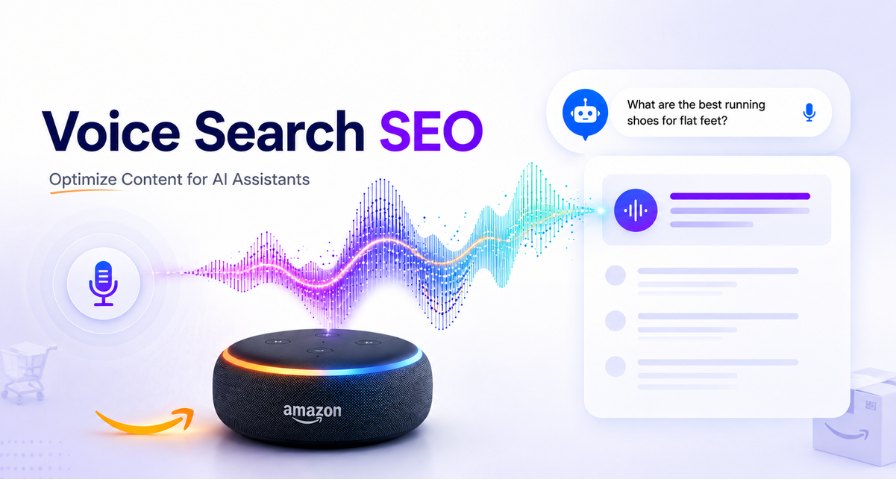
This difference between the typed searches and the voice searches can easily be noted by comparing the two searches. In case of the typed search, one would type something like “best running shoes flat feet,” but in the case of voice search, it would be something like “what are the best running shoes for flat feet?” The voice search queries tend to be lengthy because they contain questions. It is in these cases that conversational keywords come in handy. In addition to using keywords, content creators should also think about the whole questions that people are going to ask on the topic and cover all of the "who," "what," "where," "why," and "how." Considering how well natural language processing algorithms are now capable of understanding the search intent, it makes no sense to stuff pages with weird constructions that fit in with keywords' criteria. Content that works these days should sound natural and conversational.
Featured Snippets, AI Overviews, and the New Front Page
An assistant's behavior in voice search is usually characterized by the fact that assistants retrieve the answers from featured snippets or short structured text located at the top of the page. The introduction of AI overviews by Google also contributed to this trend. Instead of visiting several websites to form an answer, users can get one AI-generated snippet directly on the page of search results, and it is quite likely that the voice assistant will also use this kind of snippet as an answer in voice search. If your task is to become the source of information for this kind of answer, you need to formulate an explicit and succinct response to the question asked, which should appear right from the beginning of the page, preferably in the first few sentences. The approach that could be used in this case is the following. First of all, one should provide a brief and direct answer to the question asked (the one that could be pronounced in fifteen to twenty seconds) and then provide more detailed answers for those who require further explanation.
Writing Content That Sounds Like a Real Conversation
SEO writing continues to depend on the formal language used in textbooks, and it isn't well adapted to voice or to conversational searches in general. An AI assistant is much more likely to repeat text that has a natural flow of speech. It doesn't mean that it is necessary to abandon structure or professionalism in writing; however, it means that contractions can be used where possible, short sentences should be employed instead of lengthy jargon-filled passages. One good trick is to speak the text out loud before you publish it. If it sounds artificial and awkward when you are speaking it out, the AI assistant is very likely to do the same when determining whether it is going to use the text as a source. Articles structured around commonly asked questions are often more successful than keyword-based articles.
Trust Is Becoming a Ranking Signal
With increased responsibility for summarizing and recommending, however, they have also become more discriminating in terms of sources they are willing to read aloud. Experience, expertise, authoritativeness, and trustworthiness (E-E-A-T) begin to play a role in voice search SEO as well as classic Google ranking from now on. When an AI assistant reads aloud the answer it receives to a query, in effect, it stands behind that answer and recommends it to its users. Therefore, it tends to prefer the information that has some evidence of credibility, which implies using citations from trustworthy sources; not recycling unverified facts and statistics; regularly updating content when necessary, and not making too bold and unsubstantiated statements that may undermine the reputation of an AI assistant if they were pronounced out loud. It implies providing the information based on one's personal experience with the product or process in question or on original data rather than somebody's opinion expressed in another article. The content that can be recognized as credible and informative is much more likely to become the voice of the AI assistant compared to the content that seems to be made up just for the sake of filling some space.
Local SEO and the "Near Me" Effect
Many voice searches have something to do with location; it could be anything from finding a coffee shop close by to a plumber or getting an appointment on the same day. That’s why local SEO becomes an integral part of voice optimization and not just some additional consideration. Having the right business listing across all channels (with an exact match of address, opening hours, and contact numbers) will allow assistants to feel confident about providing your business as the answer to the search. Getting positive customer feedback and making sure that your business remains active in its online representation does make a difference, as well.
The Technical Side: Schema Markup and Page Speed
Voice Search SEO is not limited only to the content written on a website page. The underlying technical structure supporting this content also plays an important role. The usage of schema markup (special labeling allowing search engines or AI assistants to correctly understand the type of content on a page and identify it as a recipe, how-to manual, FAQ, etc.) makes the process of extracting relevant answers from your content by an assistant much easier. Also, fast-loading pages, especially fast-loading pages on mobile devices (where most voice searches happen), get another advantage in terms of their usage in a voice answer because time plays an important role when performing a voice search. This process does not necessarily require any major technical changes; however, it should be thought of as being part of the overall strategy for creating your content.
From One Question to a Conversation
The next step of this transformational process is now taking place. The process of voice search now begins to acquire features of conversational search, which means that the user is making another query after the previous one without providing additional information regarding the context of the previous query. Thus, for instance, a user could ask an assistant a question regarding the restaurant and continue with "Does it have an outdoor area?" without providing specific information regarding which particular restaurant is meant. Such a process requires maintaining the context across several turns, which means that the structured content prevails here.
Preparing Your Content for AI-Driven Search
Voice Search SEO is no longer a new approach limited to those ahead of the curve in using smart speakers. Voice searchpossible and SEO has become a significant way in which people, and indeed, the AI assistants that help find information for them, make sense of things, make comparisons, and make decisions. Those companies and individuals who are adapting well to this reality are the ones that write in natural language and question-focused approaches, answer their questions in a direct and immediate way, show their expertise, and have done their homework on the technology end – by implementing schema markup and fast load times, among other things. Search itself is moving to being more conversational than ever before, and AI-based search tools such as ChatGPT Search, Gemini, Copilot, and Perplexity are speeding up this process as much as the traditional voice devices are. Businesses that keep writing purely for algorithms and don't include any conversational aspects will have trouble getting found in the long run, while businesses that write conversationally will do well regardless of whether that search is from voice, a search engine, or an AI assistant.
Ready to Grow on Amazon?
Let our experts help you scale your Amazon business with proven strategies.
Get a Free Consultation