The Truth About Amazon Reviews: Why They Matter More Than Ever in 2026
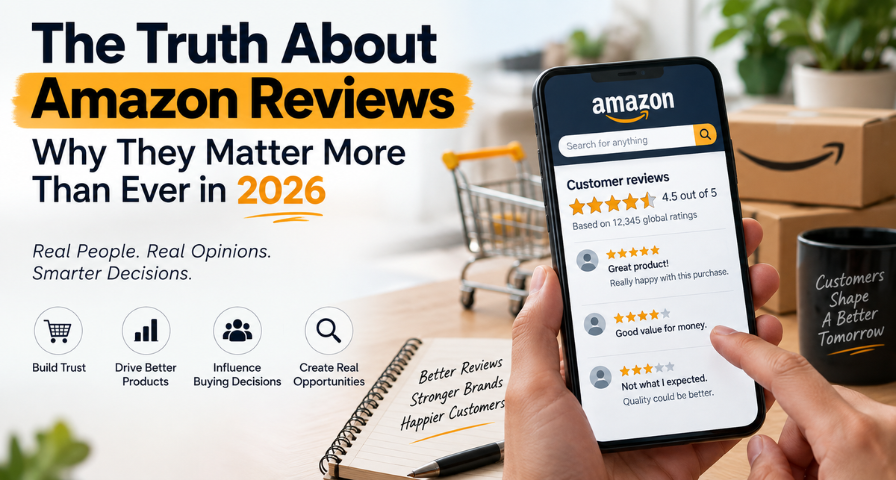
Each and every consumer has a behavioral pattern that he/she may not even realize. It goes without saying that prior to purchasing any item, consumers will bypass all the glossy pictures and descriptions and directly go to the reviews. This trend has become one of the most influential forces dictating the future of e-commerce; one just needs to take a look at Amazon.com to understand how much power review writing has gained through time and how influential it has become.
For a long time reviews were considered only as a reputational indicator, a number that had to be increased and protected. Such an approach to the reviews has become outdated, but one of the key pieces of evidence is the way of interpretation of reviews, which has become more sophisticated now, and not the appearance of any additional feature. The amount of the feedback left about each listing has become so huge that the single average score doesn’t tell anything meaningful on its own. It is important to consider such things as the average score, the amount of reviews, their recency, the vocabulary of the customers' feedback, and trends in their complaints instead of the current position of the latter. Sellers who will understand reviews in 2026 are those who will consider the complete picture instead of focusing on the star number alone. The aim of this article is to find out why reviews are so important, what information can be found from the ratings, and how the sellers can make strategic decisions based on the review analysis.
Why Amazon Reviews Influence Buying Decisions
The impact of reviews boils down to one fundamental human psychological aspect: individuals are more inclined to believe individuals than advertisements. The description of the item provided by the seller is always carefully chosen, regardless of whether or not it is true. On the contrary, a review written by someone who purchased the item in question is always honest, despite all its imperfections. It is called social proof by researchers, the inclination to take into account the experiences of other people when making certain decisions. This issue becomes especially relevant for Amazon and other online stores, where buyers cannot physically interact with an item and evaluate its properties prior to purchase. By reading the reviews, the buyer is able to get acquainted with someone else's experience concerning such issues as the size, durability, or performance of the item after weeks of usage, which is impossible to convey via images and bullet points.
What a Star Rating Doesn't Tell You
One such error that is frequently made by consumers and by sellers is to interpret the mean star rating as the only important information. But this is not the case. An item with a four and a half-star rating based on twenty recently generated ratings provides an entirely different story than an item with the same rating but based on several thousand ratings gathered over many years. In addition to the mean, the importance of the distribution of the ratings cannot be underestimated. Not only does the seller need to know what their rating is, but also why they received the one, two, three, four, and five-star ratings and whether there have been changes in the distribution of these ratings over time. A sudden increase in three-star ratings, for example, is likely to signal about a problem with the quality or fulfillment of the order that has yet to affect the mean star rating.
Why Recent Reviews Matter
Recency is yet another attribute that often goes under the radar. A product’s review profile is not fixed but a dynamic timeline of its performance. In case of a change in suppliers, packing, components, etc., the effects would be visible first in the recent reviews, well before they affect the average star rating at all. Buyers who merely look at the star rating of the product will be surprised by issues that have been noticed long ago by more observant customers and even more observant competition. The reverse is true for consumers too: reviewing the product in the context of most recent reviews provides a much clearer idea than the default sorting criterion does.
It helps a lot to approach any set of reviews by looking for a simple line within them: what the customer expected from his purchase, what he got in reality, where did the gap between expectations and experience occur, and what changes does that imply? The fact that a product turned out "smaller than expected" is not a question of size at all, but it is the gap between the description in the listing and the perception of the product by the customer, thus calling for changes to be made either in copy or in photos. But the case of a part breaking down two weeks after purchase suggests another type of gap – one that concerns the product itself.
The Real Value of Negative Reviews
It is common to feel defensive when facing negative feedback; however, a better response to it is a diagnostic one. Complaints regarding fragility of the item, ambiguous instructions, and late delivery are not criticism; they are free market research provided by your customers. It is essential not to overlook such valuable information and respond to every negative review by arguing with the customer because it will cost you a lot of money to obtain the same information through market research. Not all negative reviews provide truthful information about a product as well. Sometimes a customer was misled by false information provided by the seller in the listing, which means there is a problem with messaging and marketing rather than manufacturing. Differentiating these two cases is possible only if you analyze the content of the reviews instead of rating them.
Sometimes the most informative reviews are not five-star ones. Usually, a detailed and specific three-star review provides more actionable information about the product than a short and excited five-star review. It is always a good strategy to analyze the content of a review rather than its rating.
Reviews as a Product Research Tool
Perhaps the least utilized way to leverage Amazon reviews is to consider them as a constant, free source of product research. Consumers, unprompted, provide all the data a brand would typically pay money to receive via surveys and focus groups – what the consumer wanted, what surprised him or her, and how the product could be improved. If a seller analyzes reviews from this perspective, they can see repeated terminology on a particular pain point, something missing in the product that is mentioned over and over again, or even a new use case that the product was not created for but which consumers have come up with. Packaging issues, incorrect size and difficulty of setup are just a few examples of these kinds of problems.
How Reviews Connect With Conversion
There is an assumption that reviews have a direct impact on Amazon’s search rank; however, this idea does not take into account the full range of mechanisms employed by the company in the process. The algorithms of the company take into account many factors simultaneously in order to calculate the final ranking of the product, which includes such elements as relevance, price, inventory level, ad performance, sales record, etc. The impact of the reviews on the ranking algorithm is indirect rather than direct, as a good reputation attracts consumers’ attention and increases conversion rate, which is one of the factors taken into account in Amazon’s ranking algorithm. Thus, reviews do not play an important role when it comes to the ranking mechanism but rather affect the conversion rates of those products that are already visible.
Authenticity and Amazon's Review Policies
Manipulation is another important topic for any Amazon reviews discussion. There are still many fake and incentivized reviews on the site, from sellers offering free products in return for good reviews to full-fledged schemes with bots writing reviews. Amazon has put much effort into developing review detection algorithms, looking for suspicious patterns like accounts posting several reviews within a short time period and sudden surges in five-star ratings not related to usual purchasing processes, and has sued large organizations engaged in manipulation. This imposes additional responsibility on the sellers to not only avoid manipulation but also protect themselves from the competitors manipulating ratings, since even if the seller acts legally, they will still get hit by their competitors' manipulation tactics. However, it might be unwise to assume that all bad reviews are fake. The idea that a review must be fake if it looks unfair is very widespread among sellers and is preventing them from taking lessons from potentially valid criticism.
The one area that requires special attention is the connection between customer service and reviews. When you contact customers in order to settle a valid problem and provide an alternative product or a refund if there was a problem with the item in question, that is just how business should be run. However, such an approach must never be interpreted as a condition for the customer to change or remove his or her review. This is not only unethical but also risky for the account itself.
The Growing Role of Customer-Generated Content
Apart from written comments, photo and video reviews have also gained significant importance in the customer’s decision-making process. It seems like a brief video demonstration of the work of the kitchen appliance or a photo demonstrating furniture in the person’s own living room rather than in a studio setting can be more convincing than a professionally made marketing photograph. This tendency is the result of the desire for authenticity rather than perfect polished picture. When sellers use this approach without offering any incentive for doing that, they obtain the kind of evidence that is hard to produce artificially.
What Amazon Sellers Should Actually Do With Review Data
What is the lesson for sellers? Reviews require a process, not merely sporadic checks. Instead of looking at your monthly star ratings, you will do better to get into the habit of reading samples of reviews with all the ratings from time to time and see how the specific problems mentioned are developing. The benefit of this practice lies in its applicability only when the information gleaned gets delivered somewhere, and review information proves useful in five different aspects of your business.
First, there is listing content. When an ambiguity related to sizing, compatibility, or a feature is repeatedly brought up, there is likely to be something wrong with the listing, not the reader, and a revised title or a bullet point will quickly address the pattern rather than changing anything in the product itself. Second, product development. While a single complaint about a bad component may have been written by an unlucky customer, several such complaints in dozens of reviews mean that there is a real design problem, and it is likely to start influencing the product’s average rating long before that. Third, PPC diagnosis. With healthy traffic from advertising campaigns, it makes sense to see if there is a reason to hesitate buying a product in the form of a complaint pattern before making changes in bids and targeting. Fourth, competitor research. The complaints about competing products’ negative reviews will help find unmet needs, which will become the basis of an efficient listing. Fifth, customer experience: issues with packaging, delivery, usability – those complaints rarely come as a single word but as an afterthought on a damaged package or confusing directions.
Treating these five areas as destinations for review insight, rather than treating reviews as one more number to monitor, is what separates a business that reacts to its rating from one that actually uses its customers' feedback to get better.
Final Thoughts
An Amazon review is far more than an indication of reputation. It is a constant stream of valuable information coming from customers, for free, which most companies would be prepared to pay a good amount to acquire through studies and surveys. In terms of those businesses that get the greatest benefit out of this system, it is definitely those that do not strive to achieve better star ratings, but listen to the actual descriptions provided by their customers. As for consumers, the message here is equally clear: by taking into consideration the date of a review, its popularity and content, it will be possible to make much more effective purchasing decisions. When it comes to the sellers, the recommendation could not be clearer: ignore the number of reviews. Instead, focus on the quality of the product and listen carefully to the voice of your customers.
Ready to Grow on Amazon?
Let our experts help you scale your Amazon business with proven strategies.
Get a Free Consultation