The Hidden Link Between Ad Spend and Stock Levels That's Quietly Draining Amazon Profits
The answer you’ll most likely get will be a division of the mind into two independent departments. The one cares about the campaigns, the bids, the keywords, and the ACoS targets. The other is about the reorder points, the lead times, the FBA inventory limits, and the restock alerts. These two are seen as two distinct practices with separate instruments, separate KPIs, and distinct approaches to decision-making.
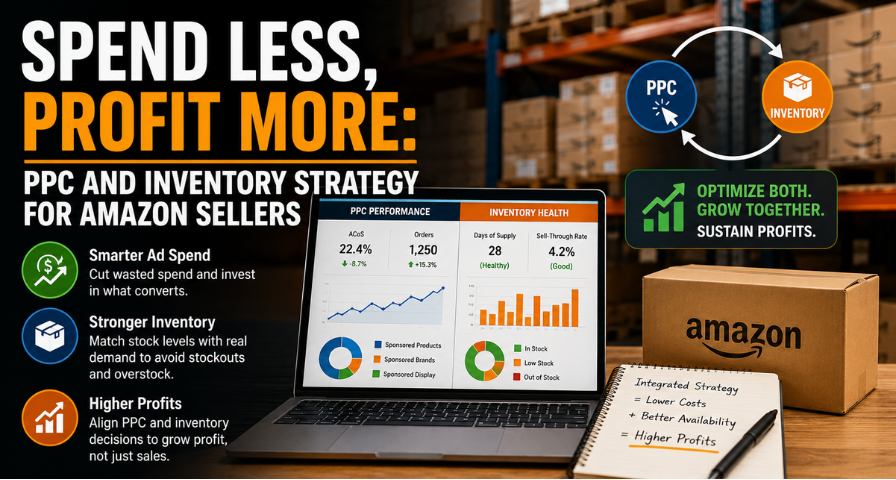
This kind of disconnect is one of the least obvious profit leaks for Amazon sellers nowadays. Amazon PPC and inventory management aren’t two independent issues. They are one issue seen from two sides of the business. Making decisions related to one without keeping in mind the implications of the other means risking either stockouts and subsequent slowing down of sales momentum or accumulating deadstock and being hit by the storage fee that erodes margins. Whatever the case, it’s the seller who pays the price without understanding clearly why.
This article will explain how these two functions are connected and how not integrating them results in profit leakages. It will also outline the correct approach to managing them.
The Problem With Judging PPC by ACoS Alone
ACoS, or Advertising Cost of Sale, is the standard KPI of a healthy PPC campaign these days. It is rather straightforward: the lower your ACoS, the more profitable your campaigns are. The problem is that ACoS doesn't take into consideration all those expenses that go into making your sale profitable.
Take a product that costs you $30. Subtracting the cost of goods, the cost of FBA, and referral fees from it, you will see that your contribution margin prior to paying advertising expenses would be around $10.50. Thus, true break-even ACoS which means that any further expenses will bring your campaign negative ROI, is around 35%, while many sellers think that 15% or 20% ACoS is safe enough.
In the meantime, the campaign with 30% ACoS looks like a dream in the dashboard, yet, having taken into consideration all those expenses that come together with operating a business on Amazon, the cost of storage, returns, inbound shipping, and others, this campaign might be bringing you close to zero profit or even losses per each unit. That's why savvy sellers don't try to run campaigns with a fixed ACoS. They manage campaigns to a profit-per-unit metric.
Why Two Keywords With Different ACoS Can Both Be Right
The other misconception is that the keyword with a lower ACoS will always be the best keyword to allocate money to. Imagine an example where one keyword produces 50 sales at a 22 percent ACoS, and another produces 8 sales at a 12 percent ACoS. Based on figures alone, the second keyword seems to work more efficiently. However, in reality, the first keyword is probably creating more profit than the second, despite having a higher ACoS percentage.
This is just one of those aspects that gets overlooked in sellers' fixation on one metric alone. While ACoS is helpful for identifying wasteful spending, it is useless when trying to figure out how to allocate budget effectively. It is not "Which keyword has a lower ACoS percentage? "That is an important question, but rather, which keyword, with current sales numbers and margins, contributes the most in profit to the company?"
Where Ad Budgets Quietly Leak Away
Even campaigns that look reasonably efficient often contain hidden waste. Search terms that generate clicks but never convert, broad match keywords pulling in irrelevant traffic, and high-performing keywords competing for the same limited budget as weak ones, all of these chip away at profitability without necessarily showing up as an obvious red flag.
Every dollar spent on a click that goes nowhere is a dollar that could have funded a converting click, covered a storage fee, or gone toward the next inventory order. Tightening this up doesn't require a complete overhaul of advertising strategy. It usually comes down to a few disciplined habits: reviewing search term reports on a weekly basis and cutting irrelevant traffic before it drains the budget, separating strong keywords into their own dedicated campaigns so they're never starved of spend by weaker ones, and adjusting bids by placement so premium rates are only paid where the conversion data actually justifies them.
The impact of this kind of cleanup adds up faster than most sellers expect. A seller spending $8,000 a month on advertising who trims even a quarter of the wasted spend through these adjustments could recover somewhere in the range of $2,000 a month, without touching a single product listing or launching a new ASIN. The exact figure will vary by account, since not every seller is carrying that much waste to begin with, but even a smaller reduction tends to produce a noticeable improvement in real profit.
How PPC Quietly Reshapes Your Inventory Needs
This is where the real gotcha for many sellers comes into play. Not only does an effective PPC campaign drive sales, but it also drives those sales much faster than normal. The problem is that most systems for managing your inventory are designed to analyze backwards based on past sales velocity.
That backward-looking approach works fine when demand is stable. It breaks down the moment a PPC campaign starts performing better than expected, because the historical data hasn't caught up yet. Sales are accelerating in real time, but the reorder calculation is still working off last month's slower pace.
The issue gets clearer with an easy-to-understand example. A merchant who possesses 600 units of inventory and sells at a rate of 20 units a day has 30 days’ worth of inventory sitting in his hands, and this appears to be enough. But if an advertising campaign increases the daily sales rate to 30 units, then suddenly this 600 units of inventory represents just 20 days’ worth of inventory left. No change has taken place in the inventory itself; however, the time available until the next stock-out situation occurred has reduced to one-third of the original time just because the advertising department was running ahead of the order calculation. The loss of revenue due to a stock-out situation does not only include the revenue lost due to the gap created.
The Overstock Trap Hiding on the Other Side
The other error is just as expensive and even more common. If the product is failing to sell, the reflex action of the seller in this case is to spend more money on marketing campaigns in order to get more traffic, which would solve the problem. However, in this case, the problem is most likely associated not with the lack of traffic but with the quality of photos, copy, price, or reviews of the product. Spending money to increase the number of clicks that do not result in conversions is simply wasting it.
However, inventory continues to come in the fulfillment center under assumptions that the sales numbers generated due to the PPC campaign would be achieved. They were not achieved. Storage fees appear. In case when stock becomes lower than anticipated according to the projections made, low inventory fees can apply. In case when inventory remains oversold for too long, aged inventory fees as well as the forced liquidation of stock appear.
Amazon PPC and Inventory Management: Reading the Signals Together
This is really the core of the issue, and it's worth naming directly. Amazon PPC and inventory management aren't two departments that occasionally interact. They're one continuous feedback loop, where advertising performance changes stock needs and stock levels should shape advertising decisions.
Your PPC account holds forward-looking demand signals that a purely historical inventory model simply can't see. Rising impression volume on your top keywords, for example, often reflects growing category demand before that demand ever shows up in your sales numbers. A jump in conversion rate right after a listing tweak is a hint that sell-through may be about to speed up. And when seasonal search terms start gaining traction, that can be a useful leading signal that seasonal demand is building, though it shouldn't be treated as a precise or guaranteed forecast, since search activity and eventual sales don't always move in lockstep.
Sellers who build a habit of watching these signals alongside their inventory decisions gain a real advantage. They can reorder earlier when a campaign is gaining traction, reducing the risk of a stockout following a demand spike. And they can pull back on inventory commitments when a campaign is underperforming, avoiding the overstock that comes from chasing projections that never held up.
A Simple Framework for Deciding When to Scale PPC
Rather than reacting to numbers one metric at a time, it helps to run through three questions before increasing ad spend on any product: is the campaign actually profitable at current volume, does inventory coverage support the increase, and is the listing converting well enough to make more traffic worthwhile?
ACoS may be in good shape, but if inventory coverage is at just ten days, PPC scaling would be a very risky venture because increased sales can result in a stockout before the next delivery. In the case where inventory coverage is in good shape at sixty days, but the conversion rate is poor, scaling the PPC would not be the best course of action because it will simply accelerate the losses on an inefficient listing. However, when the conversion is good, and the contribution margin makes the campaign viable, then scaling makes a lot of sense.
Why Steady Campaigns Produce Better Forecasts
There's also a quieter, forecasting-specific benefit to running consistent campaigns rather than ones that spike and pause unpredictably. Erratic spending patterns, where a campaign runs hard for a few days and then goes quiet, or bids jump around without a clear pattern, create messy, unpredictable sales data. That messiness makes it much harder for any restocking process, or for the seller reviewing the numbers, to project future demand with confidence.
Campaigns that maintain steady spend and generate predictable daily sales velocity aren't just easier to manage from an advertising standpoint. They produce cleaner data that feeds directly into more reliable inventory forecasting, which is a distinct advantage from simply avoiding erratic bidding. It means every reorder decision downstream is being made with better information.
What to Review Together Each Week
Making this integration stick usually comes down to a short, consistent weekly habit rather than a major operational overhaul. Pairing PPC impression and conversion trends with current inventory coverage, checked side by side rather than in separate reports, is what allows the early signals discussed above to actually get used instead of just observed. Alongside that, keeping an eye on listing health and review activity matters just as much, since it ensures the traffic PPC generates is landing on a page that's actually ready to convert it. None of this needs to be complicated. It just needs to happen on the same day, using the same view of the business, so that an advertising decision and an inventory decision are never made in isolation from each other.
The Takeaway
PPC and inventory are not two different departments. These are just two perspectives of the same decision. A campaign that does not account for inventory coverage stands at risk of a stockout, and an inventory order schedule that does not take into account PPC trends stands at risk of overstocking. Businesses that combine both aspects of it, using the right break-even figure, a scalable model, and a common meeting ground on a weekly basis, run their businesses in a way that grows without breaking.
Ready to Grow on Amazon?
Let our experts help you scale your Amazon business with proven strategies.
Get a Free Consultation