Small and Light Products on Amazon: Are Low-Priced Items Really Worth Selling?
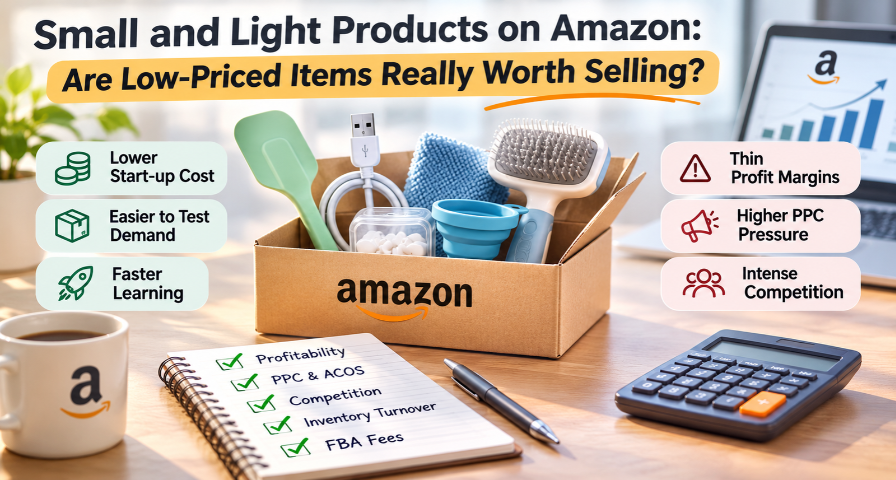
Why Everyone Recommends Small Products (and Why That Should Make You Cautious)
Flip open virtually any beginner's guide to selling on Amazon, and the same message pops out: begin with products that are small, inexpensive, and lightweight. Silicone kitchenware, cable ties, and pet grooming equipment are the types of products that always feature. The logic behind such advice seems sensible since the lower sourcing cost reduces financial risks while lower shipping cost reduces the number of unexpected issues. However, the attributes that make launching small and lightweight products on Amazon possible also make it possible for everyone else to do so. This paper discusses in which cases the economic logic behind such advice makes sense and in which it breaks down and examines the ways of finding profitable products in the niche.
Three Meanings Hiding Inside One Phrase
"Small and light" refers to three separate categories. The first one is the actual product itself. The second is the FBA size class that your packed item belongs to, and this will affect your fee per shipment. The third one is low-price FBA, where your fees will be decreased depending on the price of your product. The second and third ones will affect what you have to pay to Amazon, but not if people want to buy your product.
The Small & Light initiative that once ran independently of FBA in the US has been rolled up into the standard FBA program and hence is outdated information. In the US, the low-price FBA currently works on items that are priced at less than $10, and Amazon has mentioned that the average discount for 2026 will be around $0.86 per item in comparison to the standard rates. The threshold mentioned above is US-specific; other marketplaces have their own threshold and currency. Further fee updates are expected from Amazon, which will come into effect from January 2027, and some of those updates include the qualification criteria for low-price rates. Each dollar figure in this article is just a demonstration number; verify using your package dimensions and price through the Amazon fee calculator.
Benefits of Selling Small and Lightweight Products on Amazon
The real gains here are cost-related and functional, rather than purely commercial. The smaller the item is, the quicker it will become unmarketable due to being small. The truth is that you will have the ability to gain knowledge of your business at a cheaper rate. You will have the ability to transport a smaller quantity of goods in order to test the product without spending thousands of dollars on transporting and storing it. The costs of transporting and storing will be calculated depending on the size and weight of the item, and therefore, more items will fit into a single carton.
Quick learning is the main advantage of any new business. You will have the opportunity to start, watch the first weeks’ conversion and reviews, and then either reorder or exit the market with minimal losses incurred. Packaging is the lever that is less obvious but as effective as the first. Saving a couple of inches in one dimension or using a less bulky box and replacing it with a properly sealed poly bag will help you save costs and improve the security of the item.
Amazon FBA Profitability: The Hidden Costs of Low-Priced Products
Unfortunately, this is the truth – most costs do not decrease with the decrease in price. The referral fee depends on price, but fulfillment, preparation, labeling, and even the cost of an advertising click are unaffected. Let’s take into consideration two items which have exactly the same gross margin – the first item costs $12, while the second costs $38. The fulfillment fee of $3.50 takes up almost 30 percent of the lower price, but only around 10 percent of the higher price. Amazon raised the FBA fulfillment fees in April 2026 by 3.5 percent as a fuel and logistics surcharge in the United States. In addition, Amazon stopped offering its own prep and labeling services in January 2026, therefore preparation will now have to be done either by yourself or by a prep partner.
An example should clarify the matter even more. Consider the case of a product being sold at $14.99 with the landed product cost of $3.00. In that case, a 15 percent referral fee would cost you about $2.25, while $3.50 covers the cost of fulfillment. $0.60 goes to cover inbound and prep, with a return reserve of $0.50 on top. When advertising costs $3.00 per order, the total cost rises to $12.85, leaving you with only $2.14 left. The $2.14 left after all those expenses is contribution margin profit and not net profit. It would get even less if there were any other expenses like coupons, promotions, or storage fees.
It helps to distinguish between four concepts. The first one is revenue, which stands for what the client pays. Gross profit equals the revenue less the cost of the product itself. Contribution profit is what is left over from all variable costs, which may include fees, marketing expenses, and product returns. The net profit is one more step ahead and takes into account all overhead expenses.
Why a Higher Price Creates Room, Not Automatic Profit
One way to illustrate this is to compare two imaginary products. Product A is priced at $12.99 and contributes $0.80 in contribution margin to each sale made. Product B is priced at $29.99 and contributes $6.50. Of course, these prices are imaginary in an effort to make the example clearer. What I am trying to show is that it doesn’t necessarily mean Product B is better than Product A, since it might have a higher purchase price, a higher ranking cost and tie up more capital. However, what I want to show is that the higher pricing makes it possible for Product B to handle a bad week in terms of ad costs, increased return rate, or an increase in fees, whereas Product A will be in the red if anything goes wrong.
Amazon PPC for Low-Priced Products: Managing Advertising Costs
The impact of low prices will be felt the most in advertising, where you pay based on clicks instead of revenue generated. Let us assume that the cost of each click is 75 cents, and one in every eight clicks is converted into a sale. This results in about six dollars of advertising cost per sale made. When the product sells for $12, it amounts to half of its cost price before accounting for the cost of purchasing the product.
The concept that will prove very useful in this case is the break-even ACOS. For example, in the first scenario above, the contribution before advertising for a product worth $14.99 is $5.14. This means that this product can sustain an ACOS of about 34% without making losses. However, break-even is not the target. Targeting 34 percent would mean zero profits, and targeting 30 percent would mean very small margins to account for any unforeseen expenses. A reasonable target ACOS is always below the break-even ACOS, for instance, 25 percent for a product whose profitability one wants to ensure right away, or slightly above it when launching a new product and paying for the rank. For the latter case, at 25 percent, this product makes about $1.39 per sale.
Proper campaign management becomes even more important when you have small margins. Using exact match for converting keywords, constant addition of negative keywords, and analysis of the search terms help to decrease unnecessary clicks. Targeting products against competitors can be an additional source of cheap traffic. The crucial thing to remember is that you should fix conversion first and then raise the bids. When the product worths $12 and attracts clicks but does not attract orders, increasing the bid would just mean more money lost; improving the main image, better pricing, and product description may fix the situation. Pay attention not only to ACOS but also to TACOS (Ad Cost vs. Total Cost of Organic Sales).
Returns, Reviews, and the Cost of a Single Mistake
Returns warrant more thought than they typically receive. In a cheap item, a single return can wipe out the profit from multiple good sales, since the item may be returned as unsellable and the shipping cost may never have been recovered. Returns processing fees on many non-apparel items with higher-than-category-average returns have been instituted by Amazon as well. How fees and refunds will be charged is contingent upon the specifics of your returns and Amazon’s policies at the time, so you should verify through your settlement reports.
Product issues and incompatibility are the usual cause of returns. A single ambiguous measurement or a single missing model year from a listing, and refunds begin accumulating. It is prudent to plan on a return rate for your category, double it, and determine if the item still holds water. Add quality control prior to shipment and a listing stating fit, size, and usage, and you have done all that can be done to minimize risk. Cheap items with poor quality control are notorious for not failing spectacularly. They sap you of money quietly, with their issues evident in your reviews before you even see them in your settlements.
Amazon FBA Fee Thresholds That Can Quietly Change Your Profit
Most surprises in this class arise along two boundaries. One is the size tier boundary. The appropriate tier is based on the measurements and weight of the packaged product, so a lightweight and long or bulky product will be placed in a more expensive tier than a heavy but compact product. It is always important to use measurements for the finished retail packaging, including bags, header cards, and inserts, as opposed to the actual prototype.
The other boundary is the Low-Price FBA boundary, which applies to products priced below $10 in the US. For example, reducing the price from $10.49 to $9.99 to get the fee savings is only worth the effort when the fee savings are greater than the sacrifice of 50 cents in revenue, so make the calculations every time. It is also important to develop a high-volume cost calculation. The holiday peak fulfillment fee period currently extends from mid-October to mid-January, and storage fees, aged inventory fees, and low inventory level fees may apply simultaneously. Make sure you use the right dates for fees in Amazon’s fee schedule for the current year.
How to Find Profitable Small Products to Sell on Amazon
What sets successful small products apart? There is always some reason why a consumer should opt for them, aside from the price aspect. It is useful to consider opportunities through three different categories. Accessories that solve a particular problem (a filter that fits an appliance, a device that cleans only one surface) allow the consumer to solve a specific problem, and with better design or compatibility you get a competitive edge. Replenishable products like refills, pads, and personal care products keep bringing consumers back and reduce your average cost of advertising. Unique product bundles increase order value and combine complementary products that cannot be easily copied.
Differentiation doesn’t have to be about creating an entirely novel product. Differentiation may come from using better material, better sizing, better packaging, better instructions, a helpful additional part, or even simply addressing the problems cited by reviewers of competitors’ products. Compatibility information will also help reduce unnecessary returns and is not easily reproduced by an inattentive clone maker. On the other hand, generic phone stands, generic hair clips, and unbranded electronics are cheap to manufacture and cheap to imitate. If you cannot summarize in a single sentence what makes your product better than others, price is the only selling point left.
Judging the Competition Before You Commit
The high sales quantity gives an idea that there is indeed demand, but does not provide information about your ability to get a piece of it. Consider how many listings compete for positions on page one, how evenly the reviews are divided, how powerful the competing brand is, how has the price changed over the course of the previous year, and how active are the competitors in their advertising campaigns. For example, a market of 20 listings with 100 reviews per listing may seem much more reachable than a market with 5 listings with 1000+ reviews per listing, despite the similar total number of sales.
Operational and Compliance Challenges
Small doesn’t imply simplicity. Fragile cargo, such as glass, liquid substances, powder substances, aerosols, or devices powered by lithium batteries, might be subject to additional requirements for packaging, documentation, and even dangerous cargo evaluation. A $6 cargo requiring a protective case and a spill-proof bag is already not a $6 cargo anymore.
The high sales quantity gives an idea that there is indeed demand but does not provide information about your ability to get a piece of it. Consider how many listings compete for positions on page one, how evenly the reviews are divided, how powerful the competing brand is, how the price has changed over the course of the previous year, and how active the competitors are in their advertising campaigns. For example, a market of 20 listings with 100 reviews per listing may seem much more reachable than a market with 5 listings with 1000+ reviews per listing, despite the similar total number of sales.
Singles, Multipacks, and Premium Versions
For many sellers, single units are the obvious option because it is easy to list one, though the business model may be more important than the product itself. Orders of three units worth $12 entail triple fees, risks of returns and poor reviews. One order worth $36 entails all three. A higher order value is usually more important for profitability than a higher volume of units sold.
Multipack is the solution only when the product in question is a real consumable, on condition that the higher pack does not move up in the size category or replace your single unit listing. An upgraded item which is made from better materials and looks more impressive creates space for advertising, as long as the higher price is justified by the images, reviews and packing. In any case, calculate the fees every time you make a change in the combination of bundled products, in packaging or pricing.
FBA vs. FBM for Compact Products
Whether the choice for fulfillment of compact products is worthwhile is decided by the benefit of the Prime Qualification. Besides this qualification, there is a designation of Prime product, customer service, and returns which, for a product that requires fast movement, may lead to such high conversion rates that will justify paying a fulfillment fee. Nonetheless, having a Prime qualification does not guarantee having the Buy Box, and the higher the fee goes near one third of the price of the item, the harder it is to justify it. Nonetheless, it all depends on the unit economics of the product.
Fulfillment via FBM individually does not have to be more economical for light products. It could happen that the cost of shipment of low-cost products will turn out to be relatively high, as well as the time of handling, shipping expectations, customer service, and packaging of the order. Compare the costs of both models, including your time spent, as well as different conversion rates of them, not only Amazon fulfillment fee and carrier quote. If you do not know yet how much demand your product will have, try using either a small trial of FBA or self-fulfillment first.
Inventory Turnover: Why Small Products Can Still Create Big Cash Flow Problems
Although compact inventory occupies less space, this doesn't necessarily mean that it is fast-moving. For instance, 2,000 units of some light product may be held in FBA. Given that the product sells 10 units per day, then this is 200 days of inventory, which means working capital tie-up and aged inventory fees. Days of inventory is just units on hand divided by daily sales velocity and this is the number that should be checked every week.
Replenishment goes in the opposite direction. For instance, if it takes 45 days to deliver a product with taking into account its production and shipment, and you want 14-day safety stock, then the reorder point at 10 units per day is 590 units. Place an order whenever inventory falls to that point, rather than when you feel like ordering. Amazon will charge a low inventory level fee whenever days of supply falls below its threshold, which is 28 days at the moment. Therefore, ordering very little will cost you money. Avoid the temptation to place a big order because of the low unit price. It is still money tied up in a poor product, not a good one.
Amazon Product Research: How to Validate a Product Before Investing
A most cost-effective method to steer clear of poor products is by analyzing information prior to reviewing supplier catalogues. Software tools such as SellerSprite can help with this process. Begin with the product research filters based on price range, monthly sales, number of reviews, and trends; record the screen to repeat it once a month. Use historical trends to gauge demand for the last twelve months; remember that an explosive growth or out of stock competitors’ products may distort your findings.
Then perform a reverse ASIN lookup to learn what keywords your competitors' products are ranking for and analyze the keywords using the keyword research to determine the search volume and competitiveness. Remember that while keyword research is helpful in uncovering opportunities, it does not guarantee success in ranking for the identified keywords. It still takes a quality listing and effective advertising strategy. Don't forget to go through the negative reviews, as they give a free product description.
Every research tool has a universal warning sign: sales and search volume estimation is only estimation of the future and not a guarantee. While the product might have high monthly sales estimation, the success of that product depends completely on how well you would be able to convert the estimation into sales, how well you would be able to keep your inventory and stay profitable despite spending money on advertising. Try to apply the tool to reduce the number of options, but do not trust the estimation too much, do your math instead. Calculate the unit economics using actual quotations, shipping, duties, preparation costs, reasonable return rate, and actual cost per click, and then test it out under assumption that cost per click will double and return rate will double, while the competition will cut the price by 20%.
Sell, Test, Redesign, or Skip: Your Next Step
The small and lightweight products on Amazon are not traps nor shortcuts. They are a method of learning cheaply, and work only where there is genuine differentiation of the product, and where the numbers survive the test. Profit by modeling the contribution profit instead of gross margin, have your ACOS break-even point well known, set a lower ACOS goal for yourself, check the final packaged unit against size tiers, be cautious with your cash flow, and check on the current Amazon fees.
Before placing the next order, find out whether you can still maintain the advantage even if your competitor will have a 25 percent discount compared to you using the same supplier. If you can still hold your position, go ahead and try with the small number of units and use the data to make your decision. If not, then change the product, repackage it, or find another product altogether.
Ready to Grow on Amazon?
Let our experts help you scale your Amazon business with proven strategies.
Get a Free Consultation
Comments (0)
Leave a Comment