Q4 Is Here: Your Next Inventory Reorder Should Start With an Amazon Reimbursement Audit
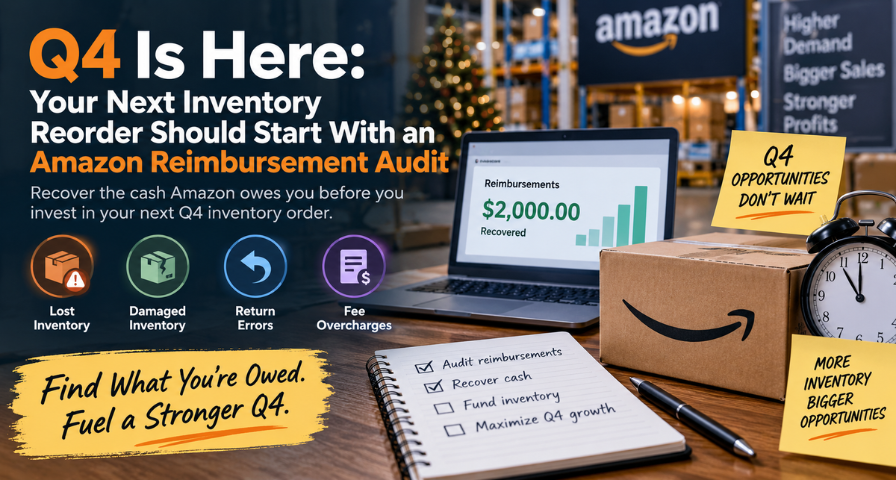
You may be making your next Q4 inventory investment with cash that Amazon already owes you. That's the uncomfortable reality sitting underneath a lot of seller accounts right now, and it rarely gets noticed because attention is pulled toward sales numbers, ad spend, and reorder timing instead of quietly checking whether Amazon's records match what actually happened to your inventory.
Q4 is already moving. Orders are going out, budgets are stretched, and every seller is deep into the busiest stretch of the year. In the middle of that momentum, a financial gap tends to hide in plain sight. Lost units, damaged inventory, fee miscalculations, and return errors happen inside Amazon's fulfillment network more often than most sellers assume, and much of it goes unclaimed simply because nobody went looking. An Amazon reimbursement audit is one of the fastest ways to close that gap, and doing it now, before your next reorder decision, matters more than doing it at any other point in the year.
Why This Matters More Right Now Than Any Other Time of Year
Cash flow management becomes particularly important in the fourth quarter because it is when sellers spend the biggest part of their annual budget on replenishing their inventory, taking into consideration such aspects as larger order sizes, faster delivery, and higher storage fees. Any cash that is blocked in the form of unreimbursed Amazon FBA reimbursement needs to be found elsewhere, either through a loan, delaying other expenses, or simply buying less inventory than is needed by the season.
Most sellers tend to have some unclaimed reimbursement in their account regardless of the size of the catalog and the total number of sales, as well as depending on the number of audits carried out previously. It is not about the specific number of dollars that you have at your disposal. It is about the fact that most accounts have unclaimed reimbursements in them in one way or another. And once you get them back, this cash immediately becomes available to you and can be used as working capital.
It's worth being precise about what that recovered cash actually represents. A reimbursement isn't automatically the same thing as profit. If Amazon reimburses a seller for a lost unit, that payment is primarily restoring value that was already spent and already lost, not generating new earnings. The real Q4 advantage isn't that the business suddenly made more money. It's that working capital, which would otherwise have stayed locked up or written off, is now available again, right when inventory decisions need funding. That distinction matters, because it keeps the focus where it belongs: on cash flow and timing, not on treating reimbursement recovery as a profit center.
The broader logic here is simple, even if it's easy to lose sight of during the busiest weeks of the year. Recovering money already owed to you is cheaper and less risky than borrowing new money or scaling back an order you were counting on. Yet reimbursement recovery still gets treated as a low priority task by a lot of sellers, something to handle once things slow down. In Q4, things don't slow down, and the eligibility window on many of these claims doesn't wait for a quieter month to arrive.
How Amazon Ends Up Owing Sellers Money in the First Place
The complexity of Amazon's fulfillment network creates plenty of room for discrepancies, including lost units, damaged inventory, unresolved returns, and fee miscalculations. Every unit that moves through a warehouse passes through multiple systems and multiple points where something can go wrong. Individually these errors look small. At scale, across thousands of units moving through dozens of fulfillment centers, they add up to a meaningful and recurring source of Amazon seller reimbursement opportunity.
Lost inventory is one of the most common categories. A unit gets received into a fulfillment center, gets shifted between locations, and then disappears from the available inventory count without a matching sale, return, or removal order. Unless someone notices the gap between what was shipped in and what's actually available to sell, that loss simply sits there, unclaimed and unnoticed.
Damage in inventory works the same way. Damage in inventory happens in the warehouse due to handling, damage happens in transit between the fulfillment centers, and damage happens in picking and packing. Damage that happens not as a result of the seller's original packaging but as a result of handling will be eligible for reimbursement for the seller. This kind of damage usually gets lost somewhere in inventory adjustments that very few sellers bother to look at, especially during this hectic season.
Returns create an additional headache. Whenever a customer returns something, that item should go either back into sellable inventory or into customer damage. What actually happens is that those returns get lost, and the seller refunds the money to the customer without receiving the inventory back in his/her account.
Fee overcharges round out the list, and they're arguably the sneakiest category because they don't show up as a missing unit at all. Instead, they show up as a slightly higher fulfillment fee than expected, caused by an incorrect product dimension or weight tier somewhere in Amazon's system. On a single unit, the difference might be small. But when a fee discrepancy repeats across thousands of units sold over a busy quarter, it starts to erode SKU-level profitability in a way that's easy to miss if you're only looking at revenue and not margin by product.
Reimbursement Windows Don't Wait for a Slower Month
The policy of reimbursement puts the onus of claiming these expenses back on the seller and not Amazon. This fact alone deserves some contemplation. The time period within which sellers may be eligible to claim these losses is not infinite. There are some claim types, which have limited time periods within which they may be filed. Depending upon the claim type, marketplace, and policy currently in place, this period can be quite short. Although the specific rules of Amazon do change depending upon the claim type, it is worthwhile to verify the period for the particular claim type currently, but the bottom line remains true irrespective of the number of days: these claims expire, and there is a risk of loss of revenue by waiting till Q4 to claim them.
That's really the core risk. Not one specific deadline, but the general pattern that discrepancies from earlier in the year can quietly age out of eligibility while a seller is focused on sales and reorders. A seller who only checks their account once or twice a year increases the risk of missing legitimate FBA reimbursement claims simply because discrepancies may age beyond their eligibility window before anyone catches them. With Q4 already in motion, that risk grows, since more units are moving and more room for error exists.
What a Reimbursement Audit Actually Involves
Fundamentally, the process involves comparing what Amazon says your inventory and fees ought to look like in terms of their records against what they actually are in terms of your sales, inventories, and finances. But the valuable version of this process takes it a step further: is the outcome of Amazon's bookkeeping accurate? Not in terms of whether Amazon lost a unit, but in terms of whether their bookkeeping is a faithful reflection of what should happen to the unit, from being put into a fulfillment center until it is sold, returned, or lost?
That requires linking up a number of different data strands. Inventory movement needs to line up with order history. Order history needs to line up with returns. Returns need to line up with either restocked inventory or a documented reimbursement. And fees need to match the expected weight and dimension tier for each product. When one of these threads breaks, that's where a legitimate claim usually lives.
In practice, the audit starts with pulling inventory adjustment reports, reimbursement reports, and fee reports directly from seller account data. From there, the work is about pattern spotting: units that disappeared without a matching sale, return, or removal order; damaged inventory reports where the reimbursement never followed; refunded orders where the returned unit never made it back into available inventory; and fee line items that don't match the expected tier for a given product.
While this can be done manually, the task is time-intensive and even more challenging for sellers who have a larger portfolio and are experiencing higher sales volumes at the peak of the season. And this is where the profitability tracking software makes its case, not to replace the audit but to highlight those SKUs that need closer attention. Software that keeps track of the profitability of an SKU will be able to highlight that there was a subtle change in profitability, and this usually is the first step towards finding out whether there are any fees missing from the account, refunds that were never received, or units that were shipped but somehow went missing in action.
A Practical Workflow, Not Just a Concept
It is important to consider this as a step-by-step process rather than one single action. The first thing is to identify the discrepancies by reviewing inventory and fee reports, where we can detect the gaps mentioned previously. After the detection of a discrepancy, it is necessary to validate it, which means to analyze the numbers to ensure that this discrepancy is true and not just an incident due to timing or other reasons, but a valid claim. The next step is to submit eligible claims to Amazon’s Seller Support.
The next step is one sellers often skip entirely, and it matters more than it seems. Recovered cash should be tracked separately from normal sales revenue, at least mentally if not in a formal account structure. That separation is what allows a seller to actually see how much working capital came from reimbursement recovery versus organic sales, and it's what makes the final step possible: using that recovered cash deliberately when evaluating the next replenishment decision, rather than letting it blend invisibly into general operating cash.
Making the Recovered Cash Count
Recovering unclaimed reimbursements only creates real value if that money gets put toward decisions that actually strengthen the business. Having extra cash on hand doesn't automatically translate into a better Q4. The advantage comes from pairing recovery with a clear look at which products deserve that capital during the weeks still ahead.
Imagine the scenario of a retailer who receives reimbursements amounting to two thousand dollars during the last quarter of the year from a number of claims lodged over a period of weeks. That particular seller has two SKUs moving rapidly, but one is more profitable with a higher sell-through rate compared to the other. The problem is not "We have two thousand dollars worth of money so we can purchase inventory." The right question to ask is which area should that two thousand dollars go for maximum benefit before the Q4 window closes. Investing it in the SKU that is more profitable will be productive.
This is where inventory planning becomes just as important as the audit itself. Recovered funds work best when they go toward restocking proven performers and adjusting order quantities based on actual sell-through data, rather than getting spent simply because the cash happens to be available. An inventory planning tool that surfaces restock suggestions based on sell-through velocity can make this decision faster and more consistent, turning "where should this money go" from a guess into a comparison grounded in actual performance data. A disciplined approach to reinvesting recovered funds consistently outperforms a reactive one, because it treats the recovered money as part of a broader inventory strategy instead of a windfall to spend quickly in the middle of a busy season.
Key Takeaways as Q4 Continues
The core idea here isn't complicated, even if the execution takes some diligence. Amazon's fulfillment network creates ongoing opportunities for lost units, damaged inventory, unresolved returns, and fee miscalculations, and sellers are entitled to reimbursement for nearly all of it. The responsibility for finding and claiming that money falls on the seller, and the eligibility window for many claims is limited enough that delay often means losing the claim entirely.
Your Q4 inventory budget isn't only the cash sitting in your bank account. It also includes money Amazon owes you but hasn't returned yet. Treating that recovered cash as real working capital, rather than a separate accounting exercise, changes how the next reorder decision gets made. With Q4 already underway, the smartest move isn't waiting until the season winds down. It's running the audit now, letting what you recover shape the decisions still ahead, and making sure money already owed to your business actually gets used to fund your business.
Ready to Grow on Amazon?
Let our experts help you scale your Amazon business with proven strategies.
Get a Free Consultation