Prime Day Sales Drop: Why It Happens and How Amazon Sellers Can Recover
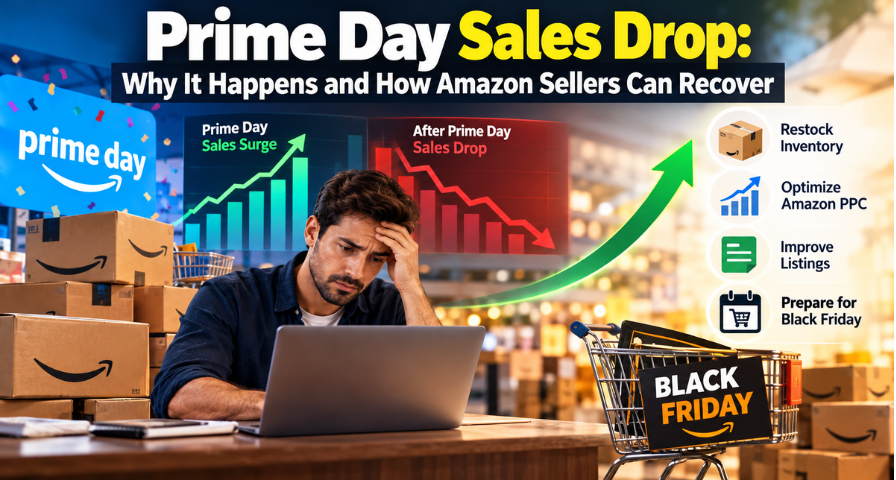
Introduction: When the Real Test Begins
The Prime Day effect may make your Amazon business seem unbeatable, but the true challenge may lie ahead. One of the accounts selling socks on Amazon US, where I served as an ad manager, spent more than $750 on ads per day when six to seven of its top-performing ASINS were out of stock. The situation was making sales increasingly difficult, and discounts allowed to keep the remaining stock profitable and compensate for the loss of sales associated with unavailable items.
And that taught me a valuable lesson that I now share with all my sellers: a fall in sales on Prime Day is not necessarily an advertising issue. It is usually a combination of changing consumer preferences, lack of stock, and rushed decisions. This article will explain why you are losing sales, what I did, and what worked for me to bounce back and get a second wind until Q4.
Why the Post-Prime Day Slump Is Normal
Consider Prime Day as a pressure cooker. Customers are trained to delay their purchase decision since they expect better prices, and Amazon invests huge resources making it an urgent situation. The result of that is customers cramming a big part of their spending into a tiny time window. Once this window is over, there is just less demand left to harvest.
A certain part of the dip after the event may represent pre-buying ahead of Prime Day rather than loss of demand altogether. If we consider only the event itself in isolation, its peak appears to be a success and the dip – a failure, but if we consider six weeks before the event and six weeks after it compared to six weeks of regular weeks, the difference will turn out to be much smaller. This approach allows one to understand whether the event has resulted in new sales or just rescheduling the old ones.
The Three Forces Behind the Prime Day Sales Drop
The first force is deal anticipation, and it works in both directions. Before the event, plenty of buyers wait. Afterward, many feel they have already done their shopping, and even those who bought nothing often decide the next big opportunity is Black Friday. Your listing may be perfectly good, but you are competing with a shopper’s patience.
The second force in play is pre-buying. People have an incentive to buy more now, when the price is low, than later on. When a household buys several months' worth of supply on discount, they won't come back in October. For sellers of replenishable products or products with a natural repeat cycle (such as socks, basics, consumables), the fall in sales can be greater and last longer than expected, since you've essentially moved demand forward in time.
The third force to contend with is inventory, which is the one that is under your greatest control. During the spike, your stock is moving faster than most forecasts anticipate. Some ASINs run out during the event itself, and shipments need some time to arrive and be put in stock, so even a fast-acting seller can be left without their ASIN available for a couple of days or weeks. And this is how inventory management from Amazon decides your fate for the quarter.
What Happened in My Case: The Spike, the Drop, and the Experiments
Here is how it played out. The event itself went well. Several listings moved more volume than they had in months, and for a short stretch it felt like the strategy had finally clicked. Then, within a day or two of the event ending, orders thinned out. A group of my best performers had sold through most of their stock, and by the time the dust settled, six or seven of the leading ASINs were out of stock entirely.
My first instinct was to fight the drop with price. I kept discounts running on the listings that still had inventory and pushed restocks toward the fulfillment centers as quickly as I could. I also kept advertising active, partly out of habit and partly out of fear that stopping would make things worse. With daily spending above $750, that fear was expensive.
For about a week, I mostly watched the numbers and worried, and I made more changes than I should have. Looking back, that stretch taught me less about tactics than about discipline. The most useful thing I could have done early was separate the problems that were temporary from the ones I was actually responsible for.
What Worked and What Did Not
The discount did make a difference, although only partially. Amongst the available listings, a small price decrease helped to sell the goods and gave some base level to the sales. The decline in sales in those listings was smaller and more stable. The discount was far from miraculous, but it worked as a support mechanism, a chance to hold your ground as the general market cooled down.
One thing that the discount could not do was compensate for the loss in income due to unavailable ASINs. No matter how low the price is, a product that is out of stock cannot be bought. This direct loss is not always fully compensated for, especially when there is an extended period of time when the item is out of stock. There are also other effects that may occur in the long term.
There was also a quieter lesson about overreacting. Adjusting prices and budgets several times in a few days muddied my data, because when you change too many things at once, you can no longer tell which change produced which result. A calmer approach would have given me cleaner information and probably better decisions.
Building a Post-Prime Day Sales Recovery Plan
Replenishment begins with inventory because all other tasks will depend on this information. Understand what you have in terms of inventory, what is being shipped, and what can potentially become out of stock before your new inventory arrives. With ASINs that are out of stock, make sure that replenishment becomes your priority and speak to your supplier about expected volume during the fourth quarter. Inventory that comes at the end of November is much less valuable than inventory that arrives at the beginning of this month. When your forecast was not accurate, use it as data for future estimations.
Now that we have ensured stability in our inventory management, let us focus on PPC optimization for Amazon, which should be viewed as a process of diagnosis and not just a response to an event. Various parameters denote various problems: low impressions could mean a lack of search traffic, delivery of campaigns, placements, and available inventory; high CPC could be attributed to auction and bidding, as well as targeting effectiveness. The same number of clicks but lower orders would point at the problem of conversion, and thus the analysis should be done of pricing, listings, delivery time, and inventory. And in case of higher ACoS, begin with checking attributed sales.
Budgets will rise without modifying them in line with changes in demands or conversions; for instance, your budget will be inefficient if you observe fewer sales but still have the same clicks. Look at the performance before making decisions about whether to reduce the budget or bids. Try to separate branded from non-branded searches wherever you can since this differentiation is essential in determining what type of customers are looking for your product, especially after an event. Re-listing ASINs requires recreating campaigns, not simply turning everything on all at once.
Also, your listings need to be analyzed because you receive a lot of new information about how customers view your product after an event. It’s important to think critically about reviews because sometimes the same question comes up repeatedly. Answer those questions in bullets or description. If you notice that some pictures don’t convey some feature of your product, replace them. Minor improvements to titles, images, and A+ content might lead to increased conversion because of lower traffic.
Black Friday Preparation Starts Now
As there is only one month left until Black Friday, scheduled for November 27, 2026, and Cyber Monday falling on November 30, the time frame of recovery becomes preparation time for sellers. One needs to make sure that replenishment time frames are set, select the ASINs that will help generate income in the fourth quarter of the year, analyze the profitability of the campaigns, and solve any listing-related problems. Leaving all these tasks for the last week of Black Friday, the time left for recovery will be minimal.
On Black Friday, you may face the second wave of dynamics of promotion anticipation, increased competition, and potential stockouts. Decide what goods will be promoted by you and whether they will have enough stock. Also, think about the magnitude of discount you can afford. The sellers that take care of fixing the inventory issues, conducting tests of campaigns, and making forecast adjustments will be much more prepared for such events than those who wait for them.
Conclusion: Treat the Drop as a Signal
A Prime Day sales decrease might sting if it happens to you personally, but that is mostly because of structure. Consumers expect discounts, place their orders earlier, and pause afterwards, and sellers that find themselves without sufficient inventory experience more difficulties than others. All of that does not mean that your company is in trouble. In this case, the market simply breathes.
The difference between a successful and unsuccessful recovery lies in actions that you make in order to recover. Do not rush and implement changes at once, consider numbers over a relevant period of time, start with fixing inventory first, preserve the efficiency of your ads and continue working on your listings bit by bit. Use discounts as an additional tool, not as a solution, and do not forget that the best lessons can only be learned when something is out of stock.
The only thing you should take from this is that a Prime Day sales decrease is a sign that needs to be investigated, rather than reacted to right away. Patience and relevant numbers will always win over haste, and with Black Friday approaching, there is another chance coming up soon.
Ready to Grow on Amazon?
Let our experts help you scale your Amazon business with proven strategies.
Get a Free Consultation