Prime Day Pricing Strategy: How to Protect Profit Margins When Competitors Cut Prices
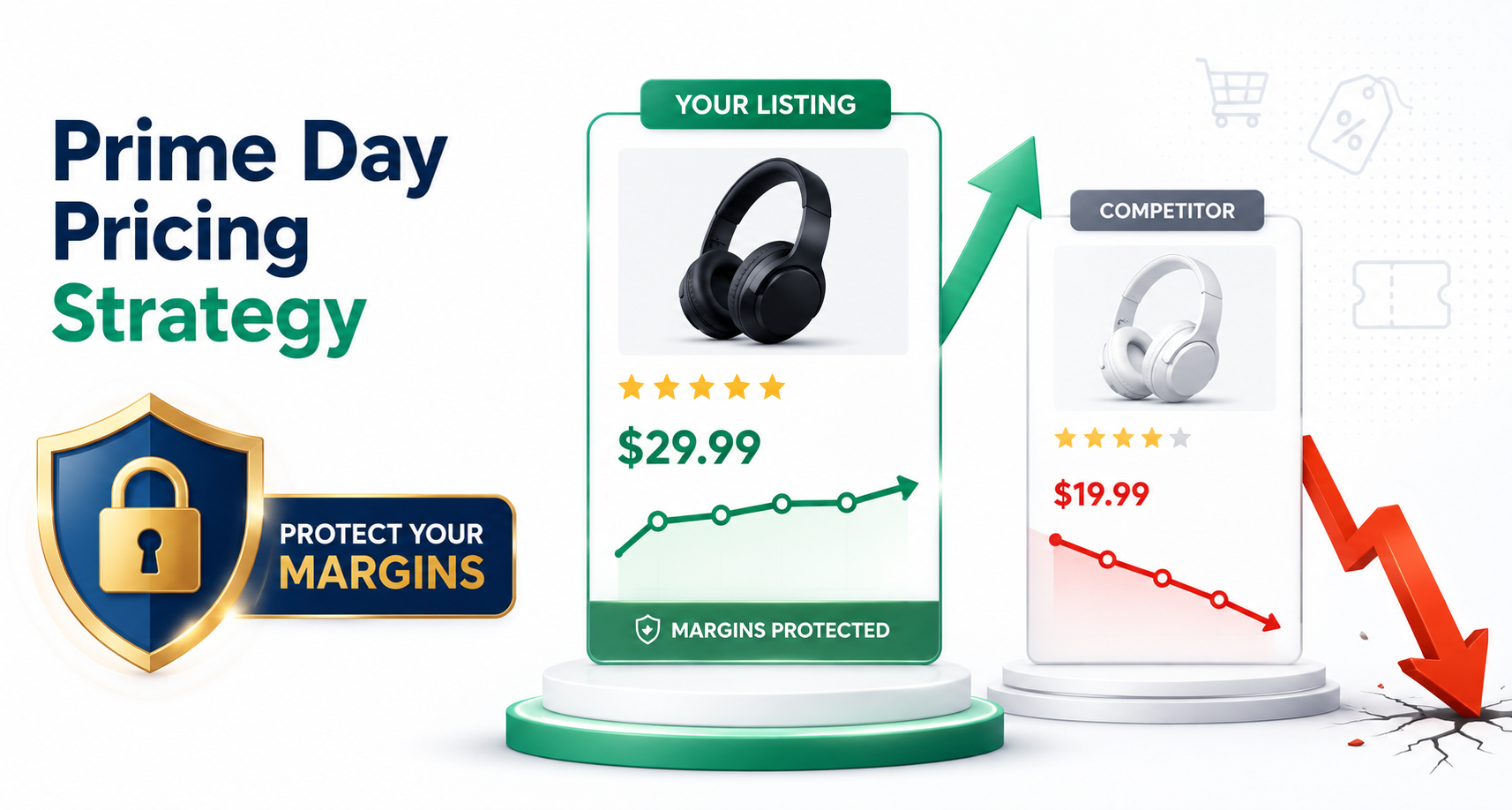
Every Prime Day, sellers face the same dilemma. The moment a competitor drops their price, there's an instinct to match it immediately, almost as a reflex. But chasing every price cut your rivals make is one of the fastest ways to quietly destroy your margins without realizing it until the sales numbers come in. A smart Prime Day pricing strategy isn't about refusing to compete. It's about competing with control, using a simple framework that accounts for your actual costs, your market position, and the real intent behind a competitor's discount. Below is a practical, two-step approach I call the Margin Shield Framework: first you diagnose the situation, then you defend your numbers with the right tactics. It's built for sellers who want to survive Amazon price wars without giving away the profit they worked all year to build.
The Real Cost of Reacting Too Fast in Amazon Price Wars
The moment that a competitor offers you a discount during an occasion such as Prime Day, you feel that the need to match that competitor becomes urgent. You have to sell quickly; you have to be seen; and above all, you can't afford to give up the Buy Box. However, most sellers react on impulse, not strategy. They look at that low price point from that competing product listing, and they match it without verifying whether it is financially wise to do so. Consider an example. Your product is at $19.99. You drop it to $16.99 to match your competitor's price. You factor in the referral fees, FBA fees, and additional marketing spend to push the volume through. That three dollar drop will secretly reduce your margin by $2 or even $3. You just lost money on something that should have helped you make money.
The Margin Shield Framework: Diagnose Before You Defend
This system works in two phases. The first phase involves diagnosis, which includes deciding whether the competitor action deserves a reaction and if so, what type of reaction would be appropriate. The second phase is called defense, which uses tactics that preserve your margin rather than sacrifice it. Omitting phase one is the primary cause of sellers' overreaction on Prime Day. Once you have your figures straight and you have knowledge about the nature of the attack, you can use your defensive tactics effectively.
Stage One: Define Your Price Floor Before You React
The first step in diagnosis is knowing your price floor, the absolute minimum price at which you can sell a product and still walk away with real profit. This sounds obvious, but a surprising number of sellers calculate it wrong. Your price floor needs to account for product cost, FBA fees, advertising spend, returns, and platform commissions. Subtract all of that from your current price and you get your true margin, not the number you assume you're making. Many sellers discover their "competitive" price is closer to breakeven than they thought, much like the $19.99 to $16.99 example above. Knowing this number in advance means you're never negotiating with yourself in the middle of Prime Day chaos. You already know exactly how far you can go, and where you can't, no matter how aggressive the price wars get that week.
Stage One: Identify If the Price Drop Is a Real Threat
Not every price cut deserves a response. Before adjusting anything, look at the competitor's market share and sales history. A competitor with a small slice of the market dropping their price has minimal impact on your sales, and matching them sacrifices margin for almost no real gain. This step is overlooked because it demands analysis and not just an instinctive response. Competitor rankings in terms of sales, speed of review, and past prices are all tools that will help you discern whether this is a real challenge or not. When you realize that they don’t pose a significant market share risk, keep your price steady.
Stage One: Read the Discount Correctly
The very nature of the discount completely changes things. Are you dealing with a limited-time, exclusive-to-Prime Day offer that will end once the day is over, or are you facing an adjustment that will change expectations going forward? If you are dealing with the former, then you could very well see this through because, chances are, you have enough reviews, brand reputation, or bundled offerings to keep people hanging around during this period of time when there’s just that bit more of a discount. It’s making no distinction between discounts that are permanent or temporary, and that is killing your company’s health.
Stage Two: Defend With Advertising Instead of Price Cuts
Once the diagnosis is done, defense begins, and advertising is one of the quietest, most effective tools available. Instead of cutting price, strengthen your ad presence on your own product pages so competitors don't appear as suggested alternatives or "frequently bought together" options, one of the sneakiest ways shoppers get diverted to a cheaper rival mid-purchase. This isn't about outbidding everyone everywhere. It's targeted spend aimed at retaining traffic you already have, rather than discounting to chase traffic you might get anyway.
Stage Two: Win on Conversion, Not Just Price
There’s an additional level of sophistication to this that distinguishes skilled sellers from all others: placement-level bidding. Instead of treating all money spent equally on ads, differentially assign budgets based on whether the aim is to defend top-of-search placement (where competitors aggressively fight to outrank) or your own product listings (where you’re protecting against substitution). A well-crafted listing, complete with crisp photos, bullet points, and a high number of reviews, can convert better than a less expensive competitor despite a higher price, which means that the true leverage doesn’t come through pricing but conversion rates. This realization allows sellers to move away from a pricing advantage to a conversion advantage that is far more sustainable in any sales contest.
Stage Two: Choose Coupons Over Price Cuts
This is one of the most underused tactics in any Prime Day discount strategy. Lowering your listed price affects your price history permanently, which can hurt perceived value long after the event ends and even affect algorithmic pricing comparisons later on. Coupons give buyers the discount they're looking for without touching your actual price history. The listed price stays intact, your long-term positioning stays protected, and customers still feel like they're getting a deal. It's a small shift in tactic with a real impact on how your pricing data looks six months down the line.
Stage Two: Protect Your Hero Products
There are always some products that account for most of the sales made by a business, and these are referred to as hero products. Whenever the need to reduce prices arises, it is common practice to do so in an equal manner across all the products being sold. This is an incorrect practice. It is important to focus on reducing the prices of slow-moving stock while protecting your best-selling products from any cuts.
Key Takeaway: Control Beats the Cheapest Price
The majority of sellers come to Prime Day focused on winning through price. But those who actually do win are those who own their numbers. Framework, diagnosis of the threat followed by defense against that threat, is what ensures that margins remain healthy even when everyone else is going to the bottom. Understand your minimum price point, assess the situation to know whether it's worthwhile to react, assess the discount properly, and defend through ads, conversions, coupons rather than discounts, and hero product protection. It's the combination of all of these things that makes a difference between a profitable Prime Day and an unprofitable yet busy one. And if you are not ready with this kind of framework coming to the next sales day, then build it now before the price wars begin.
Ready to Grow on Amazon?
Let our experts help you scale your Amazon business with proven strategies.
Get a Free Consultation