Lock Your Amazon Listing Before Someone Else Redecorates It
If you're an Amazon seller and haven't checked your active listing page within the past week, immediately pause everything you're doing and head over there right away. Your Seller Central dashboard doesn't count. Your inventory list doesn't count. We mean the real product page where your buyers see it. Because many Amazon brands today are realizing that pictures they didn't put up, product titles they didn't write, and bullet points they never saw are all featured prominently on their active pages. And when they discover that information, hundreds of buyers have already seen those details.
This isn't speculation. This is happening. To more than just small-time, carefree brands. In fact, a lot of these are actually full brand-registered accounts that thought registration would be all they needed to secure their product content.
Why Your Listing Is More Vulnerable Than You Think
Amazon's product detail page has always been a collaborative space, which sounds reasonable in theory. Multiple sellers can contribute content, and Amazon's algorithm is supposed to surface the "best" version. In practice, that system has always created friction for brands. Unauthorized sellers could push their own titles. Resellers could overwrite bullets with keyword-stuffed alternatives. It was messy, but manageable.
What's changed recently is harder to control. Amazon's AI systems are now pulling in content autonomously, and not always content that belongs to your listing. Sellers are finding synthetic images generated by Amazon's own tools, visuals pulled from related ASINs, and in some cases, imagery that appears to have originated from a competitor's product entirely. The brand never approved any of it. It just appears. And because Amazon's algorithm sometimes surfaces these changes quietly, many sellers aren't catching it through their normal routines.
This is the new version of listing hijacking. It doesn't require a bad actor with a seller account. It can happen through automation, through AI content contributions, through the very systems Amazon built to "improve" the shopping experience.
What Is Amazon Brand Catalog Lock?
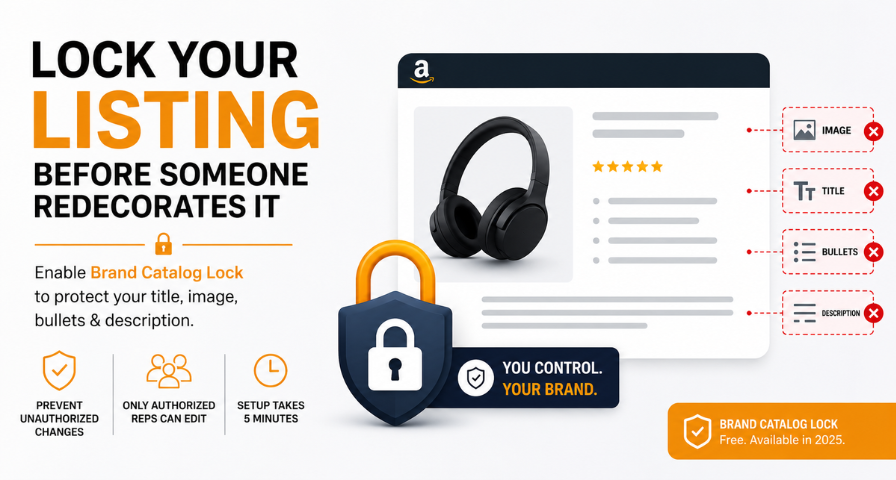
Brand Catalog Lock is a feature inside Amazon Brand Registry, and if you haven't heard of it, you're not alone. Most sellers haven't enabled it, and Amazon hasn't exactly been loud about it. The feature became available in 2025, it's completely free to use, and setup takes around five minutes.
This is how it works. By activating Brand Catalog Lock, you get the ability to lock down four particular sections on your product detail page, title, hero image, bullet points, and product description. These sections will be safe from tampering by unauthorized sellers who do not have permission to edit them. In addition, even outside contributors, like the automatic content generators used by Amazon under particular conditions, won’t be able to make changes to them without your consent.
Think of it as a content permissions layer sitting on top of your listing. Before this existed, your listing was essentially open to contribution from a wide range of sources, some legitimate, some not. Brand Catalog Lock closes that door. It doesn't affect your ability to update your own content. It just means no one else can.
Why So Few Brands Have Turned It On
That is where the frustration comes into play. Brand Catalog Lock is not that hard to locate if one knows where to look. It is found under Brand Registry’s listing protection feature section. However, it is not something that will come up in searches because most sellers do not bother searching for things that they do not know about.
The result is a protection gap. The brands who most need this feature, active sellers with competitive categories and high-traffic listings, are the exact brands least likely to have stumbled across it through normal platform use. And because listing changes don't always trigger alerts, many of them don't realize their content has been altered until a customer mentions it, a review references the wrong product image, or someone internally happens to spot it during a manual check.
The uncomfortable reality is that if your listing has been quietly modified and you haven't had Brand Catalog Lock enabled, there's no automated rollback. You're cleaning it up manually after the damage is already done.
How to Enable It Today
The Catalog Lock feature can be activated only when your account is associated with the Amazon Brand Registry program. It should be noted that in order for you to use this feature, you should register your trademark. If you have the ability to use this feature, then you need simply to log into your dashboard and activate the feature using the settings.
This feature will help lock the ASINs that you choose from outside influence. Any attempt to change the information in protected fields from third-party accounts will be denied automatically. This will allow you to edit the product data without any trouble from other users.
It makes sense to prioritize those ASINs that have high traffic and bring a lot of money to your company. They are also most susceptible to the influence of competitors and their malicious actions.
The Broader Lesson About Amazon Listing Protection
Brand Catalog Lock addresses a specific and urgent problem, but it's also a signal of something bigger. Amazon's platform is evolving faster than most sellers' internal processes, and the protective features being added reflect real vulnerabilities that real brands are experiencing. The fact that a lock feature like this even exists tells you something about how serious the content integrity problem has become.
Amazon listing optimization has always required ongoing attention, but the nature of that attention is shifting. It used to be enough to build a strong listing and monitor it occasionally. Now, the monitoring needs to be more active and more systematic, because the threats are coming from more directions, including from the platform's own automation.
This is especially the case when competing within an already crowded category that Amazon’s algorithm is testing on the product page through different images and even A-plus content from other similar products. This way, one listing could be altered from its initial position without a person making an explicit effort to do so.
Why This Matters More Than Most Listing Advice You've Seen
Most listing optimization advice focuses on what to build. Better images. Stronger copy. Smarter keyword placement. All of that matters, and it matters a lot. But it only matters if the content you've built actually stays on your listing. If your hero image can be replaced by a synthetic alternative or a pulled-from-somewhere-else visual without your knowledge, then the investment you've made in your visual brand identity is sitting on an unsecured foundation.
Brand Catalog Lock is the equivalent of putting a lock on the door after you've furnished the house. You wouldn't leave a well-designed space open for anyone to rearrange. The same logic applies here. Your listing is your storefront, and your storefront should have a lock on it.
Take Action Before You Close This Tab
The ask here is genuinely simple. Log into Brand Registry. Find the catalog lock setting. Enable it on your most important ASINs. It costs nothing, takes a few minutes, and protects against a problem that is actively affecting sellers right now.
While Amazon brand protection is not something that can be set up once and left alone, it is among the simplest processes that can be done now by sellers. These brands, which implement it, are simply closing the door they should have shut from the start. Be sure that your brand is among those brands.
Ready to Grow on Amazon?
Let our experts help you scale your Amazon business with proven strategies.
Get a Free Consultation