Landed Cost 101: The Number Every Amazon Seller Gets Wrong
How to Calculate Your True Landed Cost on Amazon
All Amazon sellers face the same question at some point: "Why am I not making money as much as I thought?" There can be sales, great reviews, and products flying out of stock, and still the financial statement will tell a very different story. And most likely, the problem lies not in the cost of marketing or in how expensive the customer acquisition process was. The truth is hidden in an even more boring thing – the concept of landed cost.
The landed cost sounds pretty simple, but there is always much more depth than it seems at first glance. While some sellers make $25,000 per month from their operations on Amazon, other sellers cannot earn even $1,000. And the reason for such a difference usually lies in one thing, how well do they understand how much a particular product costs once delivered to their customer's door? If you want to create an effective and long-lasting business on Amazon, you need to calculate and understand your landed cost now.
What Landed Cost Really Means
The essence of landed cost refers to the cost incurred to transport a manufactured product to your customers. The factors that make up landed cost include the cost of freight and manufacturing, but they also entail other factors such as the cost of insurance, cost of brokerage, import taxes, and customs duties.
What makes this figure so tricky is that it has evolved. Traditionally, sellers stopped their calculations once a product arrived at their warehouse. That's no longer good enough. Modern landed cost accounting has to include the ongoing costs of actually selling on Amazon, things like your monthly subscription fee, FBA fulfillment charges, referral fees, and PPC advertising spend. These recurring costs directly affect your cash flow, so leaving them out of your pricing strategy is a quick way to end up with numbers that look good on paper but don't hold up in reality.
There's also a shift in how sellers calculate these costs. Spreadsheets used to be the standard tool, but with so many variables now in play, manual tracking leaves too much room for error. A single missed fee or outdated exchange rate can throw off your entire pricing model.
Breaking Down the Landed Cost Formula
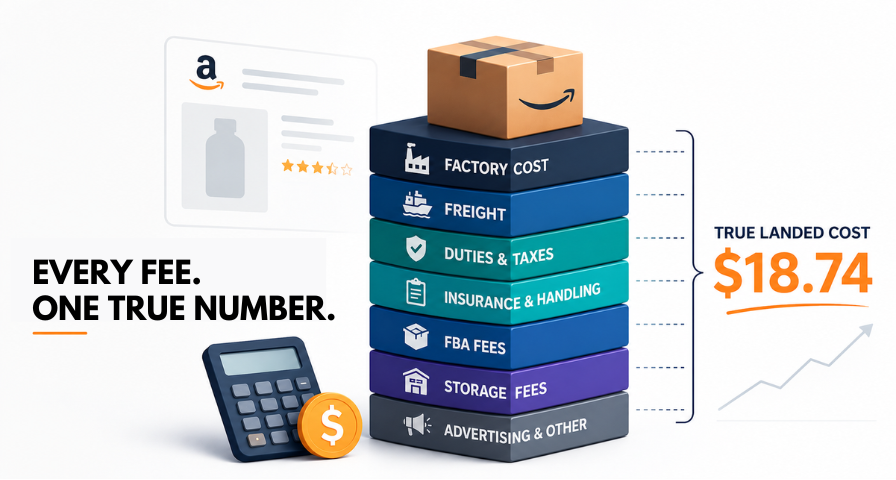
In order to obtain a correct figure, one needs to allocate each individual category of expense separately. Thus, the list would include costs incurred from factories or suppliers, freight costs (either air or seaway), duties and customs clearance, insurance and handling, packaging and preparation, specific Amazon charges (FBA and referral fees), storage, and other miscellaneous costs.
After the expenses have been properly allocated, the calculation process is quite simple – summing up all your expenses and dividing the result by the quantity of products manufactured/shipped. The difficulty in the equation is not in the math part but in ensuring that all expenses are included in the calculation process.
Why Amazon Sellers Face a Different Set of Rules
Selling on Amazon brings in costs that one would not incur when selling on any other site. Fees for fulfillment services, storage services, refunds, referral fees, and ads all come on top of the basic cost of your products. Many of these costs tend to be overlooked easily till they start hurting your bottom line.
The scale of Amazon adds another dimension of complexity to this whole process. With well over 1.6 million active sellers currently on the site, competition is high, and there is no place for price errors here. Amazon runs storefronts in several different countries; therefore, the site has become an obvious starting point for global expansion. This means that one has to deal with new customs and duties that one might never have had to before. Failure to keep track of these lands costs could literally mean failure for your company.
The Real Cost of Getting It Wrong
Businesses that do not follow through with the process of calculating landed cost will always fall into one trap, which is that they will miscalculate their profit margins due to additional costs that eat into their revenues without even being accounted for in any normal spreadsheet.
Pricing suffers first. Without a clear view of total costs, it's easy to underprice inventory and unknowingly sell at a loss, or overprice it and lose competitiveness. Cash flow management becomes harder too, since sellers without accurate cost data struggle to plan for scaling or reinvestment. And if you're ever planning to sell your Amazon business, sloppy financial reporting can tank your valuation. A buyer running due diligence will ask for cost-per-unit history broken out by SKU, and if your only answer is a rough estimate, that gap alone can knock a meaningful percentage off your asking price.
The Hidden Fees Nobody Talks About
Some of the most damaging costs are the ones sellers don't even think to track. Currency fluctuations can quietly shift your margins if you're sourcing internationally, since a supplier invoice priced in yuan or rupees can cost you more or less from one payment cycle to the next even when the unit price never changes. Aged inventory fees pile up when stock sits too long in Amazon's warehouses, and because these charges increase the longer inventory sits, a slow-moving SKU can go from mildly profitable to a net loss within a few months without a single line item changing on the product page.
Returns, refunds, and damaged goods all represent real losses that rarely get factored into initial cost projections. A product with a 12 percent return rate isn't just losing the sale value of those returns, it's also absorbing the cost of return shipping, inspection, and often disposal, which effectively raises the true landed cost of every unit sold. Inefficient PPC campaigns burn cash without a clear return, and stockouts often force sellers into rush shipping, which comes at a steep premium compared to standard freight, sometimes three to four times the cost per unit. None of these are catastrophic on their own, but stacked together they can turn a healthy 30 percent margin into something closer to break-even without a seller ever noticing the shift happening.
Landed Cost and Profit Margin Are Not the Same Thing
There are some misconceptions about landed cost and profit margin that need to be clarified. The cost of getting a product produced and delivered is the landed cost. Profit margin is the percentage of earnings that remain when all the costs are taken into account. It should be noted that the two concepts are connected but are not the same.
To get a correct profit margin, one needs to know the exact landed cost. Inaccuracies in the figures of cost may result in mistakes in profit margin calculation, which will negatively affect all key performance indicators of the seller's Amazon account. At the same time, having the correct information about landed costs makes scenario planning possible. If there is an increase in the cost of fuel and transportation prices go up, the sellers will be able to set new prices, while others will try to play catch-up.
Mistakes That Quietly Skew the Numbers
A few recurring errors show up again and again among sellers. Treating split shipments as a single cost instead of calculating each shipment separately throws off accuracy immediately. If half a shipment goes by air at a premium rate and the other half by sea, averaging the two produces a landed cost that's wrong for both batches, which then feeds directly into a pricing decision based on bad data.
Relying on rough estimates instead of actual invoice numbers might save time, but it introduces guesswork where precision is needed. A seller who rounds freight to "about 50 cents a unit" instead of pulling the actual invoice figure can be off by pennies that, multiplied across thousands of units, become a meaningful dent in monthly profit. Failing to regularly audit expenses means sellers miss shifting freight rates or duty changes that could be renegotiated, and forgetting to apply the correct HS codes when calculating tariffs can lead to customs reclassifying a shipment and charging a materially higher duty rate than the seller had budgeted for.
Scaling Landed Cost Calculations for International Growth
Expansion to markets outside the local jurisdiction brings its own challenges. Costs such as currency exchange, variations in customer demand, VAT, tariffs, regulations, and localization bring in additional cost considerations that were not there before. It may be helpful to work with experts specializing in international expansion so as to understand the cost implications involved, although the accountability for cost accounting is still on the seller’s side. This will determine how much the expansion effort will be profitable.
Building a Better Cost Tracking System
Here's the silver lining: there is a way to address landed cost issues. First, conduct an audit on each SKU to uncover any hidden costs and fee increases you may have overlooked. You may want to use an automated solution that calculates landed cost for individual products and identifies those SKUs that are quietly performing poorly. Incorporate the results of your audit into your system so that you can track the fees instantly and not find out about any problems a few months down the road.
Clean financial data matters just as much as the tools you use, and the consequences of dirty data are more specific than most sellers realize. Inaccurate cost inputs lead directly to bad PPC decisions, because a seller who thinks their margin is 35 percent when it's actually 18 percent will keep bidding on keywords that are quietly losing money on every conversion. The same bad data distorts reorder quantities, since forecasting tools and manual planning alike rely on true unit economics to determine how much inventory makes financial sense to hold. And perhaps most dangerously, it inflates reported profit, giving sellers false confidence to reinvest in growth, hire, or take on debt based on margins that don't actually exist once every fee is accounted for.
Bringing It All Together
Landed cost is more than just accounting; it's the surest way of telling if your Amazon business is a sustainable one. Calculating it correctly gives you better pricing and healthy margins and a clearer picture of the finances necessary for growth. If you've been having problems with your figures recently or never spent the time to chart all of your costs, from manufacture to delivery to the customer, there's your starting point. Knowing your true landed cost isn't going to solve all of your business problems, but at least it will help you find out what your problems really are.
Ready to Grow on Amazon?
Let our experts help you scale your Amazon business with proven strategies.
Get a Free Consultation