Integrating Amazon SEO and PPC| Why Sellers Can No Longer Treat Them as Separate Games
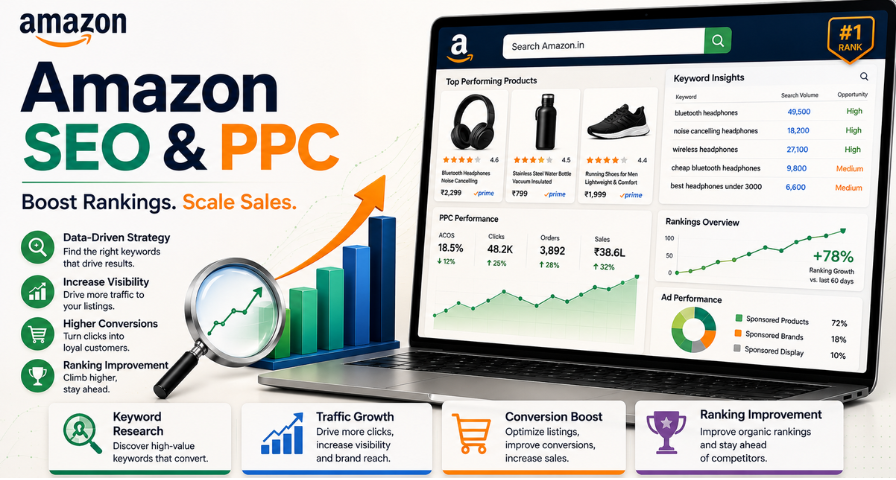
In the past, Amazon sellers viewed SEO and PPC in two separate worlds that were managed with two separate mindsets. SEO was the long game to build organic ranking. And PPC was the quick fix to pull out when you wanted visibility right away. But going forward into 2026, that dichotomy is slowly turning into a detriment. The Amazon algorithm has become increasingly connected, buyer habits have evolved into artificial intelligence-driven search, and the companies winning are those that see the Amazon SEO and PPC integration process as one growth machine. Here’s how and why it needs to change.
How Amazon SEO and PPC Work Together
This old belief that PPC and organic search cannot coexist anymore has become obsolete, particularly in 2026. This is because PPC ads provide valuable data about keywords, clicks, and conversion, which enable sellers to have a clear idea about the true requirements of the customer. But meanwhile, good SEO (proper title, precise bullet points, honest reviews) is what will determine whether the traffic you have purchased through Amazon PPC advertising converts after reaching your product listing. Think of PPC as the research arm and SEO as the conversion and trust arm. One without the other is like buying traffic to a page that isn't ready to sell or writing a perfectly optimized listing that nobody ever sees because you're not bidding on the terms that matter. Amazon's own advertising guidance now explicitly encourages this relationship, noting that sellers can use advertising to drive traffic and gradually build organic placement, then ease off bids as organic order volume grows. That's a more solid foundation for the strategy than any assumption about how the ranking algorithm works internally.
Key PPC Metrics That Actually Inform SEO
All PPC numbers do not carry the same weight for optimizing your organic listing, and it can help to know what each of them really means. Impressions give you insight into how much demand and relevance there is for a particular search term and, therefore, are an indicator of whether Amazon thinks that your product should be associated with that query. Click-through rate evaluates the effectiveness of your main image, price, and title because consumers are making their decision about your product within seconds before even considering the details. The conversion rate, on the other hand, is an assessment of the quality of your listing after a consumer clicks through to it. Cost per click is linked to bidding strategy and competition in keyword markets, whereas ACoS and ROAS measure the effectiveness of your budget spent on advertising. The most underestimated metric from the above list may be TACoS (Total Advertising Cost of Sales), but let us first make one thing clear: TACoS is not an SEO metric; rather, it is a company-level metric that shows you whether your advertising budget brings sales. Tracking the dynamics of TACoS changes against category-level advertising benchmarks offered by Amazon for metrics such as CTR, CPC, and purchase rate will provide you with much more insight than just measuring ACoS alone can.
Building an Effective Amazon PPC Campaign Structure
A well-structured Amazon PPC process normally entails multiple campaigns being run simultaneously, all of which play their respective roles. It is rarely the case when an Amazon PPC process follows a single order throughout. The automatic campaigns are normally where any discovery is made possible by allowing Amazon's algorithms to target the keywords and products that may not have occurred to the seller to bid on. The broad match and phrase match campaigns help expand the net further or narrow it down in testing, while the exact match campaigns cover the proven terms. Product-targeting campaigns round things out by placing a listing directly against competitors or complementary products. In a mature account, these often run simultaneously rather than in a strict progression, which lines up with Amazon's own guidance to combine automatic and manual targeting rather than treat one as a replacement for the other. What matters more than the order is making sure each campaign type is doing the specific job it's best suited for.
A Five-Phase Integration Strategy for 2026
Bringing SEO and PPC together works best as a structured process rather than a one-time fix. Phase one is about building your SEO foundation: solid titles, images, bullet points, and backend search terms that give the listing something worth ranking in the first place. Phase two shifts to PPC keyword discovery, where automatic and broad campaigns are used specifically to surface real shopper language, not just guesses from a keyword tool. Phase three moves into more controlled campaigns, narrowing spend toward the phrase and exact-match terms that have proven themselves. Phase four is where the real integration happens, turning PPC insights back into SEO improvements by updating listing copy, backend keywords, and A+ content based on what's actually converting. Phase five is about reducing unnecessary dependence on paid traffic where organic visibility becomes strong enough to carry more of the demand, not treating a lower ad spend as an automatic finish line. Some keywords stay competitive enough, and some products stay seasonal or new enough, that sustained advertising remains the right call. The point of phase five is intentional allocation, not blanket reduction.
The PPC to SEO Conversion Loop
It is the element that completes the strategy as a whole, and I would like to be accurate as to what is going on in the process instead of just thinking about it linearly. In PPC campaigns, the relevant customers come to your listing. You gain information about customer demand based on the conversions made by those relevant customers, which allows you to get some factual data about demand instead of making an assumption about it. Then, the insight regarding customer demand goes into your listings optimization and helps refine the campaign and vice versa. In other words, a combination of optimized listings and refined ad spends results in higher overall results of the listings. To put it plainly, PPC provides you with the relevant traffic, that traffic gives you demand insight, the insight is used to optimize listings and refine ad spends, and it is the optimized listings and refined ad spends that compound.
For example, when a company selling diabetic socks sees through PPC that "non-binding diabetic socks for men" is getting much more traction than the generic "diabetic socks," they could be tempted to raise the bid price for that phrase. What they should do instead is determine whether or not their listing makes it clear how the product is non-binding, what its size is, whether or not it is comfortable for the ankles, and what it is made out of. If the product fulfills this particular need, the listing should be rewritten around that exact need.
AI Shopping Is Changing the Rules in 2026
Perhaps one of the most important changes this year has been related to the development of AI-assisted shopping and its effects on the product search and evaluation process. The combination of Rufus and Alexa+ in one shopping experience called Alexa for Shopping allowed customers to ask questions in the search field, create shopping guides, compare products and categories, see historical prices, and even partially automate the processes of deal finding and cart creation. The direction in which Amazon is developing here shows that the company strives to implement more conversational and agentic experiences in the shopping process by allowing customers to search and evaluate products through the questions they may ask in addition to the usual search through short keyword fragments. For example, now a person can ask, "What are good noise-cancelling headphones for long flights under $150?" instead of asking for "noise-cancelling headphones" in the search field. Thus, the optimization of customer questions rather than keywords becomes an integral part of Amazon SEO, and listings have to contain specific data about a particular product, including uses cases, comparison of products, and answering the questions that can be raised by a customer during his or her shopping.
Common Mistakes Sellers Should Avoid
Many failed campaigns result from a few recurring errors. Running PPC campaigns on the basis of an ineffective listing is one of those, as no amount of traffic will do any good when the page does not convert. Focusing only on highly searched words is another frequent one, as it usually entails paying excessive amounts for competitive keywords while overlooking low-volume phrases that will convert equally well at a lower price. Relying on ACoS as the sole indicator of performance is not taking into consideration a broader view that TACoS and organic marketing can offer. Stuffing content with keywords may have worked in the old days but not anymore, as it now appears unnatural to consumers as well as to Amazon algorithms, which are getting smarter by the day, particularly in light of the growing popularity of conversational search. The most preventable mistake is changing anything without tracking the change.
Bringing It All Together
SEO and PPC Integration for Amazon in 2026
In 2026, it won't be so much a new trend as it will be a correction that was long overdue for those who treated SEO and PPC as separate channels and were missing out on performance all along. The recipe is quite simple: do some proper SEO groundwork, take advantage of PPC as a tool for learning about your products' customers, apply this knowledge to your listings, and allow both organic and paid traffic to complement rather than compete with one another. Factor in the trend of people asking AI-assisted voice search to provide more information by using complete questions, and there is no denying the importance of clarity, specificity, and proper experimentation in this situation. So, when it comes to allocating more resources for SEO or PPC in 2026, it might be more interesting to find out whether every dollar of PPC money can teach you something.
Ready to Grow on Amazon?
Let our experts help you scale your Amazon business with proven strategies.
Get a Free Consultation