How to Lower ACoS on Amazon? 11 PPC Strategies to Cut Wasted Spend and Improve Profitability
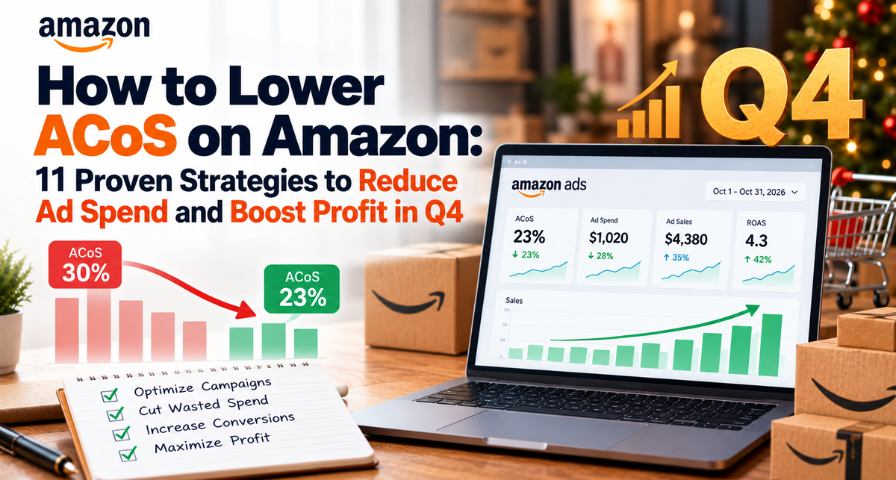
No figure on a seller dashboard instills as much fear as ACoS. Your campaigns are generating orders, sales performance seems strong, and yet your bank account reflects none of the activity. At such times, the natural tendency is to cut down bids across the board and hope that the percentage decreases. It normally does, but just for about a week. Thereafter, impressions decline, rankings slip, and you end up with a lower ACoS and reduced business.
To learn how to reduce ACoS on Amazon without paying a price in terms of lost revenues, it is important to realize that ACoS is an issue of efficiency and not expense. ACoS is total ad expenditure divided by total ad-driven sales, meaning that ACoS can be lowered by decreasing clicks that don’t convert or increasing sales from the clicks you are already paying for. Successful sellers manage to do both in an organized sequence. Here are the eleven strategies below, in that same order, but geared for Q4 when competition and Amazon ad expenses are high.
Why a Lower Number Is Not Always a Better Number
ACoS does not have one good or bad value for everyone. A merchant with a 60% margin will be profitable at 35% ACoS, while the other with a 20% margin will incur losses at 25%. Only when compared to the amount of profit left after selling will ACoS become useful.
However, chasing the lowest number is a risky strategy as well. Advertising drives organic sales velocity and makes customers get acquainted with your brand. When striving to reduce the ACoS to zero, it most likely means that you have already reduced it to a level when growth becomes impossible.
1. Calculate Your Break-Even ACoS First
The first strategy will be an arithmetic one and not a setting. The break-even ACoS is the ratio of the portion of attributed sales that one can use on advertisement before the sales become unprofitable by way of contribution. This is calculated by taking into consideration the cost of the product, Amazon fees, shipping costs, etc. ACoS that are above this figure indicate that advertising is eating up more than the contribution profit generated. It should be understood that contribution profit is not the same as overall profit, as overhead costs are still left out.
Here’s a simple illustration. Let’s assume your product is priced at $30 and gives you $12 worth of contribution profit after accounting for ads. Your break-even ACoS would be 40 percent. At an ACoS of 30 percent, you’d pay $9 in ads per order while earning $3, assuming you haven’t accounted for other costs yet. An ACoS of 25 percent increases that figure to $4.50, which is a 50 percent increase in earnings per order with just a five percent reduction in ACoS. You need to do this on a per-product basis because an expensive product and a low-cost accessory need different ACoS.
2. Audit Your Search Terms
Get the report of your search terms from the last thirty to sixty days, and sort by cost. You'll see search terms that cost you money but did not result in any orders. Some of them will be irrelevant because there is a buyer searching for a different kind of product and using one keyword similar to yours.
The audit also provides you with information about the other side of the coin keywords, which have good conversion rates but are hidden in broad and auto campaigns. These are your winning keywords. Think of the report as a means of finding leaks and generating ideas.
3. Add Negative Keywords Every Week
Negative exact and negative phrase matches tell Amazon to stop showing your ad for the queries you flag. Budget then flows toward searches that earn their keep. Make this a weekly habit, because new wasteful terms keep appearing, especially in broad and auto campaigns.
Often this is the fastest drop in ACoS available, since you are removing spend that had no sales attached at all. Be careful with terms that have only a few clicks. Give a query enough traffic to judge fairly before you block it.
4. Give Every Campaign One Clear Job
By putting your brand terms, competitors, discoverer terms, and your winning keywords together in one campaign, the winners will cover the losers, and your metrics will be averaged out so much that they tell you nothing. Separate them based on their purposes, you will have one for protecting your brand, one for discovering new keywords, one for your winners, and one for competitor listings.
Thus, now you have budgets and targets for each campaign separately. Your campaigns for brands must have a very low ACoS, whereas discovery campaigns have a little bit higher ACoS since the task of this campaign is to discover the winners. And the discovered winners become performance campaigns.
5. Match Types and Keywords That Reflect Buyer Intent
Match types are a scale between reach and precision. Broad matching is helpful to understand what the customers type in their searches, but it is also there that the clicks are irrelevant. Phrase and exact match provide more control. Use broad matches for research at affordable bid prices; later, put the queries that converted into exact match campaigns and bid confidently.
Keywords should be chosen based on the order conversions, not on search volume. A highly searched keyword that doesn’t generate conversions is a costly tool for getting clicks. The long and specific phrases tend to have a higher conversion rate, since the customer knows what he wants and competes with fewer people.
6. Set a Maximum CPC From Your Own Numbers
Your bids should be based on your economics and not just instincts. A good way to estimate is target ACoS times order value times conversion rate. So, with an order value of $30, target ACoS of 25 percent, and conversion rate of 10 percent, your estimate would be $0.75 per click.
This is just a starting point to get a benchmark bid. Your CPC and ACoS would actually vary depending on the conversion rate at the keyword level, order value, and the level of bidding competition. Performance reviews should be done for each search term, and then adjust your bids as data comes in. This is where conversion really pays back twice, because a high conversion rate means more money you could spend per click.
7. Use Placements and Dynamic Bidding Wisely
After waste is cleaned up and the structure is solid, the time has come for bid optimization. Most advertisers start here, but that’s incorrect, since tweaking bids on a flawed account just adds gloss to ineffectiveness.
Study the placement report. The top of search results, the product page, and everything else converts at different rates, so you can increase bids where ROI is high and let the poor performance be. As far as dynamic bid adjustment goes, decreasing bids based on low chances of conversion is a good strategy for efficient ad campaigns. Increase bids only when you have good keywords that benefit from being first.
8. Schedule Spend With Dayparting, Within Its Limits
If orders cluster at certain hours or days, concentrating budget there makes sense, and the effect matters in Q4 when shopping patterns shift around sale events. Budgets that run out by early afternoon can mean missing your best buying hours entirely.
There are limits, though. Not every campaign type supports native hourly scheduling, so implementation depends on the controls Amazon currently offers, budget rules, or compatible third-party tools. Hourly data is also noisy. Make sure you have enough orders to see a real pattern before reshaping spend around it, and do not assume your own habits match your customers’.
9. Fix the Listing So Clicks Turn Into Orders
Every ACoS number includes a hidden conversion rate. When 100 people click and 2 purchase, you have paid for 98 non-converters. You double your number of purchasers, and your ACoS cuts in half without changing your bids. That is frequently the most powerful option open to you, and you get an increase in your organic sales as well.
Ask yourself how an ACoS skeptic would see your listing. Does your image do an immediate job of describing your product? Do your other images give scale and answer questions? Are your bullets benefit-driven? Is your rating/review performance competitive on the search results page? Price is important too, because if you are noticeably higher than other similar products, your conversion will be inhibited no matter how strong the advertisement. Special offers can seal the deal for uncertain customers, but balance that against profit margin.
10. Keep Your Catalog Healthy and Stock Available
Advertising products when there is not much left in stock or the product is suppressed or is not winning the buy box is just a waste of money since the potential customers are clicking but cannot or do not want to purchase.
It is important to verify that the stock is available before increasing the budget and also verify that the listing is qualified and the price has remained constant.
11. Judge Progress With TACoS, Not ACoS Alone
Comparison between TACoS and ACoS is what helps keep you grounded. TACoS splits ad cost by total revenue, which includes both organic and paid sales, to help you see if the ads are creating a sustainable business which is selling more without any further advertising efforts. Increased ACoS is absolutely fine if your TACoS is decreasing due to growth in organic sales. An acceptable ACoS combined with stagnant revenue might indicate that you are just tapping into existing demand.
Monitor both at the same time every month. Effective Amazon PPC management requires achieving balance between the two.
When a Higher ACoS Is the Right Call
If a new product lacks reviews and ranking, it must have velocity before becoming efficient, and thus operating above break-even for some time may be a purposeful investment. Products that benefit from high frequency of repurchasing can also warrant higher expenses. It all comes down to the fact that the move should be considered a purposeful step, which is controlled and measured in terms of time. High ACoS that was chosen consciously is an investment, whereas an accidental one is leakage.
A Realistic 30-Day Plan for Q4
In week one, get break-even ACoS for your primary products, conduct a search term audit, and implement the first round of negatives. In week two, reorganize campaigns by type and move your proven converters to exact match. In week three, set benchmarks for CPC, examine placements, and change schedules based on solid data. In week four, optimize listings for your biggest spenders.
Make sure that the regular optimization process does not coincide with major shopping holidays. Prior to Black Friday/Cyber Monday period, focus on the availability of products, proven converting campaigns, and the budget required to capitalize on the profitable opportunity. It is recommended not to make any major changes prior to the event, as it will be impossible to evaluate their success.
By the end of the month, compare the current results with the initial benchmark. Examine ACoS, TACoS, CPC, conversion rate, total sales, and contribution profit simultaneously. Take into account attribution delay and any changes in product price, promotion, and inventory when making conclusions about your changes. The purpose is not only to reduce ACoS but also to optimize advertising costs efficiently without giving up profitable sales.
Final Thoughts: Spend Smarter, Not Smaller
What is essential to know about reducing ACoS on Amazon is that ACoS is the consequence of the efforts, and not something that can be used. It can be reduced through eliminating wastefulness, improving the targeting, and motivating the visitors to buy once they get to the listings. The reduction in advertising budget does nothing towards these aims and normally implies that all previous gains are being lost.
Spend just one hour this week analyzing the break-even point and reviewing the latest search terms report, and you will know much more about future profitability than by checking the dashboard average.
Ready to Grow on Amazon?
Let our experts help you scale your Amazon business with proven strategies.
Get a Free Consultation