How Many Amazon Reviews Do You Really Need to Increase Sales?
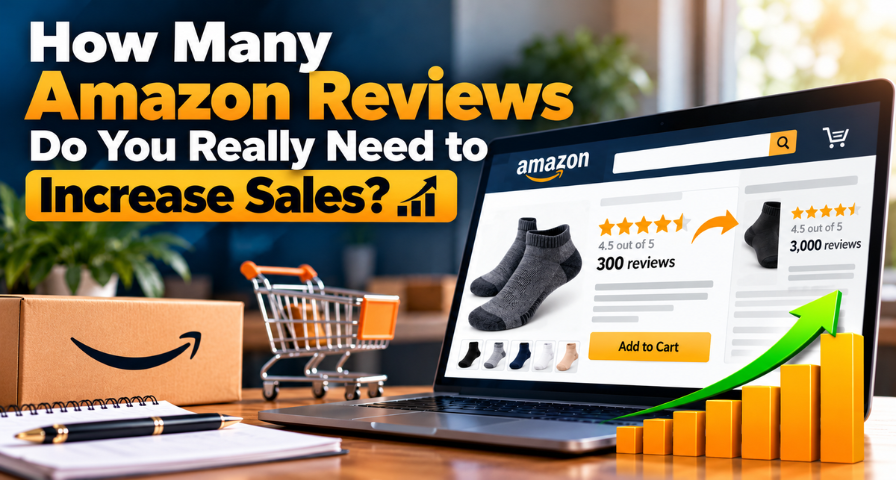
The 3,000-Review Trap
Almost all sellers have experienced this. You search the top ranking for your main keyword and see a number that makes you feel sick: 3,000 reviews or even more. Your product has just 40. The difference seems insurmountable, and the logical step you need to take is to bridge the gap and start selling.
This step will cost you dearly, and it is usually wrong. Sellers who try to compete against the total number of reviews their competitors have end up spending too much on launch strategy, missing their chance to release a profit-making product or abandoning a winning category entirely. Instead, the right question is not how many reviews the competitor has on Amazon. The right question is how many reviews the customers of your own listing should see before making a purchase.
This change of perspective was suggested by Liran Hirschkorn, Incrementum Digital CEO, and Vanessa Hung, Online Seller Solutions founder, who are both members of the Billion Dollar Sellers community. Liran used numbers and measurements. Vanessa highlighted a brand new Amazon function that could shorten the distance between a seller and his target. Here is how I understood their concepts and several caveats to be aware of.
Why Review Count Is Only Part of the Picture
Consider how you evaluate products when both appear similar to each other. Most likely, you won’t compare the number of reviews and go with the larger one. Rather, you will look at the rating and read a couple of reviews trying to understand whether the product is genuine. Your inner question will be much more like “does this look real?” rather than “which one is bigger?”
This is precisely the idea behind social proof. A product that got a decent rating and a good number of reviews shows that lots of people bought, tried, and for the most part liked it. There comes a point after which new reviews just increase trust marginally but don’t actually change many decisions. The problem is where that point is located, and it’s different each time depending on such factors as price, complexity of the product, how scary it is to make a wrong choice, brand reputation, and competitiveness of other listings.
Thus, “a couple hundred” can be seen as a hypothesis that needs to be tested in your category, but not as a rule. The key point is that you have a target you can research and plan for instead of just having a figure determined by the oldest competitor.
The Review Growth Math
Liran’s launch arithmetic explains why the target becomes very important. Let’s consider an example in which the time period is a month. When launching a product initially, every single sale is done through ads since you don’t have any organic ranking at all. Let’s assume that you have spent $50,000 per month on advertisements while having a $40 product with an ROAS of 1.0 per ad. This leads us to 1,250 units sold per month.
Let’s note that we do not speak about profitability here since ROAS is the ratio of sales to ad spend. There are still some other expenses, such as product cost, Amazon fees, and fulfillment fees, which will be included in the revenue.
Moreover, there are some people who simply won't leave their reviews after purchasing your product. Let's assume that the review rate is 5% (the standard rate). In this case, with the number of sales equal to 1,250 per month, we will have 60 reviews. Thus, to have 300 reviews starting from scratch, one will need five months. However, in order to have the same number of reviews as your competitor (3,000), one will need 50 months.
Same spend, same product, same effort, and a completely different timeline. Five months is a launch plan. Four years is a bet that your competitor stands still, the market holds steady, and your cash lasts. The numbers are illustrative, and your own ad efficiency and review rate will differ, but the lesson holds: the size of the target drives the length of the climb.
How to Estimate Your Own Review Target
If the right number depends on your category and your shoppers, you need a way to find it. Your Amazon account already holds two useful sources of evidence, and a third option exists for brand new listings.
Comparing Click Share to Purchase Share
If you have registered yourself under the brand registry, log into Search Query Performance in Brand Analytics and set the ASIN view. Choose the top five searches of yours that do not include the name of your brand. See the difference between the ratio of your brand clicks vs. your brand sales for each of those top searches. Ignore any search that includes your brand name since these customers are already convinced.
If the ratio of your sales and your brand clicks seems to be the same, it means that the people who have reached your product page have bought the item according to their clicks. It is a good sign for you but doesn't indicate that reviews are responsible for it. If your sales ratio is much lower than clicks, for example, 10% clicks with 4% sales, it means that the customers have looked and opted for other brands.
Here is where I want to be careful. This report tells you where to investigate, not what caused the gap. Reviews may be part of it, but so may your rating, price, main image, delivery promise, or how well the listing matches the search. Run the search yourself and place the listings side by side. Look at what the winners offer that you do not before deciding the answer is more reviews.
Reading Conversion Across Your Own Catalog
For those selling more than one item, take the Detail Page Sales and Traffic by Child Item report from Business Reports in the last month when no special deals took place, as promotions affect conversion rates. Concentrate on the Unit Session Percentage measure while choosing the one without the B2B suffix.
Choose some similar products with different numbers of reviews, for instance, 80, 250, and 600 reviews. When you see the increase and then the leveling off of conversion, the point when it becomes stable is an estimate of the amount of social proof your customers need. This can be viewed as a trend to test, not a rule. See if it works with different products and different periods of time, and remember that these products may be different besides the number of reviews. The reports seem to be relocated to Custom Analytics by the end of this year.
Starting Point for a New Listing
A new listing has no history to analyze, so borrow a benchmark. Run your three main searches, note the review counts on the first ten results for each, and take the middle number. It is a provisional target grounded in what shoppers in your category currently accept, rather than in the single biggest outlier on the page.
Reading the Evidence Without Jumping to Conclusions
After obtaining data, its interpretation is as important as the process of gathering it. In case you have low reviews but a high conversion rate, you should not seek to increase the number of reviews since it is obvious from the statistics that customers feel at ease. In case clicks are good but purchases are poor, it is necessary to compare ratings, pricing, pictures, delivery time, and content of your reviews before saying anything. If similar items have better conversion with an increase in reviews, it is necessary to notice the same trend on other similar listings.
On the contrary, in case you have many reviews but your conversion rate does not improve, the issue might be in other things, like frequent complaints about sizes and quality, incorrect pricing, or overrating of the item.
Amazon Review Requests: A New Way to Build Social Proof
Knowing your number is half the battle. The second half of the battle is getting there fast, and here Vanessa Hung has indicated a new path forward for Amazon. They have launched review requests, which are currently in open beta in the United States.
How does it work? If you are a verified buyer who has recently bought a product, you may see a prompt while browsing on Amazon. You can rate it with just one click and provide additional text, images, or videos. Since the prompt shows up during the shopping experience rather than in an email that can stay unread forever, it requires virtually no effort from the customer.
During the initial closed tests that Amazon conducted, the products received three times more ratings and reviews per week. This data was provided by Amazon, so take it for what it is encouragement rather than a promise. It may depend on category, price point, and the type of customers that you are selling to. What else you should know is that the reviews generated by the prompt show up on your detail page.
The campaign goes through Amazon Ads Agent and utilizes bid and budget limits familiar to all sellers. The campaign stops automatically when the product accumulates 1,000 ratings and reviews; therefore, we can deduce the target audience from that it will be products that already sell well but have not accumulated enough trust yet.
Let us multiply the threefold figure in our initial example. 60 reviews per month will be around 180 now, and it will take less than two months to get to 300 reviews instead of five months. It certainly would be a significant change in your finances and risks. However, let us look at the economics of this venture objectively. First of all, this is a paid campaign that cannot influence customer reviews directly and cannot guarantee an increase in ratings or even conversion rate and the efficiency of advertising campaigns. Before starting it on a massive scale, measure the cost of the campaign, the amount of additional reviews, the dynamics of the average rating, and conversion rate changes.
Choosing the Right Tool for the Stage
There may be a temptation to see all review strategies as equal, but there is an appropriate time for each strategy. Vine at Amazon is a review strategy where a new, eligible listing gets its first social proofs through early reviews from credible reviewers. Review Request will work well once sales are happening and there is an ongoing flow of verified customers.
That does not mean that this will be an exact approach for any product that you have. There are certain conditions that should be met for Vine and it is up to you to consider what you have in terms of your inventory and your margins. No matter which strategies you choose, they will work well when you promote a product that is capable of satisfying customers with proper listing and reasonable price.
A Better Way to Set Your Review Goal
The key takeaway is a paradigm shift in terms of how you think about your competition. Forget about comparing yourself to the largest listing in the category, compare yourself to the point where your customers feel comfortable buying the product from you. In some categories, it may prove to be just a couple hundred reviews; in others, significantly more. There is only one way to find out – analyze your own metrics.
This week, calculate the share of clicks versus the share of purchases for the top five non-branded searches, as well as the conversion rate versus the number of reviews if you have several different products on the listings. If you have a new listing, determine the median number of reviews for the top three searches for the product. Based on the data you get, come up with an estimated goal and apply the math to determine how many months/years it will take given the rate of increase in both spending and number of reviews per month. If you operate in the US and have a selling product with no social proof, try out review requests. Do not listen to the headlines, let the numbers speak for themselves.
In reality, however, the seller looking at 3,000 reviews is probably tackling the wrong issue. This is the right approach it is more precise, quantifiable, and solvable: Find the number you need to sell, develop a plan based on that, and set a time frame for yourself of months rather than years.
Ready to Grow on Amazon?
Let our experts help you scale your Amazon business with proven strategies.
Get a Free Consultation
Comments (0)
Leave a Comment