How Amazon's Latest Updates Are Helping Sellers Reduce Returns on Amazon and Protect Their Margins
Every year, as they prepare for their annual Prime Day event, the sellers have the same mentality: Sell as much as possible, as quickly as possible. It is understandable, considering the fact that Prime Day is one of the only times in the year where traffic, visibility, and buying intent are all combined into one. However, any seller who has been on Amazon for longer than a couple of seasons understands that the story is far from over after the sale is done.
That's the part of the Prime Day playbook that doesn't get nearly enough attention. A spike in orders almost always brings a spike in refund requests, customer service tickets, and unexpected costs that quietly eat into the profit a seller thought they'd locked in. Reducing returns on Amazon isn't a side task anymore. It's becoming a core part of how profitable sellers approach Amazon returns management overall, and the latest CSBA updates make that easier than it used to be.
Why Returns Spike Right After the Sale Ends
There's a predictable rhythm to big shopping events, and it has nothing to do with product quality. When people shop during a high-energy event like Prime Day, they buy differently. They order two sizes of the same item planning to return one. They make impulse purchases they later second-guess. They buy gifts without checking sizing charts closely enough. None of this is unusual, but multiplied across thousands of orders, it adds up to a return rate that's noticeably higher than a normal sales week.
For sellers, this means that the time right after Prime Day becomes the busiest time for customer service, rather than the day of the event. Complaints, refunds, and “where’s my order” messages start coming in just when sellers are trying to recover from the onslaught of order processing. If sellers fail to pay attention to this critical period, they will never know what causes their returns, and thus small issues become big issues.
A Tighter Definition of When Refunds Without Returns Make Sense
One of the more meaningful shifts in Amazon's approach involves returnless refunds, the practice of refunding a customer without requiring the product back. In the past, this happened more loosely than many sellers were comfortable with. These days, Amazon has tightened the requirements quite a bit to include only those that qualify, which include late deliveries, packages that cannot be shipped back due to being damaged, or items that would not be safe to return.
This matters more than it might first appear. Every unnecessary returnless refund is essentially a customer keeping a product for free while the seller eats the cost. Tightening this process is one of the more direct ways Amazon has helped sellers reduce their Amazon refund rate, and it cuts down on the number of SAFE-T claims sellers need to file just to recover money that shouldn't have been lost in the first place. During a high-volume window like Prime Day, when refund activity naturally climbs, this kind of guardrail has a real effect on the bottom line.
Reimbursements That Happen Without Anyone Having to Ask
If there's one thing that drains time during a busy sales period, it's paperwork. Filing claims, tracking reimbursement status, and following up on cases that seem to stall indefinitely is the kind of administrative grind that pulls attention away from actually running the business. Amazon has addressed part of this by automating reimbursements for eligible delivery-related claims, specifically for sellers using protected shipping labels through Amazon's Buy Shipping or Veeqo. Goodwill refunds that Amazon's own customer service team issues are now reimbursed automatically as well.
It's a small operational change with an outsized impact for sellers moving high volumes of orders. Multiply a few minutes saved per claim across thousands of Prime Day transactions, and the time savings start to look like real money. More importantly, it removes one more place where a seller could lose revenue simply because nobody had the bandwidth to chase down a reimbursement.
Not Every Return Needs to Be a Return
One thing that is often overlooked by newer sellers is the fact that not every returned product should be put back in stock again. The costs associated with shipping back the product, inspecting it, restocking it, and possibly disposing of it will often exceed the value of the product itself. This is where the FBA Returnless Resolution program by Amazon becomes useful.
Through the use of this program, sellers have the ability to set up a returnless resolution threshold ranging from $1 to $75 for certain FBA products. In case a customer returns an eligible product that costs less than the threshold, Amazon is able to issue a refund to the buyer while allowing the customer to keep the item without having to ship the product back. There are a number of exclusions to the program, namely hazardous materials, recalled items, gift cards, oversized products, and those costing more than $75.
The key difference between this and the returnless refund issue mentioned earlier is intent. One change is about preventing refunds that shouldn't happen. This program is about giving sellers the choice to make a returnless outcome happen on purpose when the math clearly favors it. Used strategically, especially heading into a high-return period like the weeks after Prime Day, it can meaningfully protect margin on the kinds of low-cost items that would otherwise cost more to process than they're worth.
Letting Customer Data Do the Heavy Lifting
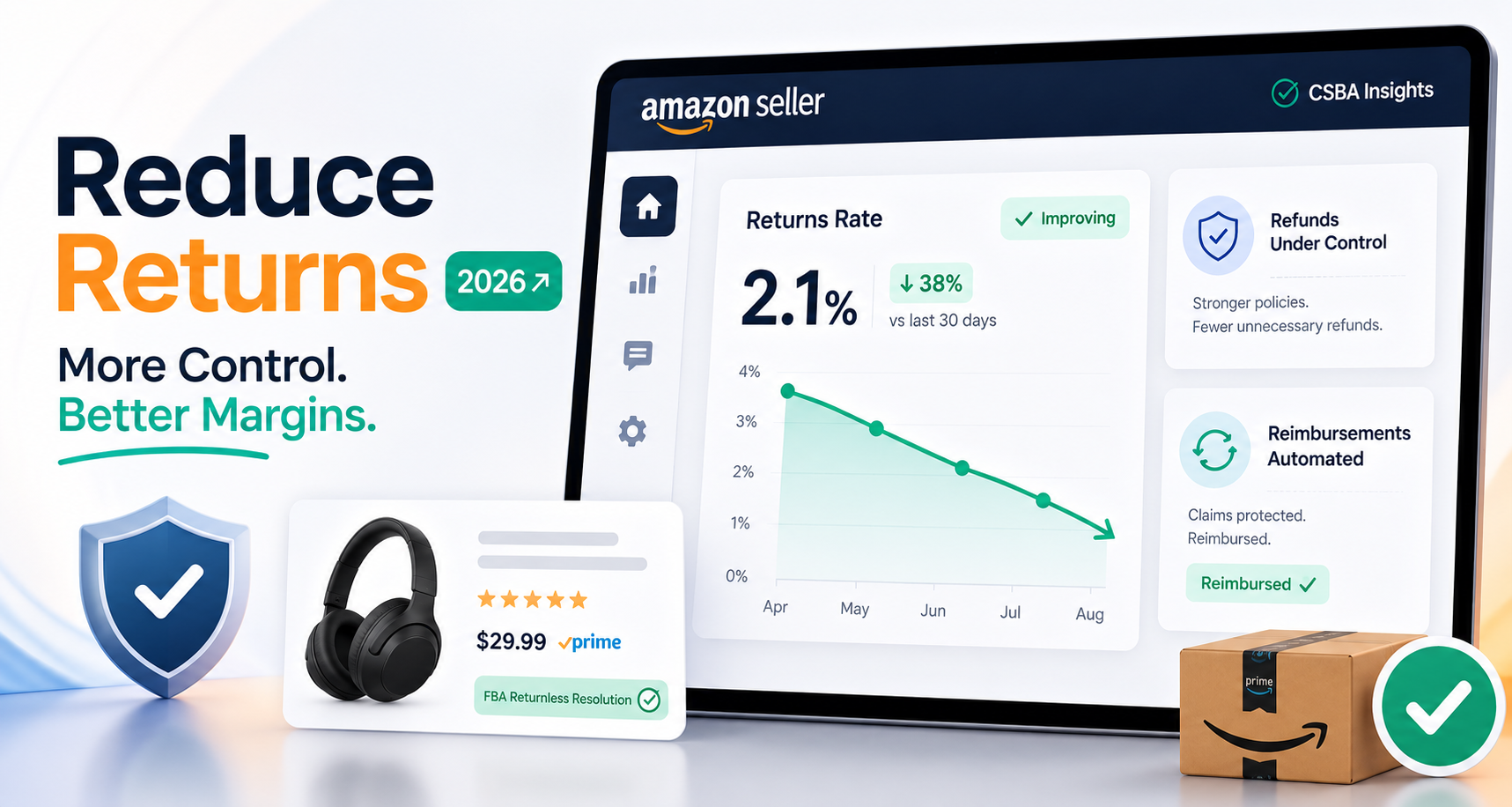
The least used tool of this update, probably, is the CSBA Insights Dashboard, which includes improvements regarding the better understanding of the reasons why customers contact you and how often they do it. Amazon uses AI to explain the reasons of customer requests in more detail than a common "return reason." Combined with the tracking of the contacts made per each product unit, it gives sellers an opportunity to see the trends regarding their products and identify such issues as misleading product descriptions, photos without proper scaling, damaged packages, and any other quality issue.
Here we can speak about switching the efforts of decreasing the returns on Amazon from a reactive strategy to a preventive one. In many cases, the cause of the return does not lie in the product itself but rather in its description, photos, or any other information provided in the listing. If customers' expectations do not meet the product characteristics, the return will be requested automatically. In order to prevent this type of return, a seller should identify the issues in his listings, such as misleading size charts, photos without scaling, and overselling features in the description, and fix them.
What This Means Heading Into Prime Day and Beyond
All of the above changes do not completely exclude returns. That is not their purpose. Returns are just one of the inevitable features of sales. What they help to achieve is better control over returns by sellers, automation of all the boring paperwork, and getting valuable information about the reasons why such things happen. It is this combination that differentiates those sellers for whom returns are an unfortunate but unavoidable reality from those for whom it is not.
The change required from sellers is not operational. It is a change in mindset. It is not "How can we sell more during Prime Day?" The smarter question is "How can we retain more of what we sell?" Those sellers who know how to optimally optimize their listings, actively monitor the insights offered by CSBA, make good use of FBA returnless resolution, and understand the changes made in the refund policy by Amazon have already developed the necessary approach to their business.
Sellers who will succeed after Prime Day will not be those who sold more. They will be those who retained more of what they sold.
Ready to Grow on Amazon?
Let our experts help you scale your Amazon business with proven strategies.
Get a Free Consultation