High-Ticket vs. Low-Ticket Products: Which Is Better for Amazon Sellers?
The Choice That Shapes Everything Else
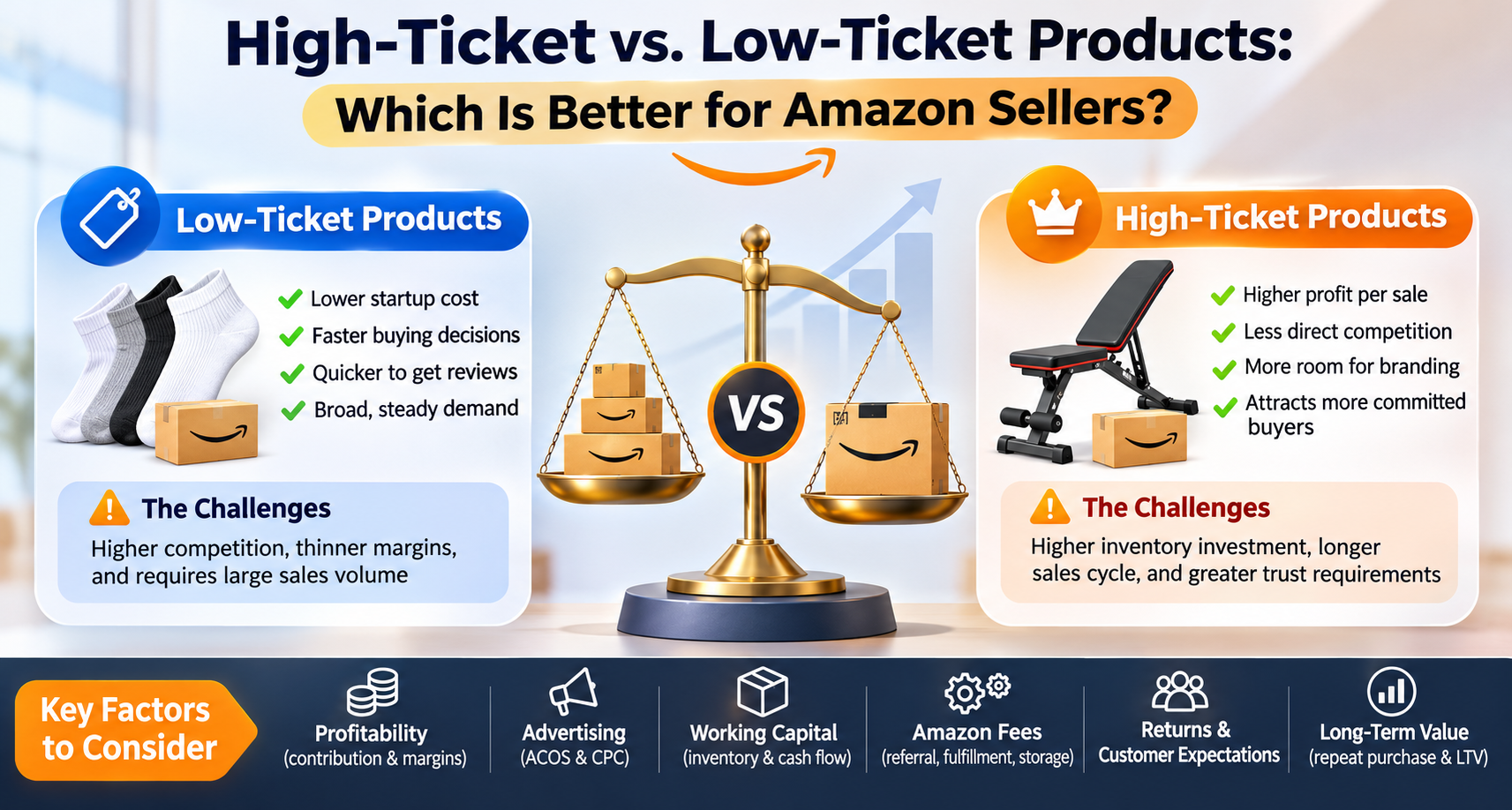
Even before you select your supplier, design your logo, or write your first bullet point on the listing, you already make a decision that controls practically everything else about the product: how much it costs. The debate on whether to pursue high-ticket or low-ticket products seems to be a question of price, but in truth, it is a question of risk, of finance, of marketing, of customer psychology, and of logistics.
Almost all of the sellers experience the same emotions when making this decision. There is one seller who sees a product priced at $12 selling several hundred units per day and thinks that the trick is in the volumes. There is another seller seeing a product selling for $199 that brings in profits from each sale and thinks that the trick is in the margins. But they see one figure and ignore the rest.
What High-Ticket and Low-Ticket Products Really Mean
There is no definitive line drawn between the two. Generally speaking, any item costing less than about $25 is considered low ticket, whereas any costing more than about $75 or $100 is seen as a high ticket item; however, these figures are only approximate and vary from one category to the next. A $40 yoga mat is a pricey item within its own category, but a $40 camera accessory is a bargain.
The real distinction lies in consumer behavior. A low-ticket purchase generally is one that requires little deliberation on the part of the customer. The buyer looks through a few items, sees the star ratings, and purchases the item. On the other hand, a high-ticket purchase involves a great deal of consumer research. The customer reads reviews and carefully examines the product photos before even deciding to come back another day after leaving the site.
Why a Higher Price Does Not Guarantee Higher Profit
The biggest confusion lies in revenue vs. profit. In order to compare fairly, all margins discussed in this post will be considered pre-ads but post-product costs, inbound logistics, referral fees, fulfillment, and storage. I will refer to this metric as contribution pre-ads.
Let me take two examples, hypothetical rather than based on any actual market figures. A bundle of six pairs of socks goes for $20. The landed cost is $6, the referral fee comes in at around $3, fulfillment is at $4.5, and storage and minor expenses are at $0.5, which leaves us with a contribution of $6, or 30%. An adjustable high-end fitness bench costs $200. The landed cost with the freight is $95, the referral fee – $30, bulky fulfillment is $28, and storage is $5, which gives us $42, or 21%. The bench gives us seven times the income per order, however, we need significantly more investment per item sold and significantly higher customer acquisition costs. Contribution per item is one side of the coin, while capital needed to earn it is the other side.
The Appeal and the Trap of Low-Ticket Products
There are advantages in selling inexpensive goods. Order volume is small, so any mistake in product selection will lead to a loss of a few thousand dollars but not of tens of thousands. The speed of decision makes sure that your new listing will be approved quickly enough. There is always some stable demand for kitchenware, pets' accessories, and socks.
What makes this strategy problematic is that exactly the same attributes will attract numerous other competitors. Very competitive keywords make it possible to sell at a reduced price, and whoever manages to squeeze the smallest margin from his product wins. Moreover, there are expenses that become significantly bigger with low prices. Fees for shipping and storage are independent of prices set for your order, and a product that costs $12 becomes pretty worthless after your first ad click.
What High-Ticket Products Demand in Return
With the increase in price comes another cost, and trust is its key component. A customer who invests $200 in a product needs evidence, meaning high-quality images, videos, comprehensive A+ content, comparison, and a credible review profile. Several reviews can be enough to purchase a $10 item, but not a $180 appliance.
Expectations become higher with the increase in price as well. Minor defects in the inexpensive item can be forgiven, but an expensive item is expected to arrive in perfect condition and work without any problems. Requirements become bigger, and one bad review can have a greater impact since customers read fewer listing items. However, the bonus is that competition is lower as well, as not all sellers are ready to take risks and invest money.
Advertising Changes the Math: Break-Even ACOS and CPC
PPC experience is critical in this case, since the ad spending may tip the scales. The two simple formulas demonstrate the point clearly. The break-even ACOS is the contribution without ads divided by selling price, and the break-even CPC is the contribution without ads times the conversion rate.
Let's apply these formulas to the socks: the contribution of $6 on the price of $20 would yield the break-even ACOS of 30 percent. With a conversion rate of 10 percent, the break-even CPC would be $0.60. When one click in the competitive keyword is $1.00, then each sale will incur losses for the first order, unless the conversion ratio rises or the organic ranking takes some share of the burden. Let us move on to the bench example: the contribution of $42 on price of $200 yields the break-even ACOS of 21 percent, which sounds like a tight ratio. However, at the conversion rate of 5 percent, the break-even CPC is $2.10, and thus it can afford to pay more for the click than socks.
Which Product Uses Your Working Capital Better?
The silent judge in this discussion is working capital. Inventories are cash parked until the customer purchases them and Amazon pays the amount. The purchase of an order of 1,000 multipacks of socks at $6 makes the cost at $6,000, whereas 100 benches of $95 each will incur a cost of $9,500. A person with $10,000 of working capital can purchase the order of socks, do the necessary changes, and repeat the process. But one order of benches will nearly drain the working capital, leaving nothing in case the listing does not gain attention soon.
Turnaround rate is as important as the purchase price. If the socks get sold in 5 weeks, then your money will be available many times in the year, which can be used further in investments. But if the benches get sold in 4 months, then your money will be blocked for more time along with storage charges.
How Amazon FBA Fees Can Reverse the Pricing Advantage
The fees of Amazon are not proportional to price in a direct manner and thus turn most assumptions upside down. The referral fee is charged according to the price of the product in most of the categories and thus increases when the price goes up. Fulfillment fees depend on the size and weight of the product; hence, the fulfillment fee could take a substantial portion of the cost of a small, light, and cheap product, while a bulky and costly one could take it easily.
The opposite of this is also true, whereby the bulky nature of fulfillment and long storage period took a huge share of the margin; that is the reason for 21 percent being less than 30 percent. Amazon's fee schedules are updated from time to time and therefore, use Amazon fee calculator to calculate the fees before ordering.
Inventory Risk, Returns, and Customer Expectations
Returns can be defined as the place where the optimism in spreadsheets comes to an end. For instance, assume that a particular bench has a 10 percent return ratio, with each of those returns costing around $40, depending on the costs involved with processing, damaged items, and unsaleable items. This amounts to about $4 per unit, making the $42 contribution margin amount to around $38 even before taking into account advertising expenses. One defective batch will make all the profit gone.
However, small-ticket items have a completely different set of risks. A loss of one dollar per unit does not seem to be much until you consider the quantity involved. Before jumping into the decision-making process, consider what the expected return rate is, the cost incurred per return, the defect rate, the time taken by the inventory before aging penalties, and the lead time involved.
Can a Low-Ticket Product Become a Higher-Value Offer?
Luckily, this is hardly an absolute and eternal dilemma. A supplier of socks can switch from selling single pairs to bundles or multiples of six pairs and twelve pairs, can increase the quality of material used, improve packaging, or offer special varieties for running, work, or gift-giving. Bundles and multiples increase the value of purchase and amortize the fixed costs on fulfillment over more units.
But there is one crucial difference here. Increasing prices does not mean increasing the perceived value. Customers must have some rational reason to justify paying higher prices, be it better quality materials, additional features that their competition does not have, or the right kind of packaging to make it a gift. If you have a solid justification, you will get pricing power, you will maintain your margin, and you will avoid direct price war.
Repeat Purchases and Customer Lifetime Value
It’s not necessarily the first purchase where one needs to evaluate the product. Multipacks of socks are a natural recurring sale since the client who bought them today will come back in a few months to buy them again. In case the advertisement cost of the first purchase is higher than the contribution, the product will eventually become profitable because of the following sales and increased organic visibility.
High-cost products are not as recurrent as low-cost ones but still have a chance to offer some additional benefits. The client who purchased a bench from you might need to change pads and resistance bands or buy other products within the same collection. Make sure that your product can create a recurring demand, help you sell something more, or even build a whole collection around itself.
A Practical Framework for Choosing the Right Product
Begin with capital. When the initial amount of funds is small, then a cheaper product with a lower niche saturation is preferred, because it allows you to learn the Amazon dynamics and accumulate reviews without the risk of catastrophic failure. If you have decent capital and would like to make fewer, but more substantial investments, then a more expensive product can give better unit economics and less competition, if you will be able to allocate enough resources to its promotion.
Then take into account your advantages. Good PPC expertise, supplier connections, and strong branding skills can serve well under both approaches. Inability to keep a large quantity of goods in the warehouse can be an argument for a smaller-sized product irrespective of price level. Inability to accept losses on a large scale of financial investment can be a reason for preferring the lower price product. There is one condition which should be taken into consideration primarily: low ticket does not mean low risks, and high ticket does not necessarily mean profits.
How to Compare Product Opportunities Using SellerSprite
Opinions come in abundance, but it is always the facts that speak the truth. With the help of some research tool like SellerSprite (Helium 10 and Jungle Scout can be used as well), one is able to estimate the level of demand, prices, number of reviews among the top players, and the degree of concentration within the niche. Having this information, one is going to know how many reviews his product listing should have in order to compete, what the price range is for sales and whether the top slots are dominated by a few brands.
Having this done, one is going to do his own research with the help of his own spreadsheet and fill it with the information about landed costs, actual fees, realistic return rate, and conversion rate. He is then going to calculate the contribution margin, break-even ACOS, and break-even CPC. Should the calculations be applicable only under the best-case scenario for him, it is most likely that he is dealing with a bad niche.
Final Verdict: Which Model Is Better for Your Amazon Business?
There are no winners here. The low-ticket product favors sellers who like speed, small risk of entry, and opportunity to try lots of things, while the high-ticket product favors sellers who have deep pockets, can afford to be patient, take more risks, and make investments in quality and building trust.
Do not select any product just because it has a price tag of $20 or $200. Rather, select the product whose demand, margins, economics of advertising, and fast turn of stock allow you to build the sustainable business. Start with what you can afford to protect in terms of capital, do the math, and use experience to scale up. There will be lots of products in your life, and the successful sellers usually choose the right product for themselves.
Ready to Grow on Amazon?
Let our experts help you scale your Amazon business with proven strategies.
Get a Free Consultation
Comments (0)
Leave a Comment