Amazon's New Validate a Product Idea Tool Is Quietly Changing How Sellers Launch Products
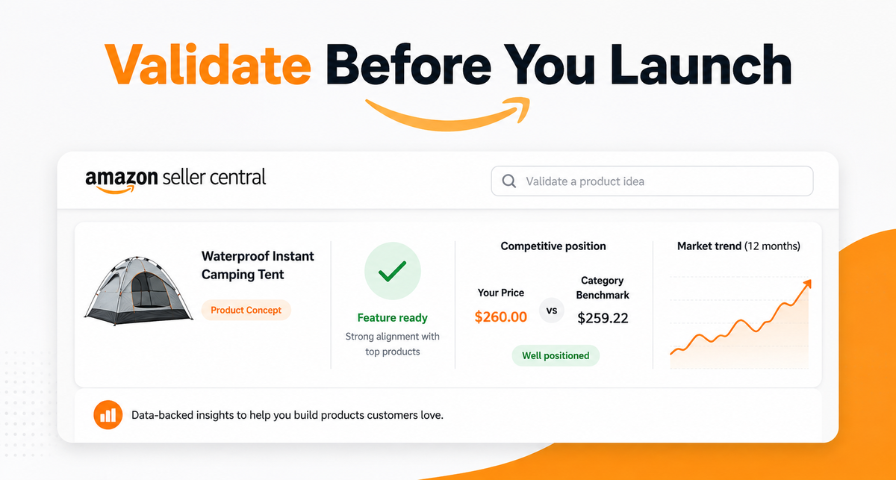
Amazon's newly released Validate a Product Idea tool within the Product Opportunity Explorer has disrupted how sellers conduct product research prior to launching their products. Over the years, Amazon sellers have been forced to piece together information from various third-party tools and even use a lot of guesswork to determine whether a product idea was worthwhile. They would look at competing listings, make assumptions based on review numbers, and hope their prices were good enough. Amazon has done away with a huge amount of the guesswork needed. Within the Product Opportunity Explorer located in Seller Central is the new tool, and it could very well be the most useful addition to Amazon's research tools in a while.
What the Tool Actually Does
The concept is simple on the surface. You type in a product title, a short description, a few bullet points, and your intended price. In return, Amazon analyzes your concept against the actual competitive landscape in that category and tells you where you stand. This isn't a vague "market looks promising" summary. It's a structured breakdown that shows your competitive position on specific attributes, how your feature set compares to what's already selling, and whether your price makes sense given what similar products charge.
One seller ran the tool on a sugar-free electrolyte powder concept priced at $30. The output included a feature-gap analysis showing exactly where the idea trailed competitors (mineral breadth, added vitamins, certifications, and sweetener transparency), a breakdown of which brands dominate the category (with one player, FlavCity, holding 27 percent of market segment share), a customer demographics profile broken out by income bracket, and twelve months of seasonal search and click trend data. It flagged that seven out of ten benchmark listings in that category explicitly name two or more electrolyte minerals in their titles or bullets, something the tested concept was missing. It also confirmed the $30 price point was reasonably close to the category benchmark of $29.22.
How This Compares to Existing Product Research Tools
It does not serve as an alternative to keyword research tools such as Helium 10, Jungle Scout, or Data Dive. They all remain the best choice when it comes to keyword research and competitive analysis. However, in terms of signals, Amazon's tool provides a totally different one, because it gives a more precise picture based on real numbers coming straight from the Amazon marketplace rather than the estimations. The most logical way would be to use the tool as the second opinion in the product research. Perform the research using the same Amazon tools, and test your idea with Validate a Product Idea.
What the Tool Can't Tell You
However, it is important to state the limits of the instrument as well. The instrument considers positioning and alignment of features but does not consider profits from the sale. Landed costs, the cost of advertising, and the risk of carrying the stock, as well as expected profits, will not be calculated by the instrument. The idea may receive a high score according to its readiness of features and customers and yet fail commercially due to unit economics. It is important for the seller to evaluate all of these aspects independently.
A Practical Example of How This Plays Out
Now suppose that you want to release an insulated water bottle. You input the basic details into the algorithm along with a competitive price and find out that there are many aspects that your product listing lacks but which are mentioned in all competing listings, such as materials being BPA-free, having a leak-proof cap, and being dishwasher safe. You add those attributes to the listing bullets and try again. Your feature readiness scores get higher, and now the customer-fit part matches the issues of buyers in this category. This is where the true power of the tool lies – you are developing a listing without producing even one item of your product.
Why Market Share Concentration Matters
When there is a concentration of more than 25% for a brand in one particular category, as we see with FlavCity in electrolytes, then this should be a matter of investigation and not something to overlook. The presence of concentration may indicate loyalty to the brand, product differentiation, or even heavy investments in advertisement, which new entrants will have to replicate. Direct competition with a dominant brand in such a scenario needs heavy budget allocations and a differentiated angle.
Using Seasonal Data to Time Your Launch
The seasonal click trend data does more than show whether demand is rising or falling. It can directly shape your launch timing. If search and click activity consistently peaks in spring, launching inventory in February gives Amazon's algorithm time to build sales history and reviews before demand accelerates. Launching too close to peak season often means missing the window entirely, since new listings need time to rank before the highest-traffic weeks arrive.
Reading the Customer Demographics Correctly
In fact, information about the income brackets is not merely interesting; it can be used for setting prices and developing messages. When most buyers within some category belong to high-income brackets, premium brands and messages focused on the value of products will work better than discount messages. On the contrary, when consumers from some product category are more sensitive to prices, it is better to use good promotions and offer discounts.
Not Just for New Products
This is especially true for existing sellers rather than those introducing something completely new. Categories change continuously, and consumer expectations change in accordance with the changes that competitors introduce, like certification or new components that soon enough become commonplace. Passing your currently selling item through Validate a Product Idea will let you see what new elements your competitor introduced after your initial launch, and which you were unaware of.
Where This Fits Into Amazon's AI Direction
As Amazon continues expanding AI-driven shopping experiences and product recommendations, listings that closely match what customers actually expect in a category are likely to matter even more. Tools like Validate a Product Idea may end up playing a role in preparing listings that align well with how AI systems evaluate and surface products to shoppers, making this less of a one-time launch checklist and more of an ongoing part of listing maintenance.
Where to Find It
This tool is located within Seller Central, under Growth, Product Opportunity Explorer, and then Validate a New Product Idea. It’s not very well marketed, and this might be the reason why not so many sellers know about its existence. Sellers usually manually check other products’ listings before purchasing any new inventory, reading their bullet points, prices, and reviews. This tool does not do that for you but makes the process much faster.
A Shift From Reactive to Preventive Product Development
For a long time now, sellers have been optimizing their listings only after their launch and usually following the discovery of some negative reviews that point out certain deficiencies. But now, Amazon has provided the seller with a way to find out about any deficiency beforehand, even before the actual product manufacturing process begins.
The Bigger Picture for Amazon Sellers
The significance of the development is not in the particular feature but rather in what it means for the future direction of the product research and tools for sellers at Amazon. With its ability to provide first-party purchase and search data in a structured, actionable way, Amazon makes the gap between a product idea and its viability much smaller. This kind of data has been available to the larger brands or through the services that require a considerable amount of money or data science team to be used.
Spend ten minutes validating your product idea before investing thousands of dollars into your inventory. It might be possible that the new feature will not help you find a lot of features to be added to your product idea, however, even a simple validation of your pricing strategy might make the process much easier in case something needs to be adjusted after the release of the product.
Ready to Grow on Amazon?
Let our experts help you scale your Amazon business with proven strategies.
Get a Free Consultation