Amazon's New Business Hour Delivery Requirement: What US Sellers Should Do Before September 2026
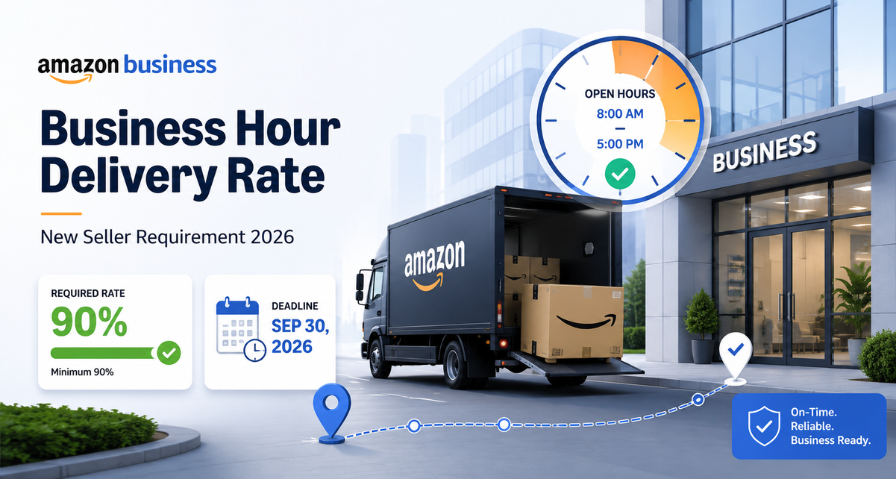
Amazon is tightening the rules around how seller-fulfilled shipments reach its business customers, and the change is worth paying close attention to if you sell in the US store. Beginning on September 30, 2026, sellers will be required to achieve a new Business Hour Delivery Rate, an initiative that is aimed at making delivery through Amazon Business reliable, safe, and in line with actual business hours. This policy change will mean a lot to sellers who greatly depend on Amazon Business for sales.
At its core, the update reflects something fairly intuitive. Business customers operate differently than everyday shoppers. A warehouse, an office, or a medical facility often has a narrow window during which someone is actually available to accept a delivery. Miss that window, and the package either sits with a carrier, goes through repeated re-delivery attempts, or ends up somewhere it shouldn't. Amazon's new requirement is essentially an attempt to close that gap by holding merchant-fulfilled shipping to a measurable standard.
What the Business Hour Delivery Rate Requirement Actually Means
The requirement is built around an existing metric, the Business Hour Delivery Rate, which tracks the percentage of seller-fulfilled orders delivered within a business customer's stated operating hours. This is calculated on a rolling 14-day basis, so it's a moving snapshot rather than a one-time evaluation. Beginning September 30, 2026, sellers will need to maintain a business hour delivery rate of 90% or higher for seller-fulfilled shipments going to Amazon Business customers.
The reason for that 90% criterion is not coincidental. It indicates that Amazon wants to ensure that almost all packages headed for a business would arrive during a predictable period of the working hours, rather than at an uncertain time “during the day” or when the facility would already be closed. Businesses that rely on reliable carriers and reasonable handling and transit times would probably have no problems in meeting this criterion. Businesses that tried to get away with unreliable shipping would have to do some hard work.
Where to Track the Metric
Of course, one thing that will definitely be asked by any seller is where they can actually find this rate before it becomes a problem. The Business Hour Delivery Rate will generally be viewable within Seller Central in either the Account Health section or the Performance section, depending on how Amazon has set up their dashboard at that point in time. Checking this regularly, instead of just when there is a notification, is the best way to ensure that this problem does not become an eligibility problem.
Why Amazon Is Making This Change Now
Nowadays, Amazon Business has turned out to be quite a big player on the market because it operates by providing services for firms that are stricter than individuals in their requirements in receiving packages. Delayed deliveries cause various negative consequences such as leaving packages outside, increasing the risk of package damage and theft, creating inconvenience for procurement officers, and increasing the number of attempts to re-deliver orders. This negatively affects the confidence of clients from business organizations and makes them unwilling to use Amazon services any further.
There's likely a competitive motivation here too. It's reasonable to think Amazon views reliable business deliveries as an important part of strengthening Amazon Business as a procurement platform, one that's meant to compete with traditional B2B suppliers on consistency, not just price. If seller-fulfilled shipments regularly show up outside operating hours, it chips away at that reliability story. A firm delivery rate requirement is Amazon's way of enforcing the standard its business customers expect and, by extension, protecting the credibility of Amazon shipping metrics as a whole.
What Happens If You Fall Short
Amazon has built in a grace period rather than an immediate cutoff, which makes sense given how much this depends on carrier performance and not just seller behavior. If your business hour delivery rate is below 90% as of September 30, 2026, you'll receive a notification along with recommendations for improvement. That gives sellers a full month, until October 30, to course-correct.
If the rate still hasn't improved by that deadline, the consequence is significant. Your seller-fulfilled offers may be deactivated specifically for Amazon Business customers. It's worth being clear about what this does and doesn't touch. Fulfillment by Amazon (FBA) listings and standard retail offer eligibility remain unaffected. This is a targeted enforcement mechanism aimed at seller-fulfilled orders going to business accounts, not a blanket penalty across your entire catalog. Still, for sellers who generate meaningful volume through Amazon Business, losing access to that customer segment isn't something to shrug off.
Practical Steps to Stay Compliant
The good news is that meeting this requirement doesn't require reinventing your fulfillment strategy from scratch. Amazon has been fairly direct about what actually moves the needle, and most of it comes down to precision and reliability rather than complex operational overhauls.
Identifying reliable carriers is the key here. All shipping providers do not provide consistent results in each region and at different times. If you work with a provider who has had problems meeting their timeframes, it is going to be visible on your delivery performance metric pretty fast. If sellers ship nationally, there may be cases when one provider works excellently within cities, while the other does better for suburban or rural deliveries. By analyzing carrier performance by destination instead of giving equal treatment to all deliveries, you can spot certain weaknesses that influence your delivery performance within business hours significantly.
Transit time estimation is equally important. Sellers often provide overly optimistic timelines for their shipments to look faster in the search results and during the checkout process. This is going to create a gap between your promises and deliveries soon enough.
Amazon has also pointed to three specific tools that can help sellers meet this standard with real confidence: Automated Handling Time, Shipping Settings Automation, and Amazon Buy Shipping. What makes these particularly useful is that Amazon has explicitly stated that shipments fulfilled using all three together are guaranteed to meet the business hour delivery rate requirement. That's a meaningful assurance, not a vague suggestion. Automated Handling Time adjusts your processing times based on actual historical performance rather than static estimates you set once and forget about them. Shipping Settings Automation keeps your transit time promises aligned with reality as conditions shift. Amazon Buy Shipping gives sellers access to negotiated carrier rates and integrated tracking, which tends to produce more consistent outcomes than piecing together shipping arrangements independently.
For sellers who haven't explored these tools yet, now is a sensible time to start, well ahead of the September deadline rather than scrambling in the final weeks.
Getting Ahead of the Deadline
The single most sensible step that sellers can take at this time is to look up their business hour delivery rate in Seller Central and consider it a real-time measure as opposed to just an afterthought. The fact that the rate is computed for a rolling period of 14 days makes it a dynamic one that reacts to the seller's carrier choice, handling times accuracy, and ability to automate shipments.
It's also worth reviewing which SKUs or shipments are most frequently sold to Amazon Business customers, since these are the ones directly affected. If a particular product line consistently ships through a slower or less predictable carrier, that's a good starting point for making changes before the deadline puts pressure on the timeline.
Final Thoughts
business hour delivery rate
Ready to Grow on Amazon?
Let our experts help you scale your Amazon business with proven strategies.
Get a Free Consultation