Amazon's New AI Targeting Beta Signals the End of Manual PPC as We Know It
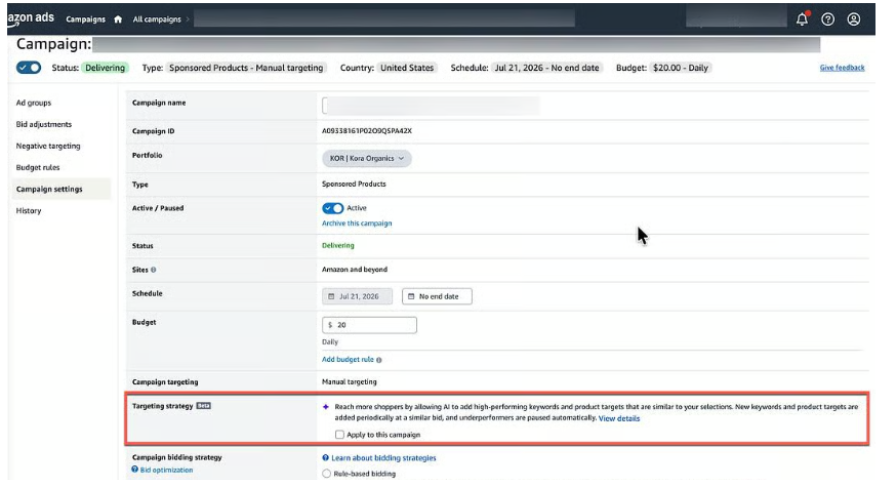
This new feature by Amazon was introduced quite discreetly, and most sellers will simply ignore it while scrolling down. Nestled in the instructions for Sponsored Products campaign setup is a new checkbox called “Targeting strategy” beta. It seems pretty innocent. It is far from that. In one simple click, Amazon has made its most explicit statement yet that Amazon PPC automation is not something that is coming in the future; it is happening in the very console that you are using.
For a long time, sellers who wanted full control over their advertising have used manual campaigns setting up each keyword and target manually and managing the bidding according to intuition and statistics.
What the New Beta Actually Does
The moment when the merchant enables this option, the algorithm from Amazon starts adding up to four new keywords or product targets automatically every 12 to 24 hours. The new keywords have a bid limit of up to the current bid for each keyword. They are determined by two metrics: the targets being targeted in this campaign and trends that Amazon has discovered in similar products' performances.
In simple terms, Amazon is getting involved in the decision-making process of the advertiser when it comes to targeting. It is not just keywords that get added by Amazon; the platform also uses the same system to pause those targets that it finds to be underperforming and even publishes its criteria for such a pause.
These criteria include the absence of impressions within three days, the lack of clicks within seven days, spending more than 15 percent of the daily budget without conversions, or 20+ clicks without a conversion within 14 days. This data is very crucial since it is the real criteria that an AI system uses to choose keywords. Any advertisers who use Sponsored Products campaigns have to pay attention to them.
Why This Is Happening Now
Amazon did not build this feature in isolation. Google's Performance Max already demonstrated, at massive scale, that automated bidding and targeting systems can outperform manually managed campaigns when it comes to raw ad revenue growth. Google proved the model works, and Amazon has been watching the results closely. Amazon Ads has historically lagged behind Google on automation, and this beta is a clear attempt to close that gap.
There is also a straightforward business incentive at play. Every new keyword or product target the AI adds represents another auction opportunity, and every auction is another chance for Amazon to generate ad revenue. The "at or below your current bids" rule is designed to make this feel safe, since it limits how much a seller could overspend on any single click. But that safeguard only caps cost per click. It does nothing to limit how much overall coverage the algorithm expands into, which means total ad spend can still climb even while individual bids stay controlled.
The Training Data Angle Sellers Are Missing
Perhaps the most overlooked part of this rollout is the phrase "performed well for similar products." That single line means Amazon's targeting algorithm learns not just from a seller's own account, but from every other account that opts into the beta. Each campaign that participates becomes a small contribution to a much larger machine learning model, one that improves with every additional data point across the entire marketplace.
This is not unusual in the world of PPC automation and advertising AI, but it is worth sellers understanding clearly. When you opt into a feature like this, you are not simply testing a tool for your own benefit. You are helping train a system that will eventually be used to make decisions for competitors selling similar products in similar categories. The immediate benefit might be a handful of relevant new keywords added automatically. The long term effect is a shift in who actually controls targeting decisions across the entire Amazon advertising algorithm.
Where This Is Realistically Heading
The pattern here is familiar to anyone who has watched platforms roll out automation before. It typically starts as an opt-in beta with visible guardrails, the kind of transparent rules Amazon published around pausing targets. Those guardrails build trust and make the feature feel low risk. Over time, adoption grows, the beta becomes a standard feature, and eventually it becomes the default setting for new campaigns rather than something sellers have to actively choose.
The next logical step is combining this targeting automation with the ROAS-based automated bidding options that already exist inside Amazon's ad console. Once targeting and bidding automation merge into a single system, the manual PPC campaign as sellers currently understand it starts to disappear. What replaces it is a model much closer to Google's Performance Max, where an advertiser essentially hands over a budget and a performance goal, and the algorithm handles targeting, bidding, and optimization from there.
This does not mean manual PPC vanishes overnight. Plenty of sellers, particularly those managing complex catalogs or highly competitive keywords, will continue running fully manual Sponsored Products campaigns for a long time. But the direction of travel is unmistakable. Amazon is building toward a future where automated Amazon advertising is the default path, and manual control becomes the exception rather than the rule.
What Sellers Should Actually Do With This Information
The smartest response to this development is not panic, and it is not blind adoption either. It is an informed observation. Sellers who manage their own Sponsored Products campaigns should test this beta on a small subset of campaigns rather than their entire portfolio. Watching how the algorithm selects new targets, and how quickly it pauses underperforming ones will inform and teach a lot about how Amazon's system actually thinks.
Also, it is important to note that it is advisable to keep track of what AI adds and takes away. The reasons behind pause thresholds, no impressions in three days, no clicks in seven days, 15 percent budget burn without conversions, or 20 clicks without conversions in 14 days are not random. There is a proper decision-making process behind it, and knowing them helps the sellers gain an advantage when automation increases.
The Bigger Picture
While manual PPC is not dead, the writing on the wall cannot be ignored. Amazon Advertising has laid its cards on the table and showed just exactly what logic the algorithm applies in order to increase targeting while reducing spend on underperforming keywords. While this beta version is only a tiny and inconspicuous addition at the moment, it is also a glimpse into what is coming in the next few years of Amazon advertising.
Those sellers who choose to figure out how the algorithm thinks at the moment, instead of disregarding it or automatically checking off a box without understanding the implications, will be well-prepared should the future become automated. It is no longer a question of if AI-powered Amazon PPC automation will come; it is already here, one click away from changing everything.
Ready to Grow on Amazon?
Let our experts help you scale your Amazon business with proven strategies.
Get a Free Consultation
Comments (0)
Leave a Comment