Amazon's Featured Offer Shake-Up: What Sellers Need to Know Before 2026
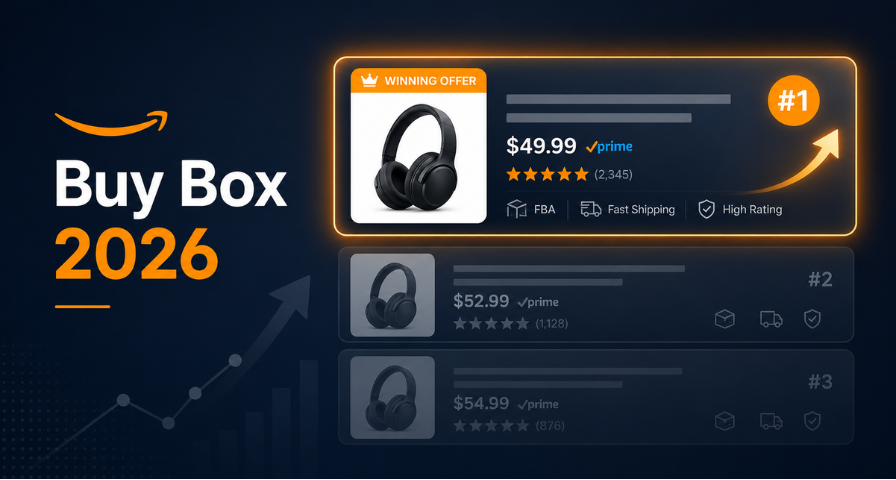
If you do business on Amazon, then you probably know that winning the “Buy Box” (which is now known as the Featured Offer) is critical to your success. The majority of all transactions on the platform go through one single “Add to Cart” button, and for many years now, sellers have been trying to find the secret recipe of how the algorithm works behind the scenes. Amazon has announced the new major update of the requirements to become a Featured Offer, and this update will surely change the playing field for all resellers, wholesalers, and brands out there.
Why Amazon Is Changing the Rules
Amazon’s strategy for some time has been based on a tiered system in which sellers have to pass a performance-based screening (order defect rate, cancellation rate, and account health) prior to being considered candidates for becoming the Featured Offer. Pricing and fulfillment parameters came into consideration only after that step had been made. The system was quite efficient when the market was not as big yet; however, with more third-party sellers entering the game, it became cumbersome and outdated in many aspects. Amazon confirms its decision to abandon this screening process and switch to a ranking-based approach. Rather than being faced with a yes/no challenge, the sellers are evaluated on the basis of a range of factors measured at once. Not only does it become a question of efficiency, it also represents Amazon’s intentions to make the whole customer experience as reliable as possible.
Price Still Rules, But It's Not the Whole Story
Let's be clear about one thing: competitive pricing remains the single most important lever in this new system. If your price is noticeably higher than a comparable offer from another seller, no amount of positive feedback or fast shipping is going to save you. That part hasn't changed, and honestly, it was never going to. Amazon's entire business model depends on being able to promise shoppers a strong deal, so pricing will always sit at the top of the hierarchy. What's different now is how much weight the secondary factors carry once pricing is roughly in the same ballpark. In the old system, sellers who cleared the performance screen were often competing almost entirely on price after that point. Under the new ranking model, the gap between a merely acceptable seller and an excellent one is likely to show up more clearly in where they land for the Featured Offer, even when prices are close.
Fulfillment by Amazon Is Becoming Harder to Ignore
One of the most obvious updates here is the ongoing preference for the fulfillment approach called "Fulfilled by Amazon." The thing is that the seller who uses such a method of fulfillment benefits from having the product shipped faster and more consistently as compared to the products delivered from other vendors. Thus, the sellers who have not abandoned the Fulfilled by Merchant fulfillment option should take the update mentioned above seriously. It does not mean that the FBM option has become useless. The merchants who deliver their goods in time and have positive feedback can still cope with the problem. However, there is no room left for mistakes anymore. The policy update discussed above is, in my opinion, rather a good reason to shift some of the product range into the Amazon fulfillment network if you use both options now.
Stock Consistency and Feedback Ratings Carry More Weight
Apart from pricing and fulfillment, there are increased efforts being made by Amazon towards ensuring consistency in inventory and positive feedback from the sellers. This makes perfect sense when viewed from the perspective of the consumer. There is nothing more frustrating to the customer than seeing that the item he or she clicked the "buy" button on has run out of stock or working with a slow-responding seller, one who ships broken products or does not know how to handle return processes. Sellers who manage to keep consistent inventory levels, do not have stock-outs, and maintain high feedback will surely benefit from the increase in how often they get the Featured Offer spot. Now is the right time for the sellers to audit themselves. Those whose inventory strategies are reactive and not proactive, or those whose feedback scores have been slowly sliding away due to the delays in shipping or poor quality of the items, should consider doing something about it.
Reading Between the Lines: Where Authorized Resellers Might Fit In
It’s good to note the difference between what Amazon has confirmed and what the sellers think about it. What Amazon has confirmed so far includes the removal of the previous performance-based screening stage, the introduction of the ranking method, and the focus on customer experience. Amazon hasn’t made a statement yet regarding any new policy on giving preference to brand-authorized resellers in the calculation of Featured Offers. However, one can draw a conclusion about this situation. As it was mentioned above, the company constantly stresses the importance of consumer trust, authentic products, and high-quality fulfillment services. In turn, brand-authorized resellers usually do better than others at these criteria, thus, their positions may improve due to the change in the ranking algorithm over time. This statement is not confirmed yet, but it’s a possible interpretation that is widely acknowledged by sellers and consultants who study this issue. Nevertheless, it is important for independent resellers and wholesalers who are engaged in arbitrage. If ranking starts favoring those qualities that are typical for brand-authorized sellers, then it might be worth thinking about establishing the partnership with the manufacturers of the goods sold.
Preparing for a 2026 Transition
Amazon has said that the process will end in full by 2026, and it’s a fair amount of time for sellers to adjust without being endless. What sellers should do right now is regard this as a period of planning and not as a far-off deadline. First of all, evaluate your fulfillment mix and start using FBA where you currently aren’t doing so. Assess your inventory control processes to ensure that no stockout problems are being faced by you due to some mistake. Check your feedback ratings for the last six to twelve months and try to solve any problem areas in order to improve your rankings. Finally, if you’re working as a reseller of branded items, you should see what it would mean for you to have authorized relationships with these brands, considering the direction that the ranking system is going.
Final Thoughts
This new Amazon Featured An offer qualification criteria policy change is not just another insignificant tweak hidden somewhere in the seller's newsletter. This is a real change in the way that Amazon assesses competition, trust, and customer experience on the platform. Price will always play the key role, but the sellers that will succeed in the future are definitely going to be those who also care about the reliability of their fulfillment, stock, and customer feedback. It still needs to be seen whether reselling authorization will become a real competitive advantage, but the very direction towards rewarding reliability and trust is obvious in what Amazon announced. Sellers that will adapt to these changes in advance, before 2026, will have a much better starting position compared to the others.
Ready to Grow on Amazon?
Let our experts help you scale your Amazon business with proven strategies.
Get a Free Consultation