Amazon Sponsored Products: What Sellers Should Actually Optimize
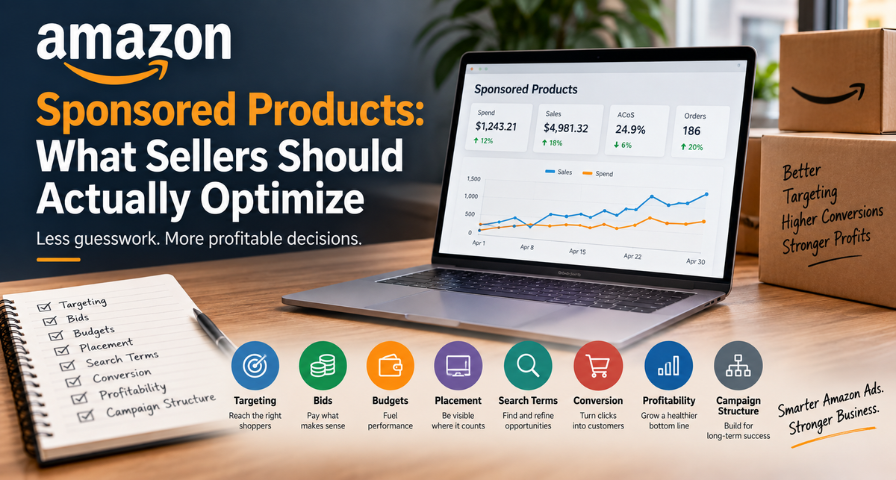
The sellers running campaigns on Amazon Sponsored Products are doing it the wrong way, or to be precise, they are doing things in the wrong order. ACoS keeps going up, causing them to freak out and reduce their bids, leaving them puzzled about why their sales have decreased along with their spending. Amazon Sponsored Products is not something where you can just tweak one aspect and hope everything falls into place. It is all about a process target convert, bid, budget, placement, search terms, and finally profitability, each of which has to make sense in the context of the other.
This isn't another walkthrough of how to create a campaign or where to find the Advertising Console. If you're selling on Amazon, you already know the mechanics. What follows is a closer look at the decisions that separate profitable advertisers from sellers who are technically "running ads" but quietly bleeding margin every month, along with the actual logic for what to do when a keyword, a campaign, or a placement isn't performing the way you expected.
Targeting Is a Strategy, Not a Checkbox
The most common misunderstanding associated with targeting is that automatic and manual campaigns are alternative types of campaigns, while they both have their different roles to play. Automatic targeting should be considered a marketing tool under the disguise of a particular campaign. As Amazon's algorithm will show you all kinds of keywords and product placements that you could not have thought of, including some very peculiar and irrelevant to your product offerings.
The error sellers make here is that they either do not pay any attention to their automatic campaigns at all (missing out on free keyword discovery), or they just keep them going forever without extracting any valuable information from them. However, manual targeting is the place where all of the control happens, provided you use match types properly. Sellers abuse broad match too much because they think that they need more reach, not understanding that a broad match of some generic keyword might attract users who will click on the ad even though they have no purchasing intention.
The correct strategy for targeting also depends on where your product stands within the sales funnel. New products without any review history should use more broad, low-cost discovery methods to accumulate data, even when this data may be costly to collect. The product with proven search terms will be better served by an exact match and product targeting method, where the task is to defend existing profitable positions rather than test new ones.
Product targeting (targeting not keywords but particular ASINs and categories) is often underutilized outside of aggressive categories like supplements and electronics by Amazon sellers. When there is another seller's listing with worse reviews, a higher price point, and a less rich picture gallery, then it can be more effective to go against this product directly rather than compete for the keyword that is being used by everyone else. Targeting of keywords, product pages, and mining search terms from automated campaigns are not separate strategies; they are actually one process divided into three stages: discovering intent, validating relevance, and finally spending money precisely in this area.
Bids Are an Entry Ticket, Not a Guarantee
A bid determines how competitive you are in a given auction and what kind of traffic and placement opportunity becomes available to you. It sets the maximum amount you're willing to pay for a click, but the actual CPC can end up lower than that, depending on the auction and the bidding strategy applied to the campaign. It doesn't determine whether the resulting click converts. Raising a bid on a keyword with a poor conversion rate just gives you more access to an auction you were already losing money in.
The more useful question isn't "What should my bid be?" but "What does this keyword's data actually tell me?" A keyword with enough clicks to raise a serious performance concern for your price point and still zero sales usually has a relevance or listing problem, not a bidding problem, and no bid adjustment fixes it. A keyword converting at or above your account average can typically absorb a higher bid and stay profitable, since the added cost per click is offset by a stronger return. And a keyword converting acceptably but sitting right at the edge of your target ACoS is often best left alone while you gather more data, rather than adjusted based on a single day's fluctuation.
Amazon's bidding strategies (dynamic bids up and down, dynamic bids down only, fixed bids) also get treated as a minor technical setting when they actually shape how aggressively your campaign chases placements. Dynamic bids up and down can push your actual cost per click well above what you set, particularly in top-of-search placements, which is fine if that placement reliably converts for you and reckless if it doesn't. Sellers rarely check which bidding strategy is actually driving their spend until the numbers already look bad.
Budgets Should Reflect Demonstrated Performance, Not Hope
A daily budget that runs out early every day is worth investigating, but it isn't automatically good news. It means the campaign has more demand than the budget allows, and the important question is what kind of demand. If the campaign is running out of budget while spending on relevant, converting keywords at an acceptable ACoS, that's a reasonable case for raising the budget, since you're likely capping profitable volume. If it's running out of budget because it's spending aggressively on broad match terms with mediocre conversion, increasing the budget just lets a weak campaign burn through cash faster. The fix in that case is tightening targeting first, not adding money.
On the other hand, there is an equally common phenomenon where budgets are generously allocated "just in case" and remain mostly untouched, making it seem like the budget is well-fueled even though all the spending is taking place in a narrow timeframe. Checking the performance of campaigns on an hourly or day-parted basis (even manually, by examining impression share) gives a clearer picture of whether the budget aligns with the actual buying behavior of consumers for that particular category.
Budgets also need to adapt as the campaigns mature. Campaigns that are still within their first couple of weeks require a budget that will help them gather meaningful data. Campaigns that are half a year old require a budget based on their proven performance, and budget increases must be based on proven profitable gaps in demand, not assumptions.
Placement Data Tells You Where Your Money Actually Works, Not Where It's Supposed To
The top of search, the rest of search, and the product page are like three separate advertising channels using the same interface, and depending on the product, the price, the competition, and the listing, each channel may show different results. The temptation here would be to think that the top of search always has the best conversion rate since it is seen first, but while this may be a fair guess most of the time, this is not something that works for all accounts. Certain types of products have good results when placed at the product page just because the consumer is looking for an alternative.
The only way to understand whether any placement actually works for your products is to take into account cost per placement and convert it into cost per conversion by using the conversion rate for the particular placement. After doing so, you will see how cost per order and profits differ for each of them. Sellers who do not monitor the placement report make an average investment that can appear to be mediocre even if one placement is perfect and another placement results in losses. Amazon gives an opportunity to manage bid price for each placement individually, but most active campaigns continue using flat bids due to lack of attention to the report.
Search Terms Are Where the Real Optimization Happens
The search term report is arguably the most underused tool in the advertising console, not because sellers don't look at it, but because they look at it inconsistently. A search term needs enough clicks to be judged fairly, and what counts as "enough" depends on price point. A $15 product with a fast purchase decision can be judged sooner than a $150 product where shoppers compare options first. Cutting a keyword after three clicks and no sale, regardless of price point, is a decision dressed up as data-driven optimization when it isn't actually backed by enough evidence.
The true art lies in recognizing patterns throughout the lifetime of the report. Conversion search terms that get lost in your broad match automatic campaign should be moved up to create their own exact match campaigns, allowing you to control both bid and budget without having them lost among other unrelated keywords. It might be good to understand what effect this move will have on you: the addition of a search term as an exact match keyword to a manual campaign provides you with better control over the bid and budget of that keyword but doesn't prevent the automatic or broad match campaign from continuing to provide traffic for this search term. If you wish to limit it, usually, you need to add the search term as a negative.
Search terms that accumulate enough clicks to raise a genuine performance concern and still show no sales, or that are clearly irrelevant to the product regardless of click count, are strong candidates for negative targeting, so Amazon stops spending on them. The key qualifier is sufficient evidence, not simply the absence of a sale after a handful of impressions.
There's also a category of search terms that convert acceptably but reveal something about buyer intent worth acting on outside of advertising entirely, things like a specific size, color, or use case showing up repeatedly. That's not just an ad insight, it's product and listing feedback that smart sellers feed back into their titles, bullet points, and even future product development.
Conversion Rate Is Usually a Listing Problem Wearing an Advertising Costume
The seller always blames the ad itself for being underperforming, while the real cause may actually be found in the product listing itself. If a certain keyword sends highly relevant traffic and yet a conversion rate is low, there is absolutely nothing you can do to fix it even though increasing bids or budgets. Your ad has done its work and brought you a potential buyer. The rest is completely a listing and offer issue: price versus competitors, images, reviews, bullets, and the most important of all whether your main image reflects the product value within half a second, which a buyer decides to stay on your listing or to continue scrolling.
It becomes very important to track conversion data according to keywords rather than according to campaigns as a whole. If some particular keyword fails to convert while all others performing in the same way have great conversion rates, then there is probably something wrong with what the customer is looking for versus what he finds in the listing.
Profitability Means Looking Past ACoS
ACoS gets treated as the single scoreboard number, but it's an incomplete metric on its own. A campaign with a 40% ACoS on a product with healthy margins might be more profitable in absolute dollars than a campaign running at 15% ACoS on a low-margin item. What actually matters is total advertising cost measured against your real contribution margin, meaning revenue after Amazon fees, fulfillment costs, and product cost, not just the raw percentage sitting in the console.
This is also where TACoS, total advertising cost of sales, becomes a more useful lens than campaign-level ACoS alone. TACoS measures ad spend against total sales, including organic sales, rather than just the sales directly attributed to a click.
It is important because sponsored products can have an impact on sales velocity and visibility that could possibly lead to better organic performance in the long run, even though there is no guarantee for it, nor should it be thought of as one. It is important to keep track of overall sales, organic sales, and TACoS in addition to your regular campaign reports, instead of thinking that every penny spent on ads will somehow positively impact your organic ranking. The sellers who only focus on reducing their ACoS will eventually reduce spending on campaigns that could have had such an impact.
Campaign Structure Determines Whether Any of This Is Even Possible
None of the previous points matter much if your account structure makes them impossible to act on. A common setup problem is cramming dozens of unrelated keywords and match types into a single campaign, which makes budget control meaningless because you can't tell which keyword is consuming spend without digging through the search term report every time.
Campaigns are worth separating when there's a real reason to control budget, bids, match type, product, or targeting theme independently, not simply for the sake of having more campaigns.
A structure that works for a lot of sellers looks something like this: an automatic campaign dedicated to discovery and harvesting, a broad and phrase match manual campaign for continued exploration around themes showing early promise, an exact match campaign built from proven, harvested search terms where budget and bids get the most precise control, and a separate product targeting campaign aimed at competitor ASINs or category pages. That isn't the only valid structure, but it illustrates the logic: each campaign should have a distinct job, so a single high-performing exact match keyword never ends up sharing a budget with fifteen mediocre broad match terms, diluted in reporting and capped by the crowd around it.
How to Diagnose a PPC Problem
The majority of the above-listed concepts come together in those cases when you have a problematic number and need to take action on it. As a helpful tip, you should approach the analysis of each symptom as a basis for further research instead of addressing the issue right away.
If you have high ACoS, the next thing you should do is find the source of the issue rather than try to adjust the number itself. Find out if the problem lies in low conversion, in an expensive CPC, in low AOV, or in the spending on traffic, which is not really relevant to the campaign. If the conversion rate is low for most relevant keywords, then the issue might be in the listing and offer. If conversion is fine but CPC increases the cost of the ad, then start with the bids and placement.
In itself, a high CPC does not necessarily indicate something that should be done something about. Benchmark the keyword’s CPC against the conversion rate and cost per order, and not just based on the CPC alone. A keyword with a high CPC but good conversion ability and profitability is worth its price tag. It is only the keyword that has a high CPC but poor conversions that should be taken notice of.
When a campaign runs out of budget, the diagnostic question is whether the budget is being consumed by profitable targets or by weak ones. If the keywords hitting the ceiling are converting at an acceptable ACoS, raising the budget is a reasonable way to capture demand you're currently leaving on the table. If the spend is going toward broad, loosely related traffic, tightening targeting should come before adding any money, or you're just funding the same inefficiency faster.
If the conversion rate is low, analyze how the search term matches the listing. If the search term is a relevant one and people are still not converting, the problem lies either with the price of the item, its image quality, review quality, or how competitive the listing appears to be compared to similar listings. If the search term does not match the item in the listing, then this is a targeting problem and not a listing problem at all.
Bringing It Together
Sponsored Products recognizes that the campaigns that take it as a continuous diagnostic exercise, rather than a budget line item that can be set-and-forget, are the ones that deserve to succeed. Targeting, bidding, budgeting, placements, keyword harvesting, conversions, profitability, and the structure of the campaigns themselves are not individual elements to cross off of a list; each of these continually informs the others. A change in a bid makes sense in the context of conversion data. A decision on budgeting makes sense in the context of whether or not the demand cap is actually profitable.
The sellers who get the most out of Amazon advertising aren't necessarily spending more than everyone else, they're just looking at the right layer of the data before making changes, instead of reacting to the first number that looks uncomfortable. If there's one habit worth building from this, it's slowing down before every adjustment long enough to ask which area the problem actually lives in and whether you have enough data to be sure, rather than assuming it's always a bidding issue. That single shift tends to do more for profitability than any bid automation tool or third-party dashboard ever will.
Ready to Grow on Amazon?
Let our experts help you scale your Amazon business with proven strategies.
Get a Free Consultation
Comments (0)
Leave a Comment