Amazon Seller Insurance Requirements Are Getting Stricter: What to Know Before November 2
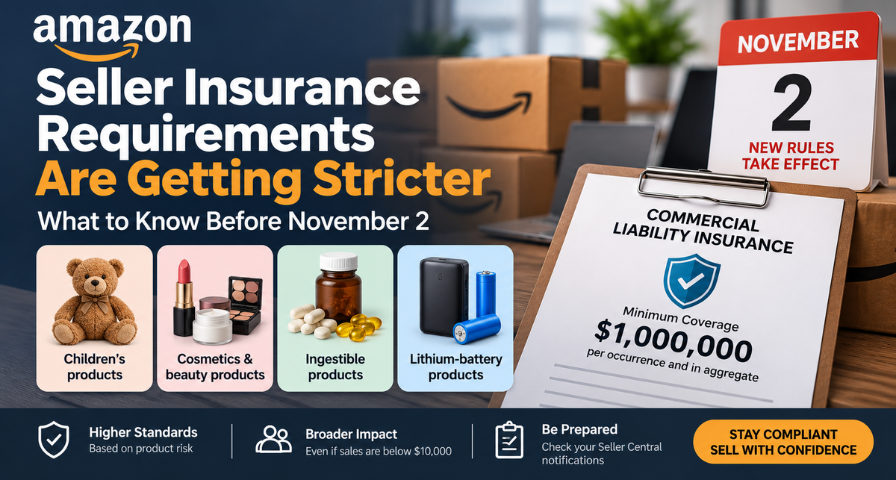
If you sell children's products, cosmetics, ingestible products, or lithium battery products on Amazon, staying below $10,000 in monthly sales may no longer be enough to postpone liability insurance. Starting November 2, Amazon's updated approach to commercial liability insurance shifts the trigger for coverage away from a pure revenue threshold and toward the risk profile of what you're actually selling. For sellers in these "enhanced safety" categories, that means insurance stops being something you plan for once you hit a certain sales milestone and starts being something you need to think about from the moment you list your first unit.
This matters more than it might sound at first. Amazon seller insurance requirements have been tightening gradually for years, but this update changes the underlying logic rather than just adjusting a number. Understanding what's shifting, why Amazon is making the change, and what it actually requires of you is worth ten minutes of your time now, especially if postponing that decision could mean scrambling to get compliant coverage in place under pressure later.
Why Amazon Requires Liability Insurance in the First Place
To make sense of this update, it helps to understand why Amazon requires commercial liability insurance at all. Under Section 9 of the Amazon Services Business Solutions Agreement, sellers have historically been required to carry coverage once their gross proceeds exceed a set amount in a single month, currently $10,000. The reasoning is straightforward. Amazon runs a marketplace with millions of third-party sellers, and when a product causes injury, property damage, or some other harm, someone needs to be financially accountable for it. Amazon doesn't want that liability sitting entirely on its own shoulders, particularly for products it never manufactures and rarely handles directly.
This requirement has evolved before. What once triggered only after three consecutive months at the $10,000 mark became a rule triggered by a single qualifying month. Amazon also built its Insurance Accelerator program, connecting sellers with vetted providers so that finding compliant coverage wouldn't be its own separate headache. The pattern has been consistent: more sellers are required to carry insurance sooner, with fewer built-in exemptions.
What's Changing on November 2
The core shift set to take effect on November 2 is this: for sellers in enhanced safety categories, gross monthly sales staying under $10,000 may no longer provide the exemption it once did. Under Amazon's updated guidance, sellers in these categories may be expected to carry coverage of at least $1 million per occurrence and in aggregate, even at revenue levels that would have fallen safely under the old threshold.
This represents a significant change from the way the rule had previously operated. Prior to the stricter system, a seller would be able to work off of certain sales markers to anticipate and budget for their insurance as they neared that threshold. However, in light of the more stringent new rules, there is no longer any grace period available for sellers whose accounts or product lines are classified into such categories. The specifics, of course, can depend on the particular product category and the notification methods used by Amazon, so it pays to double-check your own situation.
Why These Four Categories Specifically
It's worth pausing on why children's products, cosmetics, ingestible products, and lithium battery products are the categories being singled out, because the reasoning says a lot about how Amazon is thinking about risk more broadly. Children's products carry obvious safety stakes. A defect in a toy or piece of baby gear can cause serious harm to a population that regulators and courts treat with particular protectiveness. Beauty products and cosmetics do have the possibility to cause some form of an allergic reaction, chemical burns, and even long-term damage depending on the ingredients and their testing and disclosure.
Consumeable products such as supplements and food products fall into a niche where the room for error is quite small, as something that is ingested holds more risk than just being worn. And lithium battery products can present significant fire and overheating risks, both in shipping and in everyday consumer use, which is part of why regulators and marketplaces alike have grown more cautious about how these items are handled and sold.
The common thread across all four is that a product failure in these categories doesn't just produce a disappointed customer or a routine return. It can produce a hospital visit, a house fire, or worse. A single defective batch sold at modest volume can still trigger a costly liability claim, which is likely why tying the insurance requirement purely to sales revenue never fully matched the actual risk these categories present.
Why Revenue Was Never the Full Picture
Consider this analogy, which will help demonstrate the logic of this decision. Consider two merchants who earn approximately $4,000 per month from selling their goods. The first one is selling phone cases. The second merchant sells baby silicone teethers. Using the old method of determining the threshold, none of these merchants would have been obliged to purchase insurance because both of them make less than $10,000 per month. However, there is a massive difference in terms of risks for these two merchants. Defective phone cases may crack and fail to provide a good fit. Defective teething toys can put children at risk of choking. The same revenue, but a totally different level of risks.
This difference basically constitutes the main idea behind the change in Amazon's approach. Sales volume gives an idea about the size of the business but says nothing about its risks in terms of damages from selling defective products. In case of general merchandise, using sales revenue as a risk assessment tool made perfect sense. In certain categories, it stopped being the case for Amazon.
What This Means Practically for Sellers
If your products fall into one of these categories, the practical takeaway is to treat commercial liability insurance as part of your cost of doing business rather than a milestone you'll deal with once you scale up. That has real budget implications, particularly for newer or smaller sellers who assumed there would be more runway before insurance became a line item. Policies covering higher-risk categories like ingestibles or children's products can also carry higher premiums than general merchandise coverage, since underwriters price risk using much the same logic Amazon appears to be applying here.
There's an operational layer to this as well. Amazon's policy criteria are specific: coverage needs to be written on an occurrence basis, name Amazon.com Services LLC and its affiliates as additional insureds, and keep deductibles at or below $10,000. Sellers who assume any general liability policy will satisfy these requirements often discover otherwise, usually at an inconvenient moment, when a certificate gets rejected and account restrictions start looming. Getting the technical details right matters just as much as securing the coverage amount itself.
How to Get Ahead of the Requirement
The most strategic thing to do is to cease considering insurance as an afterthought and include it in the process at the very beginning during your setup process, along with registering a brand or making your first listing. Look for a specialist who knows how to cover e-commerce and marketplace sellers, as he or she will already know about Amazon’s language regarding additional insured and occurrence basis. Amazon’s Insurance Accelerator program can be a good starting point if you do not want to look elsewhere for a solution.
It would also make sense to get used to reviewing Amazon's Seller Central messages and the official policy pages rather than reading secondary information sources. Amazon has a history of communicating such changes to sellers who are affected by the change before the general public becomes aware of that. Dates of effect and definition of particular categories might differ, so if you sell products in one of these categories and have not been formally notified yet, it would make sense to check your position and get quotes in advance.
The Bigger Picture for Product Research
These changes are also relevant when you assess the profitability of your new products prior to listing them. The product may seem appealing based on demand, low level of competition, and margins. However, if the category has to do with mandatory insurance or third-party certification, then the actual economic picture of the product will change dramatically after you consider these factors. A supplement or a children's product which appears highly profitable in theory may have certain compliance requirements, which gradually decrease its appeal in terms of profitability.
This is actually the main change to keep in mind. Amazon's departure from the approach based on the revenue threshold for these particular categories represents a general shift in the online world, where e-commerce platforms as well as regulatory bodies no longer believe in the principle of "first grow and then deal with compliance issues" in case the product has anything to do with children, skin, the human body, or physical dangers (e.g., lithium batteries).
Key Takeaways
For sellers in children's products, cosmetics, ingestible products, and lithium battery categories, the message is straightforward even if it's not entirely welcome. With Amazon's updated commercial liability insurance requirements set to take effect November 2, revenue may no longer be the deciding factor in whether coverage is required. Product risk is taking its place. Confirming exactly what applies to your account through Seller Central, budgeting for coverage early, and getting the policy details right the first time will save far more stress, and likely more money, than dealing with it after the fact. And if you're evaluating new products to add to your catalog, it's worth weighing compliance and insurance costs alongside demand and margin from the start, since a product that looks good on the surface can look very different once those factors are priced in.
Ready to Grow on Amazon?
Let our experts help you scale your Amazon business with proven strategies.
Get a Free Consultation