Amazon Seller Fees Stay Flat for Holiday 2026, But the Inventory Clock Is Ticking Faster
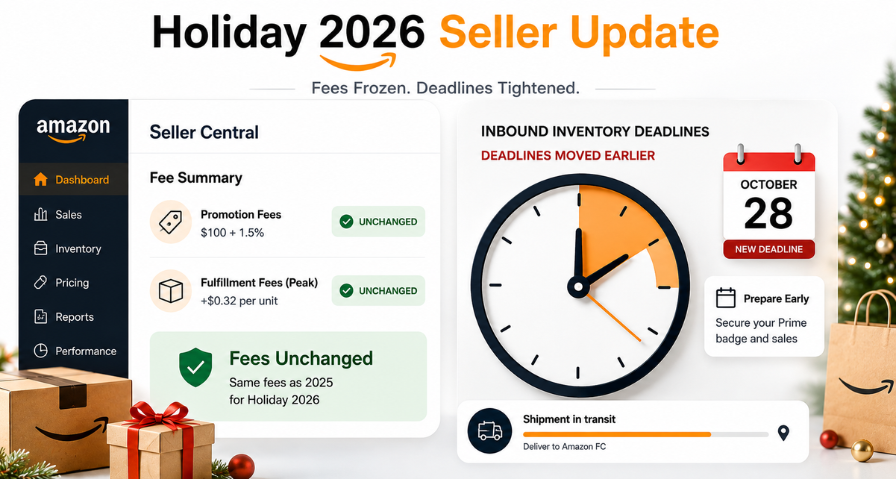
Amazon has released its full Holiday 2026 selling calendar, and the short version is this: Amazon seller fees are staying flat compared to last year, but the deadlines to get inventory into Amazon's warehouses have moved noticeably earlier. Amazon made this decision to give sellers cost predictability heading into the fourth quarter while addressing its own internal capacity constraints during the busiest receiving period of the year. For sellers, this matters because pricing your Q4 strategy is now the easy part. Winning the Prime badge during Black Friday Week, Cyber Monday, and Prime Big Deal Days depends entirely on how fast you can move inventory, not how competitively you price it.
This is the core tension sellers need to understand this season. Stable 2026 Amazon seller fees remove one layer of financial guesswork, but the earlier inbound windows mean the real competitive advantage this year belongs to sellers who plan Amazon holiday logistics months in advance rather than weeks.
Deal Submission Windows Open Well Before the Holidays
The submission window for both major holiday events opened on July 8, 2026. Sellers can submit deals for Prime Big Deal Days through September 8, 2026, and deals for Black Friday Week and Cyber Monday through October 20, 2026. Amazon has also brought back its early submission discount, a fifty dollar reduction on the upfront promotion fee per deal for sellers who submit Prime Big Deal Days offers by August 5, 2026, or Black Friday and Cyber Monday offers by September 5, 2026. This discount applies only to the fixed portion of the fee, not the variable percentage tied to sales volume.
In practice, the real decision-making window is much narrower than the full submission period suggests. Sellers deciding which products to push into the October event have less time to act than the calendar implies, since the early bird savings expire weeks before submissions officially close. For sellers running tight margins, treating early August and early September as the real deadlines, rather than backup dates, is what separates a discounted promotion fee from a full-price one.
Amazon Seller Fees for Promotions Hold at $100 Plus 1.5 Percent
For the core promotional formats, Best Deals, Lightning Deals, and Prime Exclusive Price Discounts, Amazon is carrying over the same fee structure used during Prime Day. That means an upfront fee of one hundred dollars per promotion plus a variable fee of 1.5 percent of promotional sales, capped at five thousand dollars. In addition to this, Amazon has stated that there have been no new eligibility criteria set up for the holiday events for 2026, and this reduces the ambiguity surrounding those sellers who had been eligible during previous events.
Why have the Amazon seller fees remained the same this holiday season? Amazon seems to be trying to maintain stability following their new introduction of a fuel surcharge fee, which was heavily criticized by sellers. Holding promotion and fulfillment fees flat gives sellers one less variable to model when budgeting Q4 campaigns, and for sellers who plan inventory purchases and ad spend months ahead of time, that kind of consistency reduces forecasting risk considerably. It does not, however, reduce the operational pressure created by the shorter inbound windows, which is where most of this year's real planning challenge sits.
One useful clarification in the announcement involves pricing mechanics. Promotional prices set during Prime Big Deal Days will not count toward the thirty day and sixty day lookback window that determines the maximum allowable deal price for Black Friday Week and Cyber Monday. Do Prime Big Deal Days prices affect Black Friday pricing? No, and that exclusion matters because Amazon's pricing rules typically require promotional prices to sit below a reference price built from recent selling history. Without this carve-out, a steep October discount could unintentionally disqualify a product from running a compliant deal in November.
Not everything in the fee structure landed cleanly with sellers. In light of the discussions that followed the announcement, one seller noted the difference between the pricing scheme in the announcement and the actual prices seen in the registration system, which showed a price of fifty dollars a day along with 1.5% as compared to the one hundred dollars per promotion mentioned. This difference between the two methods of pricing is substantial enough when considering an event that may take multiple days.
Holiday Fulfillment Fees Return With the Same Surcharge Stack
The peak holiday fulfillment fees will be active from October 15, 2026, to January 14, 2027, which corresponds to the same period as in the previous year. The holiday fees for FBA will include those for FBA, Remote Fulfillment with FBA, Multi-Channel Fulfillment, and Buy with Prime. The additional fee over regular rates per item will be on average thirty-two cents, the same as in the previous peak season.
However, the problem is that this peak holiday fee does not work alone. It comes along with the 3.5 percent fuel and logistics surcharge introduced by Amazon at the beginning of 2026, which initially amounted to seventeen cents per item on average in case of U.S. FBA orders. Together, these two fee elements influence all units processed during the busiest shipping season. The combined effect can be seen with the help of Revenue Calculator, Profit Analytics, and Fee and Economics Preview Reports.
The fuel surcharge remains a sore point among sellers. Several have questioned publicly why the charge persists given falling oil prices, arguing that carrier costs have dropped while the surcharge has effectively become a permanent fixture that sellers are forced to absorb. Amazon has not addressed those questions directly, and there is no indication the surcharge will be revisited before the holiday peak begins.
FBA Inventory Deadlines Shift Earlier Across Every Shipment Type
However, this year's most significant update is not about fees, but timing. In order to retain the Prime badge during each of the holiday promotions, the inventory should be delivered to Amazon's warehouse by particular deadlines before the start of each promotion window, and all of these deadlines have been shifted forward in comparison with last year's schedule.
What are the deadlines for FBA deliveries in this case? The deadlines for Prime Big Deal Day promotions through Amazon Warehousing and Distribution will be September 2, 2026, the deadline for FBA shipments using the minimal shipment splits option will be September 9, 2026, and the deadline for the Amazon-optimized shipment splits, which is chosen by most sellers, will be September 16, 2026. For Black Friday Week and Cyber Monday, the deadlines will be October 14, 2026; October 21, 2026, and October 28, 2026.
Which deadline is the latest one? The one-week difference between two FBA delivery options is not random. Minimal shipment splits minimize the number of destinations where the inventory is sent, which means easier outgoing logistics for sellers. But it means that Amazon should redistribute the stock afterwards, which takes receiving time.
The Amazon-optimized setting works differently. It spreads inventory across the fulfillment network upfront, closer to where demand is actually expected, which shortens Amazon's internal handling and buys sellers an extra week. Since most sellers already use the optimized setting, September 16 and October 28 function as the practical Amazon holiday selling deadlines for the majority of the seller base. Sellers who deliberately choose minimal splits, often to reduce their own outbound shipping complexity, are trading that convenience for a full week less runway.
These deadlines for Black Friday product availability are even more critical, since they limit an already narrow window of opportunity for supply chain management. Retailers that have their products manufactured abroad have to calculate backwards from the AWD or FBA deadline, taking into account production time, transport delays, customs clearance, and inbound handling of products, not just sailing of cargo from the production facility. Cargo that departs on time but gets delayed even minimally upon arrival to the port misses the window of eligibility for the badge, which is much worse than paying for fast transportation beforehand.
Why Amazon Moved the Deadlines Earlier
Amazon's own explanation centers on internal capacity. Fulfillment centers concentrate on receiving holiday inventory in September and October before shifting focus to order processing in November and December. During that earlier receiving phase, sellers can expect lower capacity limits at fulfillment centers, since warehouse teams are absorbing the bulk of incoming holiday stock before customer order volume spikes. Pulling the inbound deadlines forward gives Amazon more buffer to process that volume without bottlenecking the network right as consumer demand peaks.
Amazon is pushing warehousing and distribution as its preferred solution to this squeeze, and the numbers it has shared support that push. According to Amazon, sellers who enrolled in AWD during the fourth quarter of 2025 saw shipped units rise more than 13 percent and out of stock days fall more than 30 percent during that quarter. These figures come from Amazon's own reporting on program participants rather than independent verification, but they reflect a clear incentive structure: sellers who commit to bulk, early storage are rewarded with better availability precisely when receiving capacity is most constrained.
Sellers who route inventory through AWD with automatic replenishment enabled will continue paying the off-peak monthly storage rate through October 31, 2026, a temporary shield against the higher peak storage tier. Capacity Manager remains available as a fallback for sellers who need to bid for additional fulfillment center space once standard allocations run tight.
What Sellers Should Do Now
Taken together, this year's calendar rewards sellers who move early and penalizes those who wait. Flat Amazon seller fees remove one source of budgeting uncertainty, but the earlier inbound deadlines and stacked per-unit surcharges mean the real cost of holiday participation is increasingly about timing discipline rather than fee negotiation.
Sellers planning for Q4 should review inventory schedules now, finalize promotional products early enough to catch the discounted submission windows, and work backward from Amazon's inbound deadlines rather than from the event dates themselves. Anyone relying on overseas suppliers should build in extra buffer for production and shipping delays given how unforgiving the new AWD and FBA cutoffs are. Sellers who lock in early submission discounts, choose the shipment split option that matches their timeline, and get inventory into Amazon's network well ahead of the September and October cutoffs will be the ones actually carrying the Prime badge when Big Deal Days and Black Friday Week arrive. Everyone else is competing for the same customers without the visibility that badge provides, no matter how competitive their price point looks on paper.
Ready to Grow on Amazon?
Let our experts help you scale your Amazon business with proven strategies.
Get a Free Consultation