Amazon Seller Account Protection: How to Keep Your Business Safe in 2026
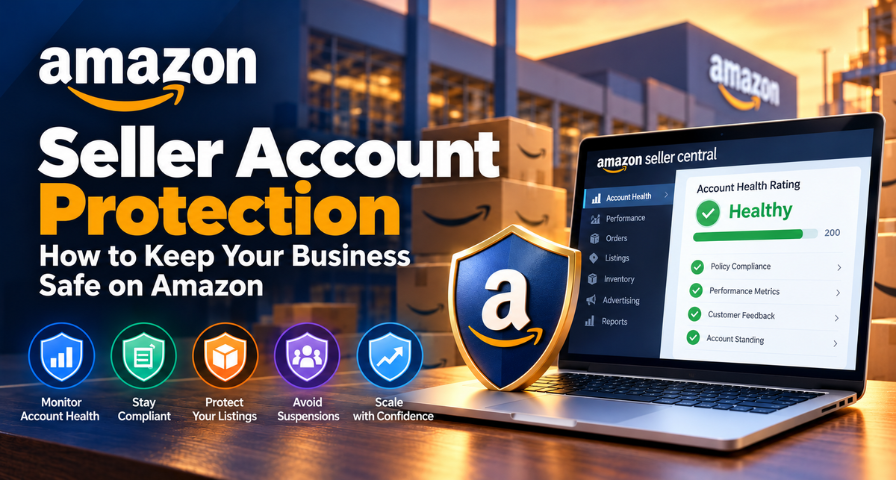
Most sellers recall the day when they became aware of how vulnerable their business could be. Some get a message that their selling permissions have been revoked. Others notice a decline in sales, which later turns out to be a deactivated best-seller. In any case, the point is clear on Amazon, one doesn't own a storefront. One gets a revocable permission to sell on it, which is dependent on their activity which can be measured, controlled, and optimized.
This is the reason why Amazon seller account protection has become an integral part of the seller's routine work and not just something else to do after the work on the product has been done. It takes just an hour to lose access to the inventory stored in Amazon fulfillment centers, the advertising budget spent against a dead product, and years of review history. Also, starting from 2026, Amazon has made changes in the process of handling performance issues related to seller-fulfilled products. This article provides information about how account health works on Amazon, where seller account risks come from, what is new this year, and how to develop a seller-friendly habit.
Why Account Protection Matters More in 2026
Many sellers treat their account like an office lease, something in the background that only matters if it breaks. Amazon's rules do not stand still, though. Policies, thresholds, and the scope of enforcement all shift, and sellers who read the rules once tend to be surprised by the version that applies today.
The concept of credit scores serves as an interesting point of comparison, but with a caveat. Being late on a payment will never result in being denied a loan, but having a string of minor slip-ups results in lenders' perception of the borrower changing. Amazon has not published their rationale for enforcement in such great detail, and hence this analogy is only a comparison to what Amazon's system might be doing rather than a description of it. What this means in terms of preventing your Amazon seller account from getting suspended is that risks tend to accumulate over time.
How Amazon Account Health Actually Works
The key here is the Account Health Rating, reflecting your compliance with Amazon's policies and performance requirements. The indicators are order defects, cancellation rates, delayed shipments, compliance, and feedback. Consider it your diagnostic tool, not your grade to boast about.
What matters more is that the general rating is only one of many things. Your account health rating, your performance metrics, your policy breaches, and action against any specific offer have nothing to do with each other, yet they are all interrelated. A seller may seem perfectly healthy by the overall rating while having one offer suspended or facing some policy issue with one product. Proper account health management requires understanding all those layers, not merely looking at the main indicator.
The biggest mistake is checking the dashboard only when you suspect something went wrong. The right approach would be reading the dashboard like a pilot does his instrument panel. Try to understand what has changed since the last check. Your account rating being lower than last month, while the complaints regarding one product are rising, will give you much more information than just a number.
What Can Put an Account at Risk
A suspension is viewed as a drastic action, for instance, the selling of counterfeit products and fraud. From my experience, most avoidable suspensions stem from what could be termed as normal operation drift, although this is an anecdotal evidence and not a statistic published anywhere. Getting to know the types will assist you in identifying areas that need your focus.
The performance type is more predictable than any other type. It is caused by order delays, cancellation, and return rates that exceed Amazon thresholds even if the product being sold is perfect. This is normally brought about by process issues like the lagging of inventory updates, carriers missing cutoffs, and sudden demand exceeding staffing.
The policy type covers a wide range of things. It includes listing claims not allowed by Amazon, sale of restricted items without permission, review manipulation, and promotional language not allowed by Amazon. A seller copying a competitor's health claim on his bullet point list can bring about a policy violation even without intending anything.
Intellectual property complaints deserve their own attention, partly because sellers lump them together. A trademark complaint concerns a protected brand name or logo used in your listing. A copyright complaint usually involves images or text taken from someone else. A patent complaint targets a product's design or function. Authenticity complaints come from buyers who believe an item is not genuine, and listing ownership disputes arise when several sellers contest control of a detail page. Each is handled differently and calls for different evidence, so identify which one you are facing before you respond.
Finally, there are account relationship issues. Amazon may look at how accounts relate to one another, and agencies or operators who manage several accounts need to follow Amazon's requirements for doing so rather than assuming any single shared attribute decides the outcome. Because the evaluation can involve multiple signals, the safest approach is to read the current multiple-account rules and keep access, ownership, and records clean.
The 2026 Change to FBM Enforcement
The most important change this year relates to offers from Fulfilled by Merchant sellers. The company stated that as of August 31, 2026, where a single FBM offer causes risk to the seller’s account health because of some performance policies, the company can disable this particular offer without endangering the entire seller's selling account. According to the news coverage of this change, the relevant performance policies include Cancellation Rate, Late Shipment Rate, Order Defect Rate, and On-Time Delivery Rate, so make sure to read the official notice from Amazon for the full list of applicable policies.
As explained by Amazon itself, the purpose of such changes is to limit the impact of enforcement to just the single offer that was problematic and not to affect the rest of your offers and your overall account health.
It also creates new work. Commentators point out that advertising spend, ranking position, and conversion history attach to the offer rather than the account, so a deactivated bestseller still hurts even when everything else keeps running. It is also not a blanket change. One law firm's analysis stresses that it does not rule out account-level enforcement for other policies or circumstances. Some questions remain open, including how a cluster of order problems gets attributed to a particular offer. Industry coverage notes that a deactivated offer shows up in Account Health under Other Policy Violations, where reactivation steps are listed, so confirm who receives those emails and check that section regularly. It also makes sense to export your recent FBM exceptions by SKU, so you know which offers are closest to trouble before Amazon tells you.
A second 2026 change is worth understanding correctly. Amazon announced on its Seller Forums that starting in July it is removing the seller eligibility requirements for the Featured Offer, with a gradual global rollout expected to finish by the end of the year. Amazon also said it is not changing how the Featured Offer is selected and that criteria such as competitive pricing, delivery speed, and performance still matter. So this is not a reason to relax. The gate has moved, but your metrics still shape both your enforcement risk and your chances of winning the Featured Offer.
The Real Business Cost of Account Problems
The financial hit is easy to describe and still underestimated. When selling privileges are removed, inventory may be held while a case is reviewed, and recent sales proceeds can be delayed. A seller with substantial stock and a thin cash cushion can run out of working capital before the process ends.
The less visible costs are often larger. Keyword rank, built over months of sales velocity, does not wait for you, and competitors can move into the space quickly. Depending on your brand rights and what Amazon allows during a restriction, your ability to defend listings against unauthorized sellers may also be limited. Ad campaigns may keep spending on products that cannot be bought. Even after reinstatement, regaining your previous position can take longer than the suspension itself.
There is a human cost as well. Many sellers describe the experience as disorienting because responses can feel templated and the path forward unclear. That uncertainty is the strongest argument for preparing before you need to explain yourself.
Building a Weekly Account Protection System
Perhaps the best protection habit is also the least glamorous one: a brief, consistent review done at the same time weekly. Access the account health dashboard, review the notifications, and look for feedback from customers and for returns that show there is a problem with one of your products. This should help you discover issues like a spike in returns due to a listing not being as described.
If you discover anything, jot it down somewhere. It will serve you well when you have to keep track of what you have discovered and how you solved a problem. If ever Amazon comes calling for evidence that you control the quality of your listings, the written proof will speak louder than your word.
Protecting Your Catalog and Listings
Listing quality may be one of the most silent risk factors. Over time, listings get inconsistent information, like out-of-date images that do not correspond to the product anymore, titles that have become too stuffed with keywords, merged improperly variations, etc. Every single inconsistency is an invitation for complaints or automated flags, and having clean listings is one of the main components of Amazon seller compliance.
First of all, audit your best-selling listings. Check if there were any changes in the packaging or in the supplier that requires you to update information about the listing. In case you sell regulated goods like nutritional supplements, electronics, and children's products, make sure your documentation is up-to-date.
Using a flat file for the upload of large volumes will help you have more controlled workflow and documentation of the changes, provided that this file is validated before the upload. Otherwise, you risk having the same error distributed over a hundred listings because of wrong data being in the wrong column. Variations should be treated in the same manner customer experience comes first.
Backend keywords deserve the same care. Competitor brand names or unrelated high-volume terms can lead to suppression. A diabetic sock listing, for instance, should not borrow unrelated medical terms just because they get heavy search traffic. The product has to match the promise, and the fix is usually easy if you catch it early.
Fulfillment, Customer Experience, and Advertising
Both operations and marketing activities expose the product to the seller’s negligence. Improperly named, poorly packed, or stranded products may lead to defects before the buyer even sees them. Ensure your shipment preparations are uniform, keep your inventory in order and remove any stranded products so they don’t turn into fees and issues with customers.
A prompt response to any customer message can prevent the development of the situation into an unsatisfied customer and even a negative feedback. Though it can’t guarantee anything, a delayed or disrespectful answer makes an escalation of the situation much more likely. Always have ready templates of responses for some typical situations such as delays in delivery or lack of some parts, and make them personal.
An advertisement is another kind of risk for the merchant. Campaigns with sponsored ads leading to the listing which has some non-compliance issues, or misleading ads with claims the page doesn’t have, can bring the unwanted exposure. Make sure your ad messaging corresponds with listing details and stop promoting those offers which are under investigation right now. As offer-level deactivation has appeared for FBM, be careful about the inventory and advertising coordination.
What to Do When Amazon Sends a Warning
Even the most careful sellers receive notifications. It all depends on how they respond to them. Read the notification carefully, determine which policy or metric has been violated and avoid trying to make an emotional case. Above all, never submit a standard appeal before identifying the cause of the violation.
A good strategy for solving the issue should consist of three elements: the reason for the problem, the steps taken by the seller to solve it and measures to be taken to avoid a repetition in the future. Be very clear in explaining how you've solved the problem. Saying "We have improved our processes" explains nothing. Explaining in detail what has been changed, for example, "We have added a second inspection before shipping and disposed of the affected batch" says a lot. Provide additional documents such as invoices, tests and corrections, but try to keep the tone dry and factual. If the initial appeal fails, try to analyze the feedback and write the next one better.
How to Scale Account Protection
As an organization becomes bigger, it should change its approach to security from individual practice to organizational procedure. Responsibility for oversight must be determined; documentation of the process must be conducted; all who have access must be trained in basic requirements for policy compliance. If the organization uses agents, contractors, or assistants, it would be wise to restrict their access to what is absolutely necessary and audit their actions from time to time because easy access often leads to avoidable complications. Having income from other sources is also a good idea.
Final Thoughts
Seller account protection on Amazon has less to do with not being penalized and everything to do with managing a business that is consistently reliable, predictable, and resilient. With the 2026 change to offer-level enforcement, this becomes all the more true because sellers have to understand not only if their accounts are in good shape but which specific offers are starting to be problematic.
The single thing that you should be doing this week is setting up a recurring calendar reminder to do an account check. In your very first appointment, use that time to review your Account Health dashboard, to verify who receives the emails from it, and to audit your five largest offers against what you actually ship.
Ready to Grow on Amazon?
Let our experts help you scale your Amazon business with proven strategies.
Get a Free Consultation