Amazon Sales Dip After Back-to-School: How Sellers Can Bounce Back Before Q4
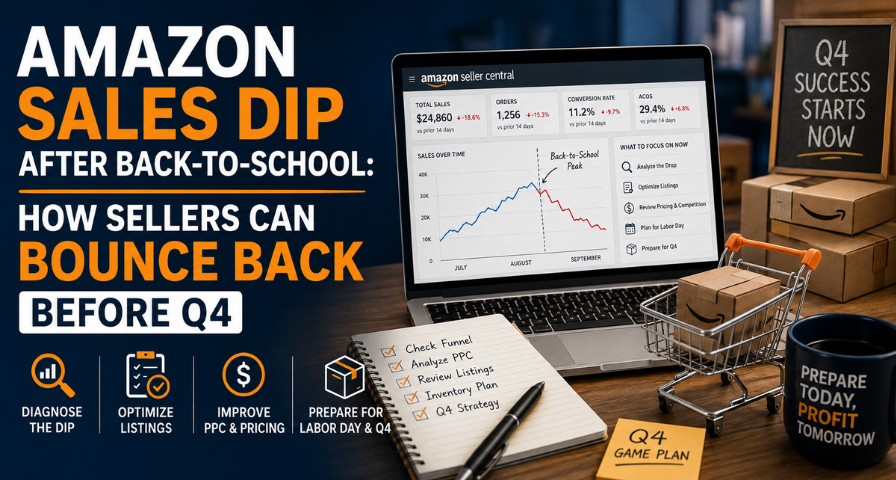
Every year around late August, a familiar pattern shows up in Seller Central. The dashboard that was buzzing with orders through the back-to-school rush suddenly goes quiet, PPC numbers look worse, and it's tempting to assume something has broken. Here's the real issue, though: the dip itself usually isn't the problem. Misdiagnosing it is. Some sellers panic and slash ad spend or drop prices reflexively and end up doing more damage to their account than the seasonal slowdown ever would have. The sellers who come out ahead are the ones who pause, figure out exactly what's driving the decline, and respond to the actual cause rather than the symptom.
Why Amazon Sales Drop After Back-to-School
For many Amazon categories, back-to-school demand builds through July and August, though the exact peak varies quite a bit by product, price point, and customer segment. School supplies and children's apparel tend to follow a different curve than laptops or dorm essentials, and even within electronics, a budget product and a premium one can peak at different points in the season. What's consistent across most categories, though, is that once the school year actually begins, that concentrated demand doesn't taper gradually, it tends to drop off fairly quickly. Families that spent heavily on tech, supplies, and clothing in July and August also tend to pull back spending for a few weeks afterward simply to let household budgets reset. That combination, demand pulling forward and then pausing, is what creates the gap sellers feel between late August and early September, right before Labor Day and the Q4 run-up begins.
Seasonality vs. a Real Performance Problem
The tricky thing about this time frame isn't the drop, it's being able to separate it from a normal seasonal refresh and an issue with your account or listing. A short-term drop that corresponds to the conclusion of a recognized seasonal demand window is usually less problematic than one that persists well past the expected time of reset for demand. It's during this time that you'll need to investigate whether or not your numbers are still low weeks after demand is expected to have reset, and there is no seasonal rationale behind it. That's when you'll want to look into your account health report, price competitiveness, fulfillment, and freshness of your listing. If you overlook a true ranking or conversion issue and wait until your competitors have ramped things back up before the end of Q4, recovery is going to become more difficult.
Diagnose the Drop Through Your Sales Funnel
This is the stage where most people tend to miss out, and yet, it can be the most important one. Instead of looking at the total sales and getting carried away with emotions, try to figure out the decrease in sales through the various stages of your marketing funnel. Every one of these will tell you what is going on. If impressions have declined dramatically, then you can expect this to be due to a decline in overall search volume, which is not unexpected after the back-to-school period is over. If impressions are steady but clicks have dropped, this could mean that there is something wrong with the main image, title, or price positioning, or possibly even a new competitor entering the market. If clicks are steady but orders have declined, you should look at the conversion rate in terms of factors such as price, reviews, delivery promise, and featured offer. And finally, if orders are steady but your ACOS has increased, the problem lies with your campaign, not the product.
What the Dip Means for Amazon PPC
PPC results may appear to have taken a nose dive immediately after the peak season, and it would be easy to misconstrue this as the campaigns no longer being effective. Actually, a keyword that was bringing ten sales a day during the peak season can actually bring in three sales after the peak season with no adjustment in campaigns at all because there are fewer searches and fewer intents to buy. While the temptation to aggressively lower bids or pause the campaigns when the ACOS increases is understandable, this may end up hurting more than helping by getting rid of relevance and velocity for the sales that will resume once the fourth quarter hits again.
Review Pricing, Conversion, and Competition
Consumers are becoming increasingly price sensitive on Amazon, and sometimes even a slight difference could cause the customer to go elsewhere. During the slower period, you might want to take a look at your listing from the point of view of the customer and compare your product to other similar products available. The price differential may affect your chances of being selected as the featured offer if the other products have comparable ratings, fulfillments, and delivery options, but this is not the only criteria used in determining the selection process. It's also a good idea to examine the fulfillment process that you have in place. FBA provides quicker and more reliable delivery services, which helps increase the competitiveness of your offer compared to other similar products.
Use the Slow Period to Strengthen Your Listings
While the post-back-to-school downtime period is seen as an inevitable period to endure, it actually offers valuable preparation time that many merchants neglect. Rather than sitting back and waiting for increased traffic, you can make changes to your product listings by updating your keywords for the upcoming season and checking the velocity and ratings of your listing to ensure your product has been properly positioned before the traffic in Q4 kicks in. You should also check to make sure your listings are not being suppressed and that your content is up-to-date, since this will help with the conversion and competitiveness of your offer compared to others.
Diversify Beyond Seasonal Demand
Now, if you build an entire lineup on the back of the school stuff season, you will end up facing the same fall-off in sales during the month of August. It will serve you much better in the long run if you begin to sell some SKUs that complement those you have been selling all along. Remember, the key point to note here is that you must stick to your target market and not launch some SKUs that are completely irrelevant to you. Try finding SKUs that share similar target customers or the same application.
Use Labor Day as a Bridge to Q4.
Labor Day falls almost perfectly in the middle of this seasonal gap, and it's worth treating as a real opportunity rather than an afterthought. Amazon's promotional emphasis can shift somewhat year to year, but Labor Day can create another promotional window, particularly for categories that naturally fit end-of-summer shopping and discounting. If you're carrying leftover back-to-school inventory that didn't sell through, a well-timed Labor Day push can help clear stock, generate fresh reviews, and keep your listing's sales velocity from stalling completely before the bigger Q4 push arrives.
Prepare Inventory and Advertising Before Q4
The period of silence is also a natural time for Q4 planning. Comparing your stock levels with FBA shipping deadlines, sell-through rates, coverage, and lead times will give you an honest assessment of whether you are really ready for expected demand during Q4 or simply have a shipment planned. Combining all this information with your final budget for advertising and an advertising calendar will give you a huge advantage over sellers who start thinking about the holiday season in October. The fact that Amazon usually confirms the dates of such campaigns very far ahead makes sellers prepared for them to win the race.
Conclusion: Treat the Dip as a Diagnostic Window
Sales drop after back-to-school is one of the most predictable trends on Amazon, not an indicator that you’re failing in your business. Those sellers who cope with it the best are not those who evade the drop but who take it as an opportunity to conduct a diagnosis and distinguish seasonality from real problems with their account, follow the funnel strategy and not the instinctive one, and utilize this period for bettering their listings and preparation for Q4. Think about this period not as a problem but as a bridge, and you’ll be much better off than sellers who just hope for the demand to return by itself.
Ready to Grow on Amazon?
Let our experts help you scale your Amazon business with proven strategies.
Get a Free Consultation