Amazon Review Requests: How the New Ad Type Can Help Sellers Get More Reviews
Those who have released products on Amazon know well about the feeling of the initial couple of weeks after launching. The listing is up, the stock has been shipped to the Amazon Warehouse, the advertisements are up, and the number of reviews still shows zero or very close to that. Consumers see two products, one with three reviews and another one with three hundred reviews. For many years, there were not many options available for solving this issue. Some required time and others broke rules.
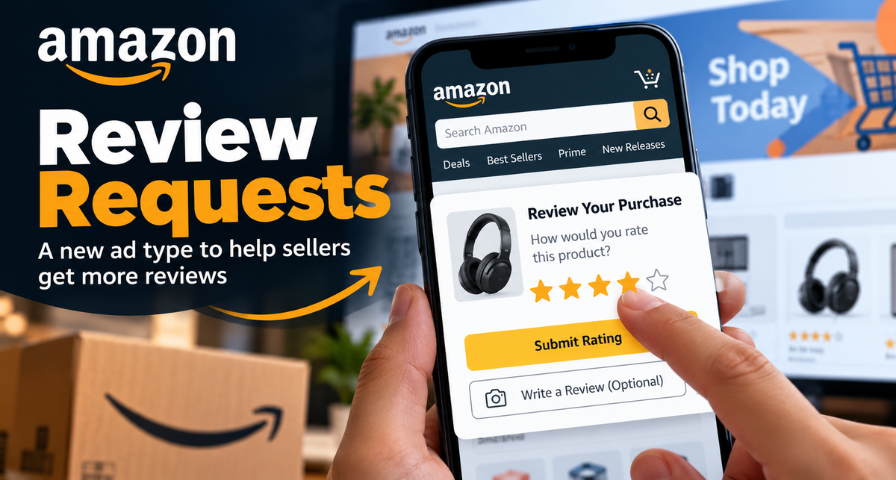
That is the context in which a noteworthy announcement was made by Amazon Ads. Amazon Review Requests is a new type of advertising that integrates into the Amazon Ads Agent and brings up a review prompt in front of customers who have already bought your product. This is not an email waiting in someone’s inbox. As stated in the announcement, this pops up on busy Amazon pages like the homepage when the customer is shopping. For the very first time, the seller will be able to set budgets and bids to advertise on the review ask.
What Are Amazon Review Requests?
Amazon Review Requests is a type of advertising designed to help sellers and vendors solicit more reviews and ratings from verified customers. Rather than depending solely on the Request a Review button that sends the customer an email that will likely be ignored, the Amazon review requests ad displays on a popular page, prompting the customer to give their feedback by choosing their rating and potentially providing a more detailed review in addition to photo or video content.
This ad is based on the principle that you are paying for the attention of the buyer rather than for a certain result. Buyers are still free to rate your products the way they see fit. This differentiation forms the basis of this new advertising approach being acceptable when other approaches were not allowed according to Amazon's policy.
How the Ad Works
Mechanics of the process are deliberately kept simple. An authenticated customer logs on to Amazon and notices a Review Requests ad for the item they had bought. All he/she needs to do is give a star rating just by tapping once. In case he/she wants to give further details about his/her purchase, he/she may then proceed with writing a review along with images or videos. The ease with which the first step can be done is the smart part. Writing a paragraph is a much bigger ask than tapping a star.
On the seller’s side, the process is expected to be similar. The user will have to create the campaign as usual, set a budget, enter the bids, and proceed with running it. According to Amazon, the ad should be accessible via Amazon Ads Agent or Amazon Ads Unified API, which might be useful for those who manage campaigns programmatically. However, as usual, the access will depend on the program eligibility criteria. Both the sellers and the vendors are eligible for using the service, provided that there are no active policy violations in the ad console account and the number of ratings and reviews per product is less than 1,000.
According to Amazon, during its initial trial run, products have had more than three times the amount of ratings and reviews each week compared to their previous levels. However, this figure was obtained from testing carried out by Amazon itself, meaning that in actual practice, it may differ based on the nature of the product and the number of buyers that you have already reached out to.
Why Amazon May Be Doing This Now
Think about the problem from the perspective of a customer. The review request message arrives in an inbox cluttered with messages. What was once a thrilling transaction on Tuesday has been forgotten by Friday. Many sellers, frustrated with waiting for a review, resorted to tactics like the Search-Find-Buy campaigns and rebate deals and, in some cases, outright fake reviews. Amazon has long struggled against the latter type.
While the reasoning behind this decision remains vague on Amazon’s part, there is a plausible explanation for the motives. A formalized and paid system for soliciting reviews from verified buyers helps to bring the number of reviews closer to those customers who actually purchased the product in question, thus lending more credibility to the rating system. In addition, it offers a legal alternative to an illegal one while giving Amazon yet another opportunity to make money off selling advertisement space on a page that generates a lot of traffic. It just so happens that all three of those motives align.
In addition to this being a fairer deal than the grey market, where it has to compete, it can also be said to be an honest system. In the old system, the motive was getting reviews, which seemed organic but were not. Now, you are paying for the right to ask, and the buyer is free to rate anything they please.
Who Qualifies and What the Limits Are
The most important rule in the announcement is the threshold. A product must have fewer than 1,000 total reviews. Threshold is the key element in this announcement, which defines that a product has to have less than 1,000 reviews and ratings in order to qualify. This will be checked both at the time of building the campaign and during its execution. Once it hits the limit of 1,000, it automatically stops.
This needs to be noted in particular because it is easy to misunderstand the figure. In fact, this is the maximum of eligibility, not the number of reviews that the seller should purchase. There is no question about the purchase of 1,000 reviews; there is only a question of the moment, when the tool becomes ineffective with a certain number of reviews.
This seems to mean that the tool may be especially useful for new listings that need to establish their credibility, but it has another practical effect. It is unlikely that a listing with 4,000 reviews gets much profit from the review number 4,001, while a listing with 40 reviews gets a lot from reaching 100.
Availability is limited at first. Amazon says this is an open beta in the United States starting in late October 2026, with more marketplaces planned. Sellers elsewhere will need to wait, and even US sellers should expect the rough edges common to any beta, such as evolving reporting or changes to how performance is measured.
How This Could Change Launch Economics
One thing for sure is that it will change the economics of product launches, so let me explain how. Previously, the costs associated with generating initial reviews were incurred indirectly. A seller might offer steep discounts to sell products, give products away for free, register the inventory with Vine, and invest lots of time in pursuing buyers, and it was difficult to compare all that.
Now, a review solicitation campaign allows some of those costs to be broken out as separate items in terms of budget, bid and results that can be tracked in the ad console. It means that the process of acquiring reviews has become more systematic and assessable. In theory, the seller is able to compare the cost per additional review generated through this ad to the cost per review generated by a discounted product launch and decide where the next dollar is best spent. If nothing else, a measurable channel is better than guessing.
Consider the example of a seller with a kitchen device that sells a couple hundred units in the first month. Prior to the introduction of the review request feature, a limited number of buyers from that group would have left any reviews. However, with the review request feature, the seller would be able to increase this number since the same consumers would receive requests for their opinion where they spend time browsing anyway. If the initial effect will stay constant, the seller will hit the review milestones in weeks earlier, and shopper behavior tends to change at certain milestones.
Also, you should remember that all the customers that did not see the advertisement will see the reviews because they exist on the detail page. So the review acquired in October works just fine in January.
The Risks and Questions Worth Asking
All of the above does not mean that it is wise to allocate a budget without prior consideration. The first concern, quite obvious, is the following. An invitation for a review does not imply a positive review of your product. Should there be something wrong with your product, the disgruntled customer is now prompted, through the use of a tool that decreases the difficulty of giving a rating, to leave their opinion in one click. The best strategy here is to get the product right prior to amplification.
Another issue is that of cost efficiency. Tripled reviews might sound good, but not when the cost per each extra review is substantial. Moreover, it will take time to see if an increase in reviews will positively affect conversions. All of these questions require some additional information that does not exist at this point, so the first campaigns can be considered as experiments.
There is also a quieter concern about fairness. Sellers with larger ad budgets can buy more visibility for their review requests, which may widen the gap between well-funded brands and smaller ones. The eligibility ceiling limits how far any single product can go, but it does not remove the advantage that deeper pockets bring during the launch window.
How to Prepare Before the Beta Begins
As the beta arrives near the end of October, you only have limited time to prepare for it. Step one is to make sure that your ad console account is healthy, as any active policy violations will prevent you from accessing the tool. It’s best to sort it out right away to avoid unnecessary delays. Step two is to audit which products you have with less than 1,000 reviews and decide which of them merit the effort.
Another sensible step to take would be planning how this ties into your current strategies. For instance, if you’re using the Request a Review button, Vine, or any other legitimate method, think of this tool as an add-on, not a substitute, and try to compare the results. Since Amazon states that the ad is accessible through the Unified API, those who already use automated advertising campaigns should think about reporting right from the beginning, not later.
Final Thoughts
Amazon's Review Request feature may be a small innovation with a big implication. What it recognizes is something already well understood by any seller – that building social proof is one of the biggest tasks at the beginning of a product's existence, and politely waiting for it is ineffective. With its turn of the review request into an ad, Amazon provides a means for real sellers to reach their past buyers with just a tap that eliminates almost all frictions.
The rational approach here is to be prepared rather than hyped or suspicious. Keep your account in order, make sure that your product merits additional visibility, and use the initial beta period to see how expensive the process of review acquisition really is in your niche. Should the numbers prove reasonable, it will become a regular part of a proper launching procedure. Should they prove unreasonable, thorough testing will not cost you much. In either case, the days of just hoping for people to leave you a review seem to be over.
Ready to Grow on Amazon?
Let our experts help you scale your Amazon business with proven strategies.
Get a Free Consultation