Amazon Review Requests Ads in 2026: Costs, the Reported $2 Minimum Bid, and What Sellers Should Know
Why Review Generation Is a Profit Question
All Amazon sellers are aware of the difficulties of building reputation about their products. Despite good prices, effective listing optimization, and successful PPC campaigns, a product with few customer reviews cannot close deals. This situation prompted Amazon to launch its new advertising campaign called Review Requests.
The information about the format of this Amazon Ads was posted by Amazon on September 29, 2026, and the US open beta test will be launched in late October. Unlike standard marketing strategies, where sellers should wait for organic feedback from buyers, now it is possible to pay money and motivate previous clients to leave a rating or review about the product.
However, there is one important issue that needs to be discussed. Does this ability to receive more reviews quicker make Amazon business more profitable? With such parameters as a $2 minimum bid and not many targeting options, all sellers need to think about the finances related to this service. Let us discuss more deeply the features of Amazon Review Requests, their costs, and the profitability of this format.
What Amazon Review Requests Ads Are
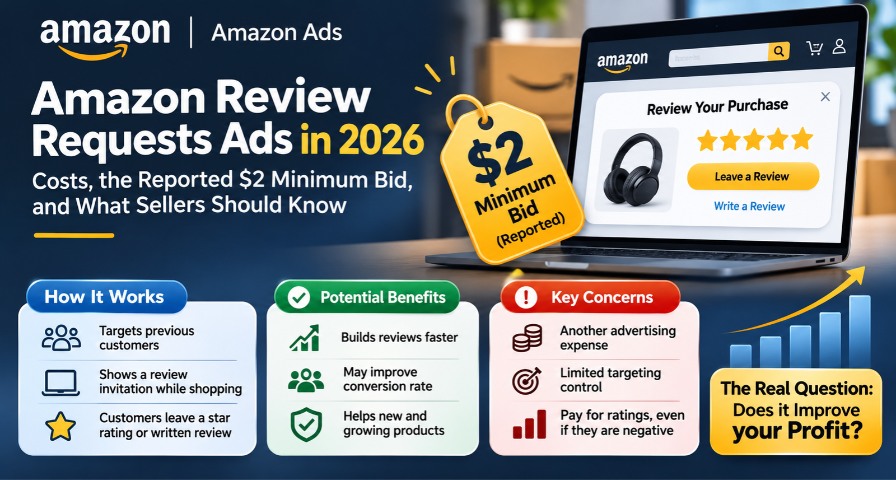
Amazon Review Requests is a campaign format offered through Amazon Ads that targets customers who have previously purchased your product. An invitation to write a star rating or review is presented to the buyer while browsing Amazon. No e-mail needs to be opened nor do buyers need to visit any special landing page. Thus, the format can be more effective than old-fashioned methods.
Eligibility is strictly limited. Amazon performs an eligibility check when a campaign is set up and during its course, while campaigns for a product will automatically stop once it gets 1,000 reviews. Good account standing is required, meaning that sellers who violate the policies will not be able to use it. It is designed for emerging products only.
The Biggest Limitation: Sellers Pay, but Amazon Controls the Audience
It is easy, too easy. The settings available to the seller consist only of the product list, the bid that is set to default, the budget, and the dates of the advertising campaign. Nothing about keywords, match types, or placements it is a step back for everyone accustomed to Sponsored Products.
The audience is not customizable either. Ads will be shown to customers from 7 to 150 days after the delivery. Sellers cannot choose their customers, who will see their ads. When there are multiple versions of a product, one version might get all of the negative feedback. Customers buying at a very low price can have a different set of expectations compared to those buying at regular prices. The seller cannot exclude them, therefore, it is an invitation to whoever Amazon chooses.
It is the true give-and-take in this case. Sellers provide a budget, Amazon decides on targeting, scheduling, and placements. It is fine when products do not vary in terms of customer experience.
Bid, Charge, and Cost Per Review Are Three Different Numbers
The field of pricing requires maximum accuracy, as three numbers are easily confused with one another. The minimum bid is the lowest number that the interface allows for input. The actual fee is the price that Amazon charges for customer actions. Cost per review is your total cost of campaign divided by the number of ratings and reviews that you have.
Regarding the first number, there is no information about this figure. There is just one author who made an analysis using his dashboard, where the minimum bid was $2. Moreover, other authors claim that there is no minimum bid and any benchmark of cost from Amazon. However, early demonstration shows that the default bid could be $0.75. It would be better to consider this number just as a report of interface requirements.
As far as the second number is concerned, Amazon claims that you will be paying only if the customer leaves a rating or review of the card, but not for views, which cannot exceed your bid. Nonetheless, the description of the Support Center page and the Review Requests page do not give clear information on the billing policy of this service.
This example helps to clarify the importance of the difference between the two. In case the seller places a $2 bid and gets 50 actions from customers, the maximum spending in case the seller used such a bid is $100, but only in case all actions were charged at the full amount of the bid. It might happen that the spending will be even less because of the specific algorithm used by Amazon. The $2 bid is only the highest possible bid but not the guaranteed price for one review.
The third chart has its own peculiarity as well. A single star rating has the same significance as a full review, and regardless of whether the feedback was good or bad, you pay for it. Amazon's system separates these types of feedback, and there are indicators related to the number of reviews, written reviews, rating-only reviews, and average star rating.
A Hypothetical Profitability Example
Below is an example scenario and not a prediction. Consider a seller investing $200 and generating 100 reviews. In this case, the cost of each review will be $2, a neat sum that provides no insight into the effectiveness of the campaign.
A better metric to focus on is the net effect, which is the incremental contribution profit minus the cost of the campaign. When these reviews drive sales such that they generate $350 in contribution profit, the net effect turns out to be a positive $150. But if the incremental contribution profit generated is only $120, the seller loses $80 in spite of a successful campaign to grow reviews.
This explains why conversion rate is crucial. Before assuming any sales increase to be due to additional reviews, it is necessary to determine if there has been an increase in conversion rate. Additional reviews are valuable only if they contribute towards increasing conversions.
Three Ways to Generate Reviews, Three Different Jobs
Review requests can be used most effectively in combination with other solutions rather than as a substitute. The free Request a Review function in Seller Central generates a review request through Amazon's system for a single purchase and is distinct from the paid campaign. It requires no payment and should therefore always be active before any spending on ads. Amazon Vine provides a supply of free samples to selected reviewers up to the point where eligibility expires at 30 reviews.
Review Requests covers the space after that. It is ideal for a product that already has reviews, but whose natural review process is too slow. If used in that sequence, the solutions complement each other. In reverse order, the seller is paying for what could have been accomplished with a free tool.
Volume Is Not Quality
Review requests speed up the receipt of all kinds of feedback. For a great product with no reviews, it is a quicker process of building trust. For an average product with varying quality, it will be mixed feedback. For a defective product, it will speed up the disclosure of defects. As one review puts it, "You are paying for access to customers who have already bought from you, and you’re not purchasing a good review."
This way, review collection must come after validation of the product, not before it. Before launching, study your one-star, two-star, and three-star reviews, see the reasons for returns, and analyze customer complaints. If your buyers consistently complain that the socks are small, first adjust the sizing chart and product description. Collecting more reviews about something that can easily be fixed in advance will make it cost you a lot. Amazon guidelines still don’t allow for any review gating, when sellers ask satisfied customers to leave reviews and dissatisfied ones to contact customer service, paid campaigns can’t change it.
Reading the "Three Times" Claim Carefully
As noted by a seller who evaluated the Amazon material, participating products were getting around three times more reviews in their testing period. It's based on the private beta statistics provided by Amazon itself, not on any independent study. The sample size, product mix, spend, and variance between the products are undisclosed. Moreover, even though the number of reviews may be true, three times more reviews does not mean three times more sales.
A Practical Way to Test It
Pick the product that will meet the criteria, such as fewer ratings and reviews, stability in the sales, a good ratio of the return, and absence of any issues regarding quality in the past. Identify the baseline considering the number of ratings, average ratings, conversion ratio, number of weekly orders, sales from the organic searches, and number of reviews without any promotion.
Establish the budget clearly along with the maximum amount that you can pay for the new rating or review without using the excessively high default amount. Carry out the promotion in a time period ranging from two to four weeks and compare the results with the baseline or any other product that was not promoted. It is necessary to exercise caution in establishing the attribution due to the effects of the promotion, seasonality, inventory, pricing, and PPC on the conversion. The results can be tested in the basis of spending, increase in ratings and reviews, average ratings, and conversion ratio.
Is Amazon Monetizing Every Stage of Selling?
This point is well observed by the sellers because visibility comes at a cost, placement comes at a cost, and an accelerator for creating social proof comes at a cost too. Amazon Advertising revenues rose by 11% to $19.64 billion in Q3 2026, revealing the importance of advertisements for the company. This does not justify the need for the review requests feature, and it would be wrong to think so. This just sets the context for the operation of sellers.
The more convincing case will be on Amazon advertising costs and the seller's profit margins. Each paid product appears sensible in isolation, but when taken together, their cost of competing rises. If the sellers have knowledge about their contribution margins, they can choose the appropriate services that cover costs. The sellers that use all the features out of fear of falling behind might see their margins erode silently.
Final Thoughts: Easier Is Not the Same as More Profitable
While Amazon Review Requests makes it easier to generate reviews, easy does not always equate to profitable. There is no need for every eligible ASIN to go through a paid campaign. If the product is experiencing solid growth in organic reviews, then there might be no need to allocate money. On the other hand, a good product that is not gathering enough feedback might be worth running an experiment on. The products with quality issues and those sold by overwhelmed sellers would just make things worse.
Before proceeding, find out if the product is worthy of additional reviews, whether the existing tools are enough, and if proof of profitability is possible. If you have used Amazon Review Requests before, provide your cost-per-review metric.
Ready to Grow on Amazon?
Let our experts help you scale your Amazon business with proven strategies.
Get a Free Consultation
Comments (0)
Leave a Comment