Amazon Review Hijacking: The Truth Behind Fake Reviews
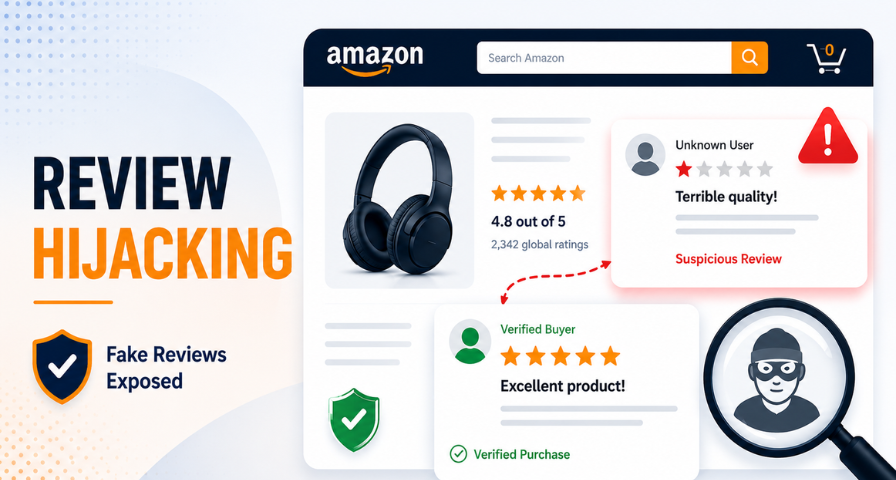
As an Amazon seller, you understand the importance of reviews when it comes to creating your listings. What if some of these reviews were never written for your listings, let alone by any customers who actually purchased your item? This is the issue of Amazon review hijacking, which is silently affecting many sellers each and every day. Almost 80% of U.S. shoppers state that they look at reviews before making purchases, which means that the rating on your product plays a huge role in how likely they are to actually purchase your product. With this understanding of how crucial this rating system is for sales, it makes sense that many fraudsters would seek ways to exploit the system for their benefit. Let's look further into this practice, its importance, and the ways to prevent it.
What Is Amazon Review Hijacking?
Now, let us consider how review hijacking differs from ordinary review frauds. First of all, it is necessary to explain what this concept means. Review hijacking involves hijacking of an ASIN or listing for posting negative reviews intended to harm your reputation or, conversely, reviews promoting other products covertly. As for the mechanisms used, they are rather simple to implement. Any customer can post a review under any Amazon listing, thus enabling an individual to post a negative comment or mention a competitor's product there as an alternative option to your own offering. It is important to note that review hijacking is close to listing hijacking, which refers to taking control of an entire ASIN in order to offer counterfeit versions of the product, resulting in genuine negative reviews left by consumers due to confusion. The difference between review hijacking and review manipulation practiced by Amazon sellers must be clarified at this point. While the former involves a third party taking advantage of others' reviews, the latter includes providing incentives to consumers (cash rewards, free samples of products, etc.) encouraging them to leave positive reviews.
Why Amazon Review Hijacking Is a Major Risk
Why does Amazon review hijacking deserve such close attention from the standpoint of sellers? The truth is that fraudulent reviews are damaging both aesthetically and financially, causing mistrust, distorting rankings, and slowly reducing the overall revenue. This is not something rare, as studies show that nearly all consumers get to stumble upon a fake review once a year. Moreover, large companies that generate lots of traffic and sales become victims of this problem mostly because high visibility equals greater potential losses as excellent reviews translate into high SEO performance and great conversion rates. How does a fake review hurt your listings on Amazon? Quite a lot! First, SEO performance will worsen due to Amazon using review quality as one of the factors to determine ranking positions. Second, there won't be enough positive ratings to make the listing eligible for the highly desirable Buy Box position. Third, the advertising budget is sure to increase. Besides all of the above, there might be a threat of losing your business due to penalties and/or suspension of your Amazon seller account.
How Fake Review Networks Operate
It is easy to imagine an angry rival CEO taking matters into his own hands and staying up late in the night writing one-star reviews, but this is not how review scams normally play out. Instead, there are third parties, who may be specialized review brokers or paid teams formed expressly for the purpose of creating reviews, doing the legwork and writing the fake negative reviews for competing products. This is not a labor of love; instead, the person or group gets paid for his efforts, usually either with cold hard cash or with a product. So where does all this take place? On social media applications like Telegram and WhatsApp, which are far more organized than sellers think until they fall prey to them.
How Amazon Detects and Fights Fake Reviews
The good news is that Amazon isn't sitting idle while this happens. The company enforces a strict anti-manipulation policy and has invested heavily in AI systems that scan thousands of data points within a single review before it ever goes live. This isn't just policy on paper, either. Amazon's enforcement has escalated into real legal action. In 2025, the company seized control of dozens of domains openly selling five-star reviews, and just this past February, it filed lawsuits against additional companies running similar schemes. For sellers, this means there's an actual safety net in place. Amazon automatically removes reviews it flags as suspicious, and sellers can also report and request removal of fraudulent reviews themselves, which we'll walk through next.
Warning Signs of Review Hijacking on Your Listings
How will you be able to tell when you have been victimized? Although this can seem difficult to detect, there are tell-tale signs. A dramatic increase in one-star reviews over a single night is a surefire way of knowing that something fishy is going on, particularly if there have been no changes made to the product or service that could cause this to happen. When you come across a review that makes claims not associated with your product at all, such as complaining about the quality of cosmetics on a frying pan listing, then you can be sure that this is review fraud. If the content of a review references an entirely unrelated product, then chances are very good that the reviewer is a fraud attempting to steer buyers towards an alternative listing. A drastic swing in average rating or a poorly composed review filled with grammatical errors or one written entirely by artificial intelligence should raise red flags. Check to see if the review was marked as a Verified Purchase, as frequent buyers generally qualify for this. Another good indicator is finding out that the account from which the review originates has no other review history at all.
How to Protect Your Amazon Listings
What can be done by sellers to protect themselves from review hijackers? First and foremost, sellers have to take preventative measures and be able to act quickly when it becomes necessary. For example, sellers need to monitor all their reviews, including images and videos, in order to detect suspicious activities before they bring any negative consequences. Sellers could also register for Amazon Brand Registry, which is a free service provided by Amazon where sellers can trademark their products. Good listing integrity will also come in handy when dealing with fraudulent activities. With visual branding and logos, you will easily recognize whether something looks suspicious. In addition, when you discover any suspicious activity in the form of a review, you need to click on the Report button and then provide your comments via Amazon's reporting system. If you would like to generate some legitimate reviews, you should not have any difficulties doing so. Amazon provides its sellers with Amazon Vine, Request a Review, and a good package insert that will surely help generate genuine reviews.
Building a Sustainable Review Strategy
This is not a mere inconvenience but a real threat to your reputation, rankings, and sales! People who do well in this business do not act when everything has become bad for them. Instead, they stay vigilant, monitor regularly, and create their system of defense right from Day One. That means concentrating on factors that can actually generate trust in you and what you do: high-quality products, branding, effective marketing, optimization, communication, and increased efficiency of operations. Today, it's trust that generates sales. Are you prepared to accept the truth about your Amazon review hijack?
Ready to Grow on Amazon?
Let our experts help you scale your Amazon business with proven strategies.
Get a Free Consultation