Amazon Review Count Drop 2026: Why Sellers Are Suddenly Seeing Reviews Disappear
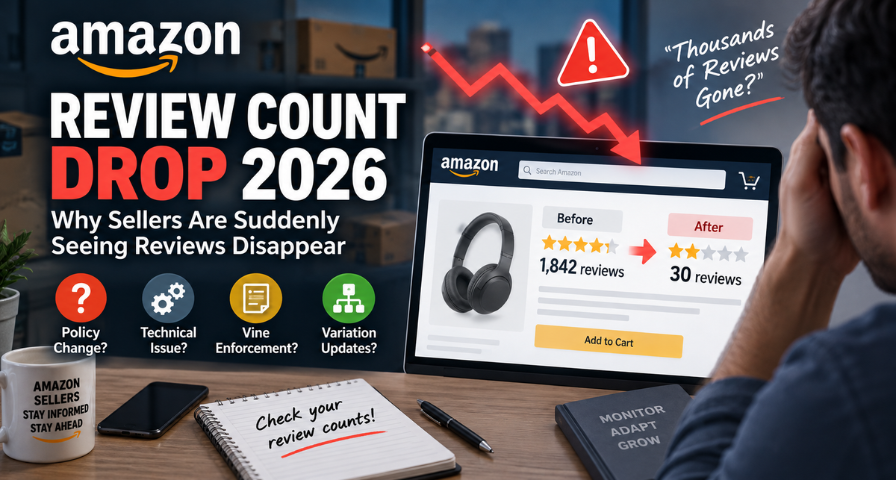
However, if you have a business on Amazon, it might be worthwhile to check the number of your reviews right now. Over the past two weeks, a trend has been developing among the US and German seller communities that cannot simply be written off as the result of the usual changes in Amazon policy. Listings with consistent review numbers for months, sometimes even years, suddenly see their history disappear in a single day, without any notice or explanation. One user reportedly saw one of their listings drop from around 180 reviews to 30, including Vine reviews. Other reports suggest that individual ASINs are losing 1,000-2,000 reviews per day. It cannot be overlooked when the same phenomenon is seen in different accounts and in different marketplaces at once.
This article will cover all the information available about the phenomenon of September 2021 drops what is confirmed by Amazon, what sellers report, and how big the gap between the two is right now. There is no question about the fact that right now, no one besides Amazon knows what causes the September drops of 2021.
What Sellers Are Reporting
The reports share a few consistent features. The drops are large relative to the listing's history, not the kind of small fluctuation Amazon's review system produces routinely. They're arriving without any advance notice or after-the-fact email. They're affecting accounts that, by the sellers' own account, haven't recently merged, split, or restructured their variation listings. And in at least one case, the loss extended to Vine reviews specifically, which sellers generally expect to be more stable since they come from verified, incentivized reviewers rather than the open public. None of that proves a cause. It does establish that this isn't an isolated account issue.
What Amazon Already Changed in 2026
One verified change that needs consideration despite the fact that, as will be seen in the next section, it does not necessarily explain the current situation that needs mention for its context. On February 12, 2026, Amazon revealed that it would be changing its policy on the way reviews are shared among different variations in a product family with the aim of ensuring accuracy in that customers would view reviews relevant to the exact products they were looking at and not reviews of all colors, sizes, or types available under the same listing. Earlier, reviews could be shared among all variations of a product even when these had slight differences that could have some implications on the functionality of the product. According to the new policy, shared reviews could still apply to variations that were deemed insignificant and non-functional in terms of color, pattern, and pack sizes.
Why Variation Review Sharing Matters
The reason why this policy matters in any discussion of disappearing reviews is because it changed what was meant by the term “review count” for that particular listing. Prior to this, a variation which had received good reviews could pool the number of reviews with a sibling which had either launched more recently or hadn’t performed quite as well. Now that this has been altered, that pooling will not occur anymore if the variations are determined to be different enough. Thus, simply having a lower number of reviews does not automatically mean that one has been taken away from the system. Instead, it simply means that the review remains there and is attached to the account, but is no longer used to boost another child ASIN’s count. The distinction between deletion of reviews, separation of the reviews among ASINs, and merely altering how they are counted/displayed is the most critical part to consider when trying to analyze any individual instance of this.
The Vine Review Question
Vine reviews disappearing is not, by itself, a new complaint. Sellers have described Vine reviews vanishing one at a time, sometimes within a day or two of posting, in cases tied to merging or unmerging variation listings, where Amazon's own guidance has been fairly direct that review retention isn't guaranteed once a variation relationship changes. Separately, some industry sources have described a tighter cap on how many stacked Vine reviews a single ASIN can carry within a marketplace, aimed at curbing the older tactic of inflating review counts through repeated Vine enrollments funneled into one listing through variant merges. That would be a legitimate enforcement action if accurate, and it would explain losses on listings that had been stacking reviews this way. It's worth being cautious here, though: that specific cap figure comes from third-party industry commentary rather than a primary Amazon announcement, so it should be treated as a reported detail rather than confirmed policy. What it doesn't obviously explain is a clean, single-variation listing with no recent merge history losing the bulk of its organic review record overnight, which is closer to what several of the current reports describe.
Why September Is Different
This is the part of the story that actually deserves the most scrutiny, and it's the question that makes this moment more interesting than a simple continuation of known policy. Amazon's variation review-sharing rollout was scheduled to be complete by May 31, 2026. The reports being described now are landing in the third week of September, roughly four months after that window officially closed. If the current wave were simply the same rollout playing out on a delay in a handful of categories, that would be a reasonable, almost mundane explanation. But four months is a long gap for a "delayed rollout" story to still be the full picture, especially when the accounts affected span different categories and two different marketplaces at once. That gap is the strongest reason to treat the September reports as something that needs its own explanation, rather than folding them into the spring policy change by default.
Four Possible Explanations, Held Separately
With that in mind, it's more useful to hold four distinct possibilities apart rather than reaching for one. The first is that the variation review-sharing policy is still being enforced or expanded into categories or edge cases that weren't touched in the original window, which would mean the rollout simply isn't finished everywhere. The second is stricter Vine-specific enforcement against review stacking or improper variant merges, which would legitimately reduce counts that had been artificially inflated. The third is a technical or catalog-aggregation error, something Amazon's own seller forums have documented before in smaller-scale cases, where a listing's displayed rating or count shifts without any underlying review actually being touched. The fourth is a newer enforcement action or system change that Amazon simply hasn't announced publicly yet. Each of these would look similar from a seller's dashboard. None of them can currently be ruled in or out with confidence based on public information.
What a Review Count Drop Can Mean for a Business
Regardless of what the cause might eventually turn out to be, the practical implications would be significant. If there is a sudden drop in review counts, this will reduce the amount of social proof available to customers on the listing in question, and reduced social proof would negatively impact customer confidence and ultimately conversion effectiveness. This is a fair and defendable assertion to make. To say, for example, exactly how Amazon ranks or advertises products based on the number of reviews received is a separate assertion that does not have sufficient information available to make with confidence, as Amazon has not made such information public. The safer approach is to say that a listing that appears less established because of a reduced star rating or reduced number of reviews, is going to convert less effectively until it is established again.
What Sellers Should Check Right Now
The most useful thing any seller can do at this stage is build a record before drawing conclusions. That means capturing, for every listing you're concerned about, the parent ASIN's review count and the review count on each individual child ASIN, since these can diverge in ways the front-end display doesn't make obvious. It means noting the star rating alongside the review count, since a rating change without a matching review change is itself a distinct signal worth flagging separately. It means checking the Vine dashboard specifically if you've enrolled a product in that program, since Vine counts and public-facing counts can disagree. And it means logging the date and time you noticed the change, along with an honest note about whether you've made any recent catalog edits, variation merges, or splits, since that context will matter enormously if you end up filing a case with Seller Support or escalating through an account manager. A dated, specific record is worth far more than a general complaint once you're trying to get Amazon's attention.
Beyond documentation, it's worth auditing your variation structure with fresh eyes regardless of whether you've been hit yet. If any of your listings group products together in ways that stretch the definition of a minor, non-functional difference, untangling that now is safer than waiting for enforcement to force the issue. And it's worth resisting the temptation to rebuild a lost review count quickly through incentivized reviews outside of Vine. Amazon's detection systems have reportedly gotten more capable over the past year, and a review count rebuilt through risky shortcuts right now is exactly the kind of pattern likely to draw more scrutiny, not less.
What We Still Don't Know
To be direct about the limits of this article: Amazon has confirmed a change to how reviews are shared across variations. Sellers have reported major, unexplained review-count changes, some involving Vine reviews specifically, across multiple unrelated accounts and two marketplaces within a short window. What hasn't been established is a confirmed link between those two facts or confirmation that Amazon has launched any new broad review-enforcement action in September. The gap between the known spring rollout and the current reports is real, and it's the detail most worth watching for an official explanation from Amazon in the coming weeks.
Final Thoughts
The most reasonable conclusion is the following one: Amazon’s review sharing policy of 2026 has indeed taken place; however, it does not necessarily mean that everything happening can be explained by those changes. The sellers need to make sure that they document all that they see and analyze their own variations' structure. Moreover, the analysis of problematic ASINS needs to be done at the level of a child and not just at the total front-end number of reviews. One needs to keep in mind that the reduction in the displayed number does not necessarily mean that all those reviews were deleted forever.
Ready to Grow on Amazon?
Let our experts help you scale your Amazon business with proven strategies.
Get a Free Consultation