Amazon Removes the Variation Wizard From Seller Central: What Sellers Need to Know
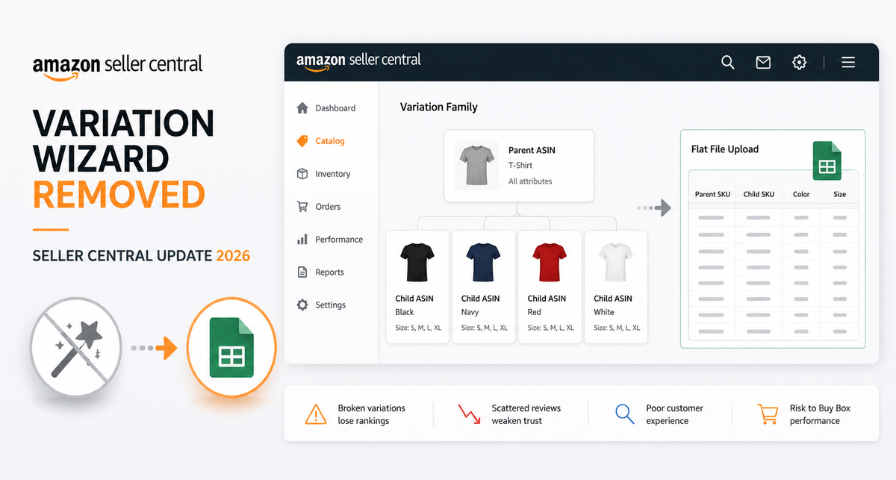
For as long as sellers could remember, the Variation Wizard was the standard tool within Seller Central for creating or modifying parent-child relationships at Amazon. This powerful tool allowed the creation of associations between products based on the selection criteria, a particular t-shirt grouped by size and color or a skin care range by scent. No more! Amazon has pulled the Variation Wizard out of Seller Central, and now sellers are encouraged to use the alternative approaches to managing parent-child associations, such as search, flat file templates, and blank forms.
This is not a cosmetic change. Variation management is one of the key issues that affects catalog management, from product discovery through search engine results to inventory management. Those who understand what happened, why it happened, and how to proceed will be able to manage their catalogs efficiently.
Why This Change Matters More Than It Seems
Upon a superficial analysis, the idea of deleting just one tool does not seem to be a major change in operations. However, the truth is that the Variation Wizard was the least complicated way of getting into things for sellers who found the whole concept of dealing with spreadsheets and data fields too complex. The process is indeed a rather complicated one, even though it may appear to be simple at face value.
With the wizard gone, that guided simplicity disappears too. Sellers now have to lean on tools that require a steeper learning curve. Search-based creation and blank forms can work for smaller catalogs or one-off adjustments, but for anyone managing dozens or hundreds of variation families, flat file templates become almost unavoidable. That's a meaningful shift in workflow, especially for sellers who built their entire catalog management process around the wizard's interface.
A Simple Example of What Changes
Consider a seller who wants to add a new blue color option to an existing t-shirt listing. With the Variation Wizard, this was a guided process. You selected the parent listing, chose the variation theme, entered the new attribute, and the system walked you through the rest while checking your entries along the way.
However, now this process goes through a flat file where the seller will need to input manually Parent SKU, Variation Theme Name, Parentage Level, and Child Relationship Type in proper row and column formats as per Amazon's requirements for that particular category. In case of incorrect inputting of the parent SKU or in case the variation theme is not within the allowed range for that category template, the whole uploading process may fail completely, and, which is even worse, the newly created child ASIN may become orphaned from the parent. The once two-minute task has now become vulnerable to formatting errors.
Why Amazon Is Making This Shift
Amazon rarely removes a tool without a broader strategic reason behind it, even when the company doesn't spell that reason out explicitly. Variation management has been a persistent source of catalog issues, including sellers stretching variation themes to group unrelated products together, inconsistent data across parent-child families, and listings that confuse buyers rather than help them compare options. Flat file templates give Amazon tighter control over exactly what data gets submitted and how, since the structure is standardized and validated against category-specific rules.
This move also fits a pattern Amazon has followed for several years now. Seller Central has been gradually shifting away from simplified, guided interfaces and toward standardized, template-driven workflows across many areas of the platform, not just variations. Bulk listing tools, inventory management, and even certain compliance processes have all moved in a similar direction, favoring structured data submissions over manual, click-based tools. Seen in that light, the removal of the Variation Wizard isn't an isolated decision. It's part of a longer trend of Amazon consolidating catalog control around flat files and standardized templates, likely because they scale better across thousands of categories than a guided interface ever could.
The Practical Impact on Everyday Sellers
For sellers that were dependent on the Variation Wizard, especially the smaller sellers or those who are still relatively new to the Amazon world, this will be a significant shift in how cataloging is done. Activities that took only a few minutes are now going to involve generating an export, editing an Excel sheet, and uploading back through a flat file while waiting to check whether the change has taken place properly.
This also raises the stakes for accuracy, and the consequences of getting it wrong go beyond simple inconvenience. Variation errors can affect how reviews are aggregated across a family of listings, since a broken parent-child link can scatter reviews that were previously pooled together, weakening the social proof a listing depends on. They can also hurt search visibility, since a fragmented variation family loses the combined sales history and relevance signals that helped it rank in the first place. Customer experience takes a hit too, since shoppers expect to see all color or size options on one page, and a broken variation forces them to search separately for what should have been a single listing. In more serious cases, these errors can even affect Buy Box performance, since disrupted listings sometimes lose the sales momentum and consistency that Amazon's algorithm rewards. None of this is guaranteed to happen with every flat file mistake, but the risk is real enough that sellers need to treat variation edits with more care than the old wizard ever demanded.
Preparing for a Flat File Future
At this point, sellers should learn how to upload flat files as part of their basic requirements rather than as an additional skill. It involves knowing the structure of variation themes per product category, which fields are mandatory and which are optional, and being able to export the category listings report to analyze variations prior to uploading the updated flat file. Sellers can also conduct a small-scale trial run on selected listings to see how the new changes work and prevent any possible disruptions throughout the whole catalog.
Large or complex catalogs can benefit from the assistance of catalog management specialists or using third-party software developed specifically for flat file creation and validation. The use of such software would allow detecting potential problems with formatting and avoid listing breaking up in Amazon's system. Small catalogs will only require several hours of practice with test listings and reading Amazon's documentation on flat files to master the new process.
Key Takeaways
The elimination of the Variation Wizard is definitely a milestone for how Amazon wants sellers to handle the relationship between parents' and children's SKUs. Instead of having an easy and relatively risk-free option for creating those connections, Amazon forces sellers to have a certain level of technical expertise in using flat files, search-based linking, or even manually filling out forms, and the risks of making mistakes go far beyond organizational issues affecting everything from reviews to search ranking and even Buy Box performance. Moreover, this is not an isolated instance of a change at all. In line with the trend of pushing Seller Central towards template-oriented workflows, sellers with an understanding of catalog structures would be ready for any future platform changes.
Ready to Grow on Amazon?
Let our experts help you scale your Amazon business with proven strategies.
Get a Free Consultation