Amazon Q4 Pricing Strategy: How to Stack Discounts, Protect Profit, and Find Your Price
Imagine two competing listings appearing on the same page in the search results. You have one review, while your competitor has twelve hundred. Even though your photos are better, your text is more compelling, and you probably even have a superior product, the buyer chooses the competitor listing without giving it another thought. This situation happens in the fourth quarter when the buyer is in a rush and the competition is fierce, which is why that difference in the number of reviews costs a new seller much more than anything else.
However, writing will not get you out of this hole, while pricing will allow reducing its negative impact. When building a Q4 Amazon pricing strategy, you should use an attractive initial offer in order to decrease risk perception of the buyer and gradually test your sales price. The idea is not only to appear cheaper to the buyers. What you should do is attract early buyers, understand the pricing range of your offer on the market, and ensure the profitability of every transaction. Further, I will discuss how three savings signals could work together, whether the discount could be sustainable, and how to raise the price.
The Conversion Stack: Three Savings Signals on One Listing
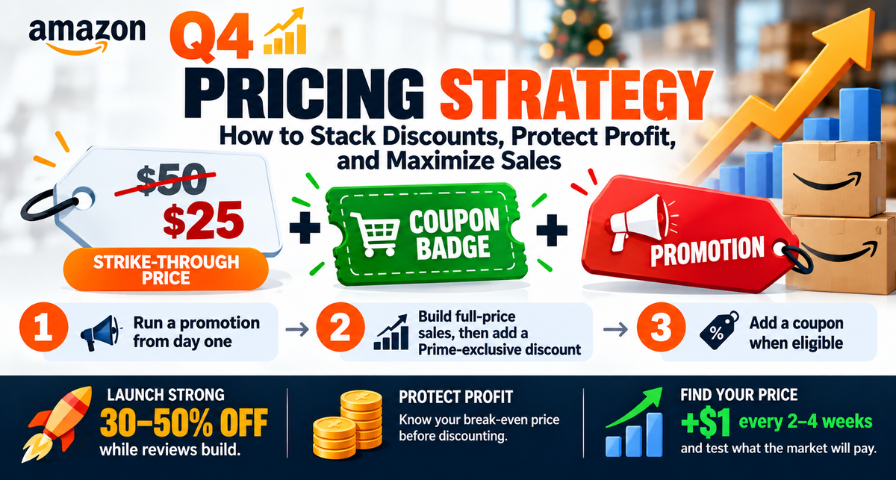
How does this work? There can be up to three different types of savings on a product page simultaneously: a strikethrough price, a coupon icon, and a promotion. Customers do not add those discounts together and rather interpret them as different types of gains, which will encourage them to click that buy button. Seeing all three savings on the product page will be interpreted as a combination of gains in favor of the customer, regardless of the total savings being equal to one big discount.
However, there are eligibility criteria for each of these savings types thus, you cannot combine them on one product listing at will. The right order of actions has three steps: first, use a promotion as soon as you start using this listing, as it is the only tool that you have right out of the box. Second, generate sales at your normal price point and launch the Prime exclusive discount as soon as you become eligible for it. Third, include a coupon as soon as you are able to do so.
Why a Launch Discount Works and What It Cannot Do
The buyer who is checking out your product with only one review in mind is not balancing the features of your product. They are balancing risks. Will your product be delivered in damaged condition? Will it break down in a few days, or will it look nothing like the images you show in your listing? Reviews usually address all those concerns, and the new product listing does not have reviews yet.
A good discount will change the numbers. If the fifty-dollar product is listed with thirty dollars off the price, then the customer’s thinking may shift from "Can I trust this product?" to "At this price, I should give it a shot." Essentially, you are paying people to try something new. Many launch strategies use discounts between 30 and 50 percent. Do not view this as the rule. The appropriate level for your product will depend on your margins. More about margins in the following sections.
It is equally important to know what the discount is unable to accomplish. The discount will bring buyers, but the act of buying does not mean getting reviews. Buying and the creation of reviews are two distinct things that are connected. Consumers write their reviews on their own accord, and you should stick to the Amazon-approved ways of asking or earning reviews. Be prepared for the reviews to come slowly compared to the rate of sales.
Set a Defensible Reference Price and Test Your Selling Price
The simplest method of presenting a low price is by using a low list price. This looks simple, but this means eliminating the reference price that makes the offer seem like an offer. A price of $25 without any reference is just a number. It could also make shoppers associate the item to the $25 product, making future increments difficult to justify.
A better method involves choosing a reference price that is defensible and creating a launch discount based on it using promotions and coupons. The term "defensible" is important because a reference price is only relevant when it represents an actual price that the product has been sold at or is being offered for sale. An exaggerated figure that nobody has paid will not stand and could damage the shopper’s perception of it.
The price at which you sell your product is nothing but a hypothesis that must be tested. Costs fluctuate, the competitive environment redefines the market, and at times, even a product launch might make you realize that the price you had originally set for your product was simply wrong. When that happens, the only way out is a permanent change in price.
Strike-Through Pricing and Amazon’s Eligibility Rules
Of the three, the strike-through appears to be the most conditional since it requires the platform to accept the legitimacy of a reference price. The platform’s requirements for the strike-through have become stricter than before, as well as the algorithm used to calculate the typical price. Overall, it can be stated that the platform would like the presence of a reference price to be based on actual purchases or reliable offers for it.
In light of that, I am not going to present any kind of formula, which would include an arbitrary amount of orders that would automatically enable the display. Such figures cannot be promised, because everything changes, and the conditions may vary. The right way is to create a genuine pricing history with the help of actual customers purchasing at actual prices and checking the present eligibility requirements on Seller Central. It goes without saying that making purchases artificially for the purpose of enabling the display or changing the price in order to make one is not the best idea. It is a signal of manipulating listings and can put your account in danger. The absence of the strike-through means that a promotion and a coupon can do their job for you.
Run the Numbers: Break-Even Price and Discount Capacity
Before you decide on what not to accept, you have to know how much you can go. Say, for instance, you have an item with a marked price of $70, a landed cost of $16, a referral fee of 15%, and a fulfillment fee of $7. This is just an example, use your own figures.
The total referral fee is $10.50, leaving you with $36.50 after taking into consideration the landed cost, fees, and fulfillment without advertising. Apply a 40% discount on the launch price, giving you $42. The referral fee is now $6.30, and the contribution before advertising is $12.70. If you spend $8 in advertising for each sale you make, the contribution is $4.70.
But the more relevant one would be the level of the floor itself. Since the percentage of the referral fee decreases with a decrease in price, you will receive 85 cents out of every dollar of the sales price in this case. Hence, your fixed costs ($23 – landed cost plus fulfillment) would have to be recovered from a sales price of $27.06 to break even before advertising expenses are accounted for. When accounting for an additional $8 per sale in terms of advertising, your break-even price would be around $36.47. Considering that the reference price is $70, you can say that the maximum allowable discount, at which point you start losing money on each sale, is 48 percent in this case, while any discount deeper than this is just a subsidy. A zero profit from a sales price discount is not really a strategy; hence, most sellers will have a minimum contribution per unit and plan from there. For instance, if you want to have at least $10 in contributions after advertising, your sales price should be about $38.82.
It is contribution margin profit based on specified assumptions; it is not yet net profit since other costs like storage cost, return cost, overhead cost, and other expenses have not been considered. Hence, it is advisable to leave a buffer while determining the floor. It will depend on your own calculations whether you can tolerate a low margin during the initial days because of the increased sales volume.
Sometimes, you might encounter other guidelines such as selling the product at three to five times landed cost or not purchasing products below a certain retail cost. These are just guides, and it is not mandatory for all businesses to follow them; it will solely depend on the cost incurred by your business. There is also the popular guideline that more expensive items have reduced advertising costs. Sometimes, it may be true; however, you need to calculate cost per click and conversion rate per item.
Finding Your Ceiling One Dollar at a Time
Once the listing gains momentum, there’s a staged process for determining the amount of money people are willing to pay. You can start listing the product at a higher cost, such as $69.99, and then introduce it to the market at a lower cost, such as $59.99, and then gradually increase the price by $1 to $60.99, then to $61.99, and then on until $69.99. A recommendation here is to give 2-4 weeks between stages, although it should be treated as an initial period and not as a guarantee of good results.
The critical element is not the timing but the decision rule. Prior to each price increase, establish a baseline for the price that prevails prior to the increase: conversion, daily sales volume, daily revenue, and daily contribution margins net of advertising. Following the increase, compare the relevant metric over a similarly-sized period. Keep moving up until it is justified to do so. If conversion and sales remain constant or decrease by an amount smaller than the added margin per unit, contribution margins are increasing, and the next move is justified. If there is a sharp drop-off in conversion and a drop in total contribution margins, revert to the old price level.
But do not blame the price for everything. There could be seasonal changes, a stock-out condition, the lightning pricing offered by competitors, or even a variation in the volume of traffic due to advertising efforts. Compare apples to apples, alter only one variable, and be ready to wait with the price a little bit longer, if necessary. Once you discover that certain level of sales beyond which profits begin to decline, decide upon the price about one or two dollars lower and use it for your operations until the circumstances change.
Reviews, Vine, and the Price Reviewers See
It makes sense to obtain those reviews via legitimate means since they are the ones that will give you the reason for having the launch discount. The product can be eligible for the Vine program. This way, it can get credible reviews faster than if it had to rely on organically acquired customers, depending on the nature of the product and its category.
There is one point which needs to be highlighted. Reviewers are able to see the price. This can affect how they review the product. Having an insanely low price can make them think that the product is not worth it. It can also give the impression of low quality of the product. The price should be reasonable. There are differences between getting reviews through Vine and through customers.
Fulfillment: A Small Test, Not a Rule
It makes sense to obtain those reviews via legitimate means since they are the ones that will give you the reason for having the launch discount. The product can be eligible for the Vine program. This way, it can get credible reviews faster than if it had to rely on organically acquired customers, depending on the nature of the product and its category.
There is one point which needs to be highlighted. Reviewers are able to see the price. This can affect how they review the product. Having an insanely low price can make them think that the product is not worth it. It can also give the impression of low quality of the product. The price should be reasonable. There are differences between getting reviews through Vine and through customers.
Your Q4 Action Plan: Three Outcomes That Matter
Ignore the specifics and it all comes down to three results. First, you get people to buy your product. Promote your product, give it a Prime exclusive discount, and offer a coupon as it gets eligible. This way, you ensure that there is enough credibility for a customer to test your unknown item. Second, you test customers’ willingness to pay for your product. Once your sales become consistent, you slowly increase your price in steps and evaluate the effectiveness of each increment in terms of conversions and contributions. Finally, you protect your profit margin. You know your break-even point before offering any discounts. You have the minimum contribution from every unit and make sure that you stay above that line at every price level.
First of all, make sure that you comply with Amazon's pricing policies. Reference pricing keeps changing, so it is important that you meet them now. Instead of asking yourself how low you should go, ask whether it is possible for you to appear as a great bargain without turning yourself into a cheap product. If you do this successfully, you create a bridge to your price.
Ready to Grow on Amazon?
Let our experts help you scale your Amazon business with proven strategies.
Get a Free Consultation