Amazon Product Validation: How to Identify Profitable Opportunities Before Investing in Inventory
Amazon Product Validation: How to Identify Profitable Opportunities Before Investing in Inventory
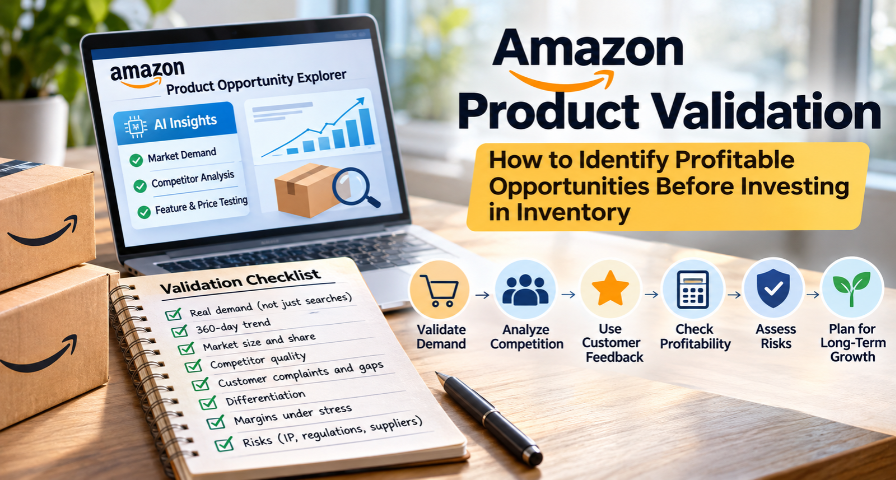
Amazon continues to update its Amazon Product Opportunity Explorer, and the updates are really helpful. Now you can use AI to discover untapped demand, benchmark your idea against competitors who sell similar products, and evaluate features and pricing before ordering anything from manufacturers. Tasks that used to require expensive third-party software are done in mere minutes.
While better tools did not solve the oldest blunder in product research for Amazon private label products, however. The seller notices growing search volume, becomes excited, and starts asking for samples, but no one considers whether the idea is even worth developing. Amazon product validation determines whether you are building a long-lasting brand or simply cluttering your garage. This article will cover all the basics a seasoned product research specialist would never omit, regardless of how smart the software becomes.
What Has Changed and How to Use It
Upgrades make searching for anything much easier. Artificial intelligence enables you to identify gaps in the market, competitors enable you to see what your potential opponents are going to be, and testing ideas and prices allows you to assess the potential viability of an idea. There is no doubt about it Amazon clearly aims to make sellers more knowledgeable when it comes to making investments.
However, the ability to act quickly brings in another issue. Previously, several days had been required for carrying out some research, but now anyone can find potentially profitable ideas in a matter of minutes. This is why having a well-thought-out workflow becomes extremely important. Rather than starting with the product itself, it would be wiser to consider its need, analyze the niche data in Product Opportunity, see what the listing competition is, and test the idea and its price.
Demand Is Not the Same as Search Volume
A keyword with 100,000 monthly searches may seem like quite an achievement, but searches indicate only interest; nothing else. There are many high-volume keywords that relate to products that are being looked at, compared, and left by the consumer.
A better measure of demand would be purchases and their analysis. It is important to see what conversion rates you have with the use of searches, if your sales are consistent or concentrate in one season, and how revenues are divided. In the case of diversified sales across many products, an entrant will have a real chance to make some profits. If the market is dominated by a couple of players, then you will be knocking at a closed door.
In addition, there is another pitfall in the analysis of demand. Searches and category demands are two different things. A particular product can be found under many keyword varieties, and thus the sum of all these volumes will represent a doubled number of consumers.
Look at the Full Year, Not a Flattering Snapshot.
The thirty-day period makes virtually any business look healthy since the sudden surge of demand works wonders until its end. A year-long timeframe will help you understand if you face real growth, flatness, or the end of a trend.
A November spike doesn’t necessarily mean that the business is bad, but rather you should be aware of such an issue before making an investment decision. The seasonal factor affects the company’s cash flow and the time during which its capital will be frozen waiting for the next peak season.
Follow the Money and Be Honest About Market Share
When it becomes clear that there is demand, figure out the overall revenue, average selling price, and units sold per month for the niche. These figures reveal the size of the pond, but not how much of the pond you have access to. The important issue is how much the newcomer will be able to capture.
Several million in sales in a niche sounds impressive until you realize that the dominant players in the market have thousands of customer reviews and high rankings. It is better to capture a realistic share of the profitable niche than to capture an imaginary share of the huge one.
Judge Competitor Quality, Not Just Competitor Count
Low competition may often be a problem, as markets with few sellers could actually be markets in which there are no takers for the product at all. The quantity could give a false impression as well. There may be five hundred sellers who have very few reviews or pictures, but they are easier to beat than twenty sellers.
Evaluate the brand concentration, reviews by the top sellers, advertising, and whether or not they have pricing power. Top performers who have good margins are difficult to unseat. The poor performers who compete on a percentage basis are not even worthy of entering into the market.
Separate Market Gaps from Profitable Opportunities
The one-star reviews and reasons for returns provide a free development brief by disgruntled customers who put down their money and were not satisfied. This gives the information about the flaws and defects as well as what could have been done differently.
Not every problem represents an opportunity, however. It needs to be tested against three parameters. Does the need for implementation of this solution apply to many customers or just a few reviewers? Is the solution implementable from a technical point of view and affordable? Are customers willing to pay extra for it? The toughest question is why should the customer buy it from you instead of the bestseller? And if the answer is, "The same thing, but cheaper," then your foundation is sand, since a competitor will easily take away this advantage with a lower price.
A Worked Example: Reusable Food Storage Bags
The figures below illustrate how everything connects. Picture a seller analyzing reusable food storage bags. The demand pattern shows constant purchases throughout the year with a slight boost in the summer, and revenues are diversified across numerous brands. The competitors are good but not great. The negative reviews say the same thing: the zippers stop working after several washes.
This is what can be called a potential gap in the market. It is common enough and solvable by improving closure and using heavier materials, and the reviews indicate consumers would be willing to spend extra money on bags that work for a while. The seller estimates the cost at $24.99 against the cost of the landed product at $6.50. Amazon charges $9.00 in fees (a 15 percent referral fee of $3.75 and a $5.25 fulfillment fee). The returns and storage cost $1.00. This leaves $8.49 for each bag without accounting for the marketing, or 34 percent of the cost. In theory, the concept is sound. The next part will determine if it holds water.
Stress-Test Margins and Learn Break-Even ACOS
However, there is often little congruency between the margin on the paper and the margin in practice. Gross margin does not account for advertising costs, returns, and inventory, and thus contribution margin is the more valuable metric, which represents what is left after everything but the cost of advertising. Break-even ACOS is the ratio of contribution margin to price and thus is product-specific and cannot be used universally as a target. In our case, $8.49/$24.99 = 34 percent.
Here, focus on the plan and clarify assumptions. With the launch campaign spending 30 percent ACOS, that would mean $7.50 per product on ads, leaving only $0.99 per unit, after paying all the costs previously mentioned. Then, reduce the price by 15 percent to $21.24 to compete with another seller. This way, the referral fee is reduced proportionally to the price reduction and becomes $3.19, while the fulfillment fee remains $5.25, since it is not dependent on the price. Contribution becomes around $5.30, the break-even ACOS is reduced to around 25 percent, and spending 30 percent of the ad budget amounts to $6.37 per unit, resulting in losses of approximately $1 per sale. In case you incorrectly considered all fees as fixed, then the outcome would be even more unfavorable, and this is the reason why the differentiation between them is crucial. TACOS should be tracked as well.
Mind Your Cash Flow and Advertising Dependency
Per unit profit shows only half the picture. For example, if the vendor requires 1,000 items, then for us, the seller, we will have $6,500 spent on purchasing the item, and it will lie untouched for months before the first order is made. Take into account the waiting period to reorder, how quickly the item sells out, and how much money flow can be invested.
Think about whether the item will provide natural or paid orders. Competition, high cost per click, and the need to compete with other ads of competitors can completely ruin all your calculations.
Validate the Market, Then Validate the Product
These are two distinct positions. Market validation indicates that the consumers have a need for a product similar to yours. Product validation means that your particular product, with its unique design and quality, will meet that need. One could excel in the former and fail in the latter.
Order samples from multiple vendors, test them rigorously, and see how they measure up against your competition. Perform quality testing prior to mass production and get feedback from a few real consumers. In our case, it all depends on whether the innovative closure will withstand several washings, and that can only be tested physically.
Weigh the Risks, Including Intellectual Property
Every product comes with risks that will never come up in a keyword report. There could be regulations requiring testing, there could be difficult manufacturing that leads to defects, and unreliable suppliers ruin product launches. It's almost a certainty that people will copy your product if it succeeds, so it's best to know what you'd do from the start.
Your intellectual property must get checked separately, and this must occur well before you order your first inventory, not after you have an item ready for launch. Utility patents guard functionality; design patents guard appearance; and trademarks guard names. An item can legally be manufactured but illegally violate another patent or trademark. A cursory search does not mean the product is cleared, so if any conflict arises, consult a lawyer.
Build a Validation Scorecard
In the event that you have to compare multiple alternatives, instinct will make a bad judge. A simple weighted scorecard will ensure consistency in the process. Rank each of the products between 1 and 10 for the following criteria and their weights: demand for the product 20%, profitability 20%, competitive landscape 15%, customer issues 15%, differentiation 15%, risks in operation and legally 10% and possibility of brand expansion 5%.
Let us assume that the scores for our bag idea are 8 for demand, 6 for competition, 8 for customer issues, 7 for differentiation, 5 for profitability, 7 for risks and 6 for expansion. Multiplying the scores with their respective weights and adding them gives a score of 6.75/10. Determine your cut off point before scoring the products to ensure that enthusiasm does not shift goal posts. Not forgetting that an extremely high score cannot override any failure.
A Practical Five-Question Check
Given limited time, answer five questions concerning one product and pre-determine your criteria for “strong evidence.” Is there persistent demand for buying? Strong evidence includes stable sales and conversion throughout the year. Is there a possibility for a new product to be competitive enough? Find diverse revenue streams and beatable competitors. Do you know what customers hate about the product? Repeated complaints make up strong evidence, but a negative review is not enough. Can you make something truly better? There should be an implementable solution that is based on samples and that customers would pay for. Will it stand the test of time? There should still be profit after lowering the price, increasing advertising expenses, and accounting for the inventory requirements.
Validation requires finding ways to disprove the hypothesis. If you can’t provide positive answers to all five questions, you have work to do.
Final Thoughts: Protect Your Capital, Not Your Excitement
AI could help sellers find opportunities faster, but disciplined validation is what would make those opportunities worthy of their investment. Product Opportunity Explorer will help to generate ideas faster than ever before, but the discipline of testing the ideas and saying no would remain with you.
Before you approach a seller, test the demand, analyze the whole year, assess the finances, check the complaints, pressure the margins, and validate the cash flow. Do not be afraid to let go of the idea of a product that is simply not worth pursuing. Finding out about the deficiency of a product when you are still in the research phase takes a couple of hours of work, but discovering it after you pay the manufacturer for it could mean that an entire budget goes to waste.
Ready to Grow on Amazon?
Let our experts help you scale your Amazon business with proven strategies.
Get a Free Consultation
Comments (0)
Leave a Comment