Amazon Product Title Policy Update 2026: What Every Seller Needs to Know Before July 27
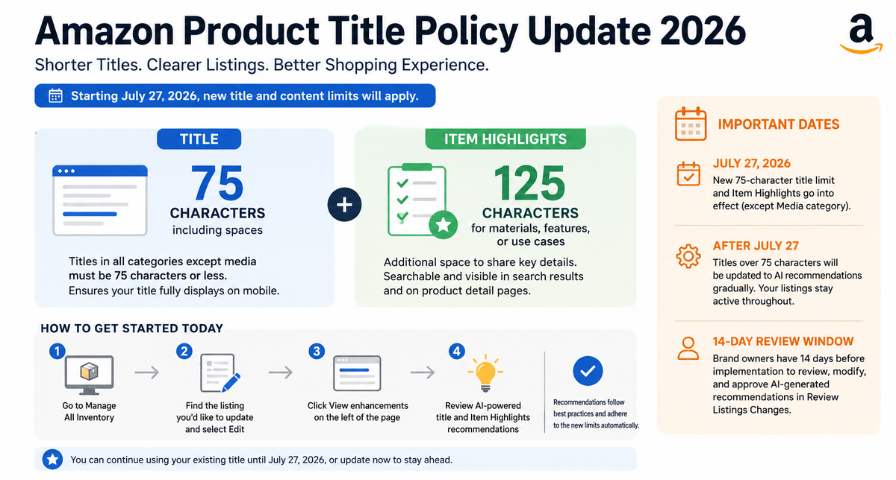
Amazon is simplifying product titles starting July 27, 2026. Titles will be limited to 75 characters, making listings cleaner and fully visible on mobile. To balance this, sellers get 125 extra characters through Item Highlights, where key features, materials, and use cases can be added without cluttering the title. This update shifts the focus from keyword-heavy titles to a more structured approach. Sellers who adapt early can improve both visibility and customer experience.
As an Amazon seller, you would have spent considerable effort ensuring that each of your products had an extensive title filled with relevant keywords. You might remember when including every last detail about materials, sizes, colors, and applications was the best way to go. However, this time around, there will be no escaping the changes Amazon is bringing, and this time they will affect your listings drastically, fast.
As of July 27, 2026, all products on Amazon other than media products will be expected to adhere to a 75-character limit on the product title. Otherwise, Amazon will automatically change the title to conform using its AI software. As an Amazon seller, this should concern you greatly.
Why Amazon Is Enforcing the Amazon Product Title Character Limit
Amazon's decision to make its product titles shorter has nothing to do with whims or fancies. This change has been necessitated by the simple fact that today's consumers spend more time on mobile devices for their shopping activities; therefore, it is only natural that they can no longer be provided with long product titles, which cannot possibly fit on a small mobile screen and force the consumer to scroll down further.
While 150 or 200 characters may allow Amazon to list all the important product features, mobile shoppers will have to see such product descriptions as "Stainless Steel Water Bottle 32 oz Insulated Double Wall Vacuum Sealed BPA Free..." Even though the product's name would be there, its description would still be incomprehensible.
Amazon's adoption of a 75-character limit puts the e-commerce giant in line with other popular online retailers and shows their understanding of what it takes for modern consumers to make good decisions when shopping online from any device.
What Changes and What Stays the Same
In a nutshell, what needs to be done is making sure that product titles in all the non-media categories are 75 characters and below. It is about as long as this very sentence, so the length is relatively small. Many of the sellers would need to reconsider what should go into the title and what should go somewhere else.
However, there is also another addition to the process, which is the concept of Item Highlights. What this does is give you an extra 125 characters to play with, for such information on your product as materials, usage instructions, compatibility issues, and all those factors which allow clients to decide whether they need your product or not. What is important is the fact that this additional information is also searchable, meaning that your product visibility is not compromised at all.
In other words, this becomes a two-level process whereby titles describe what the product is, while item highlights explain why the customer needs it. In total, this allows for up to 200 characters of writing, and when used effectively, this strategy can even surpass the effectiveness of a title alone.
The AI Recommendation Tool: A Head Start, Not a Hands-Off Solution
This is not to say that Amazon has washed its hands off the situation. It even offers AI-generated tools in the Seller Central section, with the help of which you can generate titles and Item Highlights following the new requirements. These tools can now be found when you log into the "Manage All Inventory" section, edit any listing, and then go to "View enhancements" located at the left side of the page.
AI-based recommendations were created to keep key information in the title, while all other product details were to go to Item Highlights. For a lot of listings, this approach will do fine. However, ignoring these recommendations as just another piece of advice given by an AI algorithm would be a huge mistake.
AI-generated tools work with data, and they don't have access to your unique brand image or buyer language. Your AI-generated suggestion may be accurate enough but not nearly as compelling as the suggestion you made. In other words, the suggested phrase may stress an inappropriate product attribute and not use the very keyword your potential customer needs.
What Happens After July 27 If You Do Nothing
Amazon has made it very clear what will happen in case you do nothing. Your listings, for which the title is over 75 characters long after July 27th, will be automatically optimized into the AI recommendation. In this process, your listings will stay up, and this means that you will not incur any downtime. But one thing will be lost for sure your ability to control the presentation of your products.
Speaking about brand owners, Amazon provides a two-week window in which they may consider and modify AI recommendations in the Review Listing Changes section of Seller Central. The window is limited and does not give you unlimited opportunities to change the outcome.
How to Approach Your Title Rewrite Strategically
Having a limited number of characters (75) is very helpful for good sellers because you will be forced to create an effective title with every word worth saying. First, determine the main thing that a potential customer should understand. It means what your product is and who can buy it. This is what should be said in the title.
Here is a good example of such a title: "Organic Bamboo Cutting Board with Juice Groove, Large Kitchen Chopping Board." This title has 74 characters and includes all information about material, the most important feature, and the purpose of the product. It doesn't mean that other information shouldn't be mentioned at all, it may just go to Item Highlights and product attributes.
When rewriting for Amazon listing optimization, consider leading with the product type or brand name depending on your category, include one or two distinguishing features that matter most to your customer, and use Item Highlights to capture the rest. Do not sacrifice search relevance for brevity. If a specific keyword drives significant traffic to your listing, find a way to include it, even if something else has to come out.
Brand Owners: Act Before the 14-Day Clock Starts
For those who own a brand account on Amazon Brand Registry, this process comes with both obligations and benefits. While you can always review changes made by AI prior to approval, this only means something when you do it actively. After all, the 14-day review period goes by faster than you think, even more so when you work with an extensive catalog.
You might want to start off by auditing your listings that generate the highest traffic and sales; otherwise, there will be huge risks in case any of their titles change, thus adversely affecting their performance and conversions. Make sure to check out the Review Listing Changes dashboard on Seller Central regularly until July 27.
The Bigger Picture for Amazon Sellers
Title updates by Amazon have been in the works for quite some time now as part of a larger effort to make the product data within the platform cleaner and more organized. The introduction of Item Highlights, the shift towards AI-supported content, and the uniformity of title lengths are signs of a platform trying to optimize and enhance its shoppers' experiences.
The fact is that sellers can use this opportunity to polish their offerings by making their product pages tighter and clearer and testing different variations of title structure. A shorter and more straightforward title that conveys the value to potential buyers right off the bat can perform better than a lengthy title that does nothing but confuse customers.
As per the deadlines announced, it will be July 27, 2026. All the necessary tools are here, and the question is not if but rather how to make the update work for the benefit of your business.
Ready to Grow on Amazon?
Let our experts help you scale your Amazon business with proven strategies.
Get a Free Consultation