Amazon PPC Updates 2027: New Ad View Attribution Model and Unified Reporting Changes
As someone who runs campaigns on Amazon, you will know the silent fear when you login to the dashboard and see that a figure has changed. Sometimes you caused it with a bid change, a new creative, or a budget shift. Sometimes the market did it through seasonality or a competitor’s promotion. And sometimes the ground itself shifts, because the way a metric is calculated has been rewritten.
The latest Amazon PPC updates fall into that last category. One changes how credit is assigned when shoppers see an ad and buy later. The other retires the old advertising report pages in favor of unified reporting. Both don’t necessarily force you into doing something new, but they do impact the way you interpret your figures. Here is what is different, why it matters, and how to avoid confusing one for the other.
What Is Actually Changing
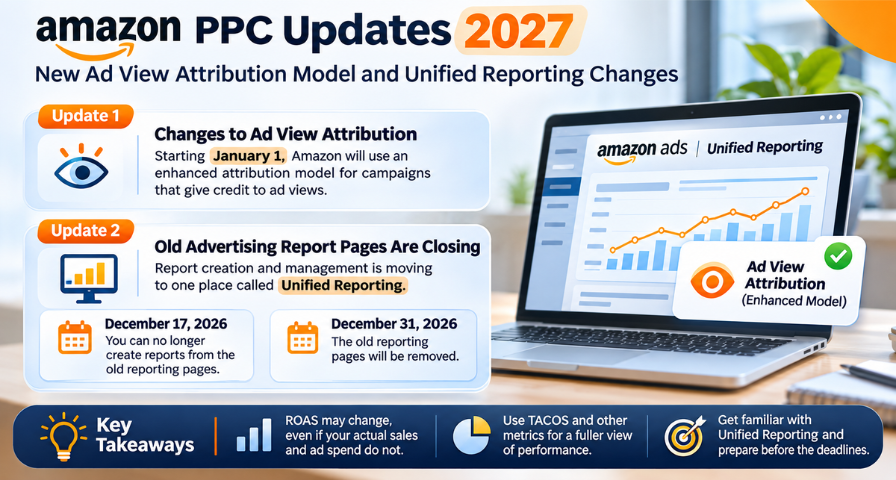
Amazon announced two updates. The first is an enhanced attribution model for campaigns that give credit to ad views, effective January 1. The second is the closure of the old reporting pages for Sponsored Ads and Amazon DSP, with report creation and management moving to Unified Reporting. On December 17, 2026, you can no longer create reports from the old pages. On December 31, 2026, those pages are removed.
The two changes land within weeks of each other, and that is the real challenge. You will be learning a new reporting environment while working with a metric calculated differently than it was the month before.
Ad View Attribution Explained
An attribution model is the set of rules Amazon uses to decide which purchases get credited to an ad. Imagine a shopper scrolls past your ad, doesn’t click, and buys your product a few days later. Did the ad deserve credit? The model answers that question.
This is particularly important in campaigns that are crediting views, which are impressions where the shopper has seen the ad without actually clicking on it. In click attribution, the question is asked whether the shopper clicked and made the purchase, while in view attribution, it is asked whether the shopper has just seen the ad before making the purchase. This is a different question from the previous one and the advanced system approaches it differently.
Why Your ROAS May Move Without Any Real Change
Return on ad spend, or ROAS, is attributed sales divided by ad spend. Ad spend is a concrete number. Attributed sales is contingent on the attribution model exclusively; thus, if the attribution model changes, the numerator will change regardless of how shoppers behave.
Imagine an example with made-up numbers that are not related to real Amazon metrics. A campaign is spending $1,000 in December, and the previous model attributes to the campaign $4,000 in sales; ROAS equals 4.0. In January, the campaign is still spending the same $1,000, the total sales remain equal to $10,000, but the enhanced model attributes to the campaign $4,500; the reported ROAS equals 4.5. The campaign did not perform better; no additional shoppers came to Amazon. The number has changed because the measuring ruler changed, not the measurable object itself.
Of course, it could happen the other way around as well, and a campaign going from 4.0 to 3.6 ROAS does not indicate any problems. Take any ROAS fluctuation after the switch as a question mark, not an answer.
Keeping a Fair Comparison With the Previous Model
This bridge has been provided by Amazon. You will be able to track the purchase metrics based on the old algorithm in the Reporting beta, under Purchases (all views). If there are changes in the new algorithm numbers but purchases (all views) remain unchanged, that is a good indication of a measurement change and not a behavior change. However, if both change together, something else might be happening, and bids, creatives, inventory, pricing, and competition need to be reviewed.
When writing this down, make sure to use the exact wording of Amazon. Additionally, make sure that the column does indeed provide an exact match for your campaign types. Take your December metrics into account before the change-over as well.
ROAS vs. TACOS: Which Metric Should Advertisers Trust After the Update?
When one metric’s definition changes, it helps to lean on a metric that views the business from another angle. TACOS, or total advertising cost of sales, compares ad spend with your total sales, including organic orders. ROAS is a view from inside the ad system, and TACOS is a view from the whole business.
If reported ROAS rises while total revenue and ad spend stay flat, TACOS stays flat too, which suggests the improvement is an accounting effect. TACOS is a useful cross-check, not a perfectly independent judge, because advertising influences total sales over time. It also says nothing about which individual campaigns earn their keep. Use ROAS for campaign-level optimization and TACOS as a guardrail for overall health.
How to Evaluate Amazon PPC Performance Beyond ROAS
Using a combination of different metrics is much more accurate than looking at one metric in isolation. For example, let’s take the numbers for an imaginary account (these are just made up numbers). In December, the total sales are $10,000, the ad spend is $2,000, and the sales from ads are $5,000. As such, the ROAS is 2.5, and the TACOS is 20 percent. In January, the total sales and ad spend remain the same, while sales from ads are $5,500, resulting in the ROAS of 2.75 and still 20 percent of TACOS.
The company has generated the same amount of money through the same spending on advertising. What has changed is the credit allocation only. An advertiser relying solely on the ROAS will see a 10 percent increase in the metric, while another one who also uses total sales and TACOS will see a stable account performance.
Which Amazon Advertising Campaigns Should You Monitor Closely?
The message is about campaigns that get credit for ad impressions, so this is the best place to begin. Based on your configuration, this likely means that the eligible campaigns will include your Sponsored Display and Amazon DSP campaigns, since view-based attribution occurs here more commonly. Do not assume that other campaigns like Sponsored Products or others will experience the exact same adjustments in their ROAS numbers.
Identify your campaigns that have view-based attribution, tag them, and analyze them separately from your click-based campaigns. Mixing everything together in your ROAS calculation in January will make it more difficult to draw any conclusions.
The Move to Unified Reporting
Unified Reporting is bringing together all the reporting generation and management under one roof for Amazon so that there would no longer be separate pages for Sponsored Ads and Amazon DSP. It’s especially good news for those accounts that use both platforms and would have to find information across two different places.
Don’t be tempted to make any assumptions beyond what Amazon promises. Don’t think that all the metrics will be rolled up together automatically, that the format will be preserved from the old report page, or that saved settings and automatic exporting will follow you.
Think of your regular week: an account manager pulls a search term report on Monday to include more negative keywords, on Wednesday a targeting report helps find which keywords require more budget, and on Friday a placement report shows whether the extra costs of Top of Search placement were justified. Every routine will be tied to the old report page and will need a new place soon.
Why Historical PPC Comparisons Could Become Misleading in 2027
There is, however, a more subtle issue that arises when analyzing trends due to the shift in accounting treatment. If one compares December 2026 versus January 2027, one would be comparing two periods that are using two different rules of measurement. It is the same with quarterly analysis and annual comparison. January 2027 versus January 2026 may be apples-and-oranges, as the latter period was reported under the old system.
The improvement or deterioration in advertising efficiency might simply be due to the difference in reporting methods. In order to ensure that this is not the case, agencies preparing monthly and annual analyses should confirm the method used for each period and label the graphs accordingly. Whenever possible, make comparisons on the basis of purchases (all views).
Important Dates and How to Prepare
The dates are set in stone. December 17, 2026, will be the last date when you can create reports from the old pages, December 31, 2026, will be the date they are gone, and the attribution change will occur on January 1.
First, list out all of the reports you use, whether it’s the weekly reports, search term reports, the client reports, or even any reports going into your spreadsheet. Then recreate those reports in the new Unified Reporting and verify them. Ensure that the date range, campaign name, targeting details, search terms, placements, and performance columns are all there and what you need them to be. Understand how the file downloads impact the spreadsheet that you’re using, as a small change to a column header can wreck a perfectly good formula. Do this early in December before the old pages are no longer there.
How Amazon PPC Agencies Should Communicate These Changes to Clients
This adds another hurdle, since the client might look at one number. If a client notices that the ROAS is jumping from 3.8 to 4.3 in January, they might think that the agency has done an incredible job and request a larger budget, only to be disappointed once the number stabilizes.
Communicate first. Prior to January 2027, let the client know that ROAS might shift due to the improved attribution model, regardless of sales and costs remaining constant. Add the appropriate method used to all reporting templates, and show how to see purchases (all views). People do not like surprises but are calm in case of being warned beforehand.
Should You Change Your PPC Bids or Budgets After January 1?
It is not by ROAS alone. Should the ROAS of a particular campaign increase but sales remain flat, increasing the budget due to that increase is difficult to defend. But before making any change, one should analyze sales, ad spend, conversion, inventory, and campaign performance itself.
The first few weeks after the implementation of a new measurement system are meant for watching out. Change something if and when there is agreement among several signals, rather than just one, which may have shifted only because of the change in measurement.
Conclusion: Question the Number Before You Act on It
These Amazon PPC updates give an edge to those who prepare calmly. New improved version starts January 1 and even changes ROAS despite stable sales and spend levels. Old reporting pages close for new reports from December 17, 2026, and become unavailable December 31, 2026. Study Unified Reporting, get December baseline, compare Purchases (all views), use ROAS with TACOS, and tell your clients about expectations.
Amazon’s advertising system becomes data-focused but good reporting doesn’t always imply smart decision-making. PPC managers should know the algorithms of calculation first before drawing conclusions from the numbers. Next year, success will go to those advertisers who will know when to optimize their campaigns and when to question the calculations.
Ready to Grow on Amazon?
Let our experts help you scale your Amazon business with proven strategies.
Get a Free Consultation
Comments (0)
Leave a Comment