Amazon PPC in the Age of Alexa for Shopping: How AI Is Changing Sponsored Ads
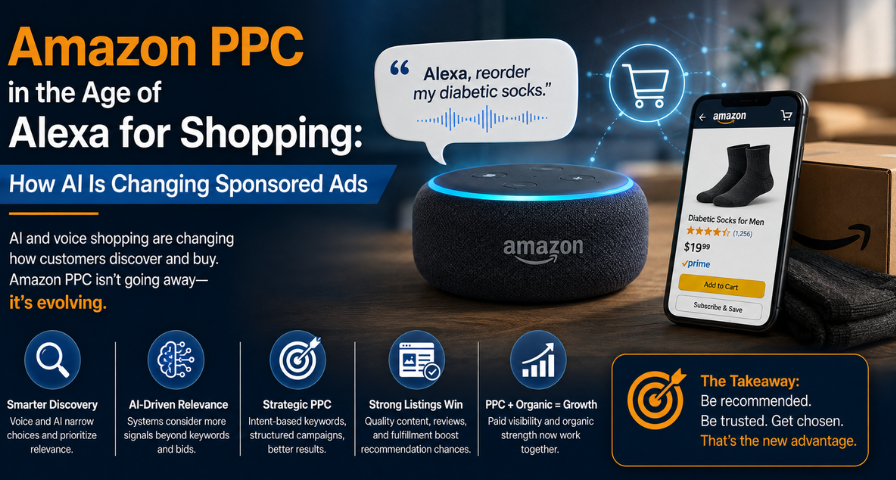
Amazon PPC has been telling the same story for decades. A user enters a search term on the Amazon mobile or desktop platform, a list of sponsored products pops up along with organic search results, and the advertisers fight to catch the user’s eye through bidding and advertising. Things have changed in Amazon PPC, but that doesn’t imply its departure from the scene. In light of the increasing usage of AI technologies in the decision-making of purchases, such as Alexa for Shopping on Amazon, what does that imply for the sellers? What has changed, and what stays the same in the customer experience story? This piece is not about the displacement of Amazon PPC by AI. It is about the optimization of PPC in light of the new experience of shopping.
Why Alexa for Shopping Changes Product Discovery
In a conventional way of doing Amazon PPC, it is based significantly on the customer being confronted with a screen that has options. The product titles, images, stars, and sponsored icons will compete for the customer’s attention in just a few seconds. Voice shopping strips out almost all of the visual cues. In the case where the customer is searching via typing, he or she can scroll down and make comparisons of the available options. However, with voice shopping, the comparison is made much shorter, and maybe only one option will be provided.
This is a meaningful shift in how discovery works. Being ranked fifth or sixth in traditional search results still gets a brand seen by a scrolling shopper. Being the fifth option in a compressed, voice-driven interaction gets a brand far less exposure, because there's no equivalent of scrolling in a spoken exchange. This doesn't mean sponsored ads stop mattering. It means the competitive bar for being considered at all has moved, and sellers who only think in terms of keyword bids may be missing half the picture.
AI Is Changing What "Relevance" Means
It's tempting to describe Amazon's AI systems as though they follow a known, fixed formula, weighing specific factors like delivery speed or reorder rate in exact proportions. That level of certainty isn't something outsiders can verify, and articles that claim to know Amazon's internal ranking logic should be read with some skepticism. What's more defensible is this: Amazon's broader shopping ecosystem gives its systems access to a wide range of signals beyond keyword matching, including product ratings, fulfillment consistency, purchase history, and overall customer experience. AI-assisted shopping tends to reward products that perform well across this fuller picture, not just products that win an advertising auction.
As far as the seller goes, this means that relevance is now not just the process of matching the keyword to the bid. Relevance is now about the whole product representation: the proper content of the listing, regular availability of the goods, good feedbacks and timely deliveries. PPC can increase visibility of the listing, but it cannot replace either poor listing representation or unreliable deliveries. This link between advertising expenses and quality of the listing is getting more important than ever before.
What Happens to Amazon PPC
Even though there is talk about voice and AI shopping causing a disruption in voice and AI and shopping, Amazon PPC is not going away anytime soon. Most searches on Amazon are still done through search and browse, which means it won’t go away overnight. However, the environment in which Amazon PPC takes place is evolving. Advertisers need to realize that they can no longer consider sponsored product ads as separate from other factors such as organic performance, listing quality, and customer experience.
The campaigns that are expected to succeed moving forward will be the campaigns designed based on the fact that there is a relationship between paid visibility and recommendation. While sellers will still need to run and optimize their Amazon PPC campaigns, this time around it is important to look at it from a different angle. The campaigns that are structured right, by dividing high-intent keywords, discovery keywords, brand keywords, and competitor/product keywords into different groups, will help sellers get a clearer picture of how things work.
Keywords Still Matter, But Search Intent Matters More
Search behavior on Alexa and other voice-optimized shopping channels does not look the same as typed search behavior. Typing queries is generally a shorter and more direct approach. For example, people type "wireless earbuds" or "protein powder vanilla." Voice queries tend to be longer, like "I need some new wireless earbuds for the gym" or "I want more vanilla protein powder like the one I usually buy." It is an interesting and valuable trend to take into account, but there is an important caveat connected with it.
It may seem that adding conversational phrases to PPC campaign manually would allow capturing voice search queries. However, there is no guarantee that the phrase "best budget earbuds for running outside" will work for voice-optimized PPC campaigns since Amazon PPC relies on Amazon targeting and auction rules. One can try different match types and conversational terms, long tail keywords, and respond to the voice trend. However, all such moves must be based on factual information from the search-term data and campaign itself, not assumptions regarding voice-influenced demand. Search intent is a useful perspective in keyword research and selection. It is not a substitute for data and evidence.
PPC and Listing Optimization Are Becoming More Connected
If there's one section of this discussion that deserves the most attention from sellers, it's this one. Amazon PPC and organic listing quality have always been related, but AI-assisted shopping is tightening that relationship. A product with strong reviews, complete and accurate content, and consistent availability has a natural advantage in almost any AI-influenced discovery scenario, independent of how much is being spent on sponsored placements. That means advertising budget increasingly needs to be paired with investment in listing quality, not treated as a separate line item.
This will impact how sellers think about ACOS and TACOS too. Measuring the performance of a PPC campaign in isolation without considering its contribution to overall sales velocity will overlook the big picture. Campaigns that seem underwhelming from their own metrics may still be contributing significantly to the sales process in that they contribute to sales velocity, hence increasing organic visibility and, in some cases, AI recommendation eligibility. This is why measuring total advertising cost of sales with the performance of your organic listings will provide more insight into the contribution of the campaigns.
AI Does Not Replace PPC
This is important to say explicitly, because the shopping via AI story makes it sound as though it does not. Sponsored listings still form one of the easiest ways to create visibility on Amazon. While AI discovery via Alexa or other new technologies affects the environment that PPC works within, it does not mean that PPC no longer needs to be managed and thought about. If sellers give up on their PPC plan under the assumption that their product will automatically get good recommendations from AI, then their product visibility will suffer rather than improve.
The Future of Sponsored Ads
Voice-assisted and AI-driven shopping might limit the visibility of conventional sponsored placements just by virtue of the fact that the consumer is not navigating through the results page in the traditional sense of the word. It definitely is a paradigm shift, but one that should not be feared or even considered too much of an impediment. Those merchants who can establish solid organic foundations, as well as running effective PPC campaigns, will be in a more advantageous position no matter what extent voice-shopping gains in popularity in the long run.
Key Takeaways for Sellers Moving Forward
Alexa for Shopping isn't killing Amazon PPC. It's changing what sellers need to optimize around it. The advertisers who adapt well won't necessarily be the ones spending the most on Amazon Sponsored Products, but the ones who understand that PPC, listing quality, reviews, and fulfillment consistency now function as one connected system rather than separate efforts. Don't stop optimizing PPC. Start optimizing everything around it, because in an AI-influenced marketplace, being recommended matters just as much as being seen.
Ready to Grow on Amazon?
Let our experts help you scale your Amazon business with proven strategies.
Get a Free Consultation