Amazon PPC in 2026: Why More Campaigns Do Not Always Mean More Sales
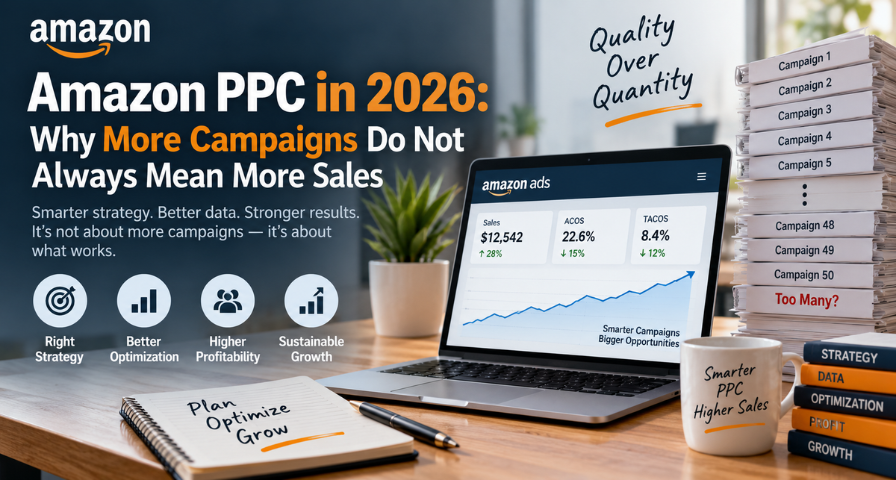
Many Amazon sellers find themselves running more than 30 different campaigns for a single product yet still having a hard time figuring out why their sales are no longer growing. This logic, while being quite natural and comprehensible, is fundamentally flawed. While a single campaign drives sales, adding more and more campaigns appears to be the only way forward. However, Amazon PPC is not mathematics, and trying to make it so is likely to result in increased expenses and less knowledge.
The goal of this article is to explore why campaign volume has become a misleading metric for success, what really makes it all go right inside Amazon's ad ecosystem by 2026, and how sellers can transition from the "more" to the "smarter" mentality of Amazon PPC campaigns management.
The Campaign Sprawl Problem
As competition for Amazon ads has increased, an odd thing has happened. Advertisers, agencies, and even some algorithms have embraced the notion that by breaking up their ad campaigns into a myriad of specific and extremely focused campaigns, they can uncover some kind of demand that was unknown before. The reality is that it has the reverse impact. As a single product is broken up into too many ad campaigns, each campaign ends up receiving very few impressions and clicks. As such, it is impossible to know whether a particular keyword or placement is not working due to lack of demand or simply due to a lack of sample size.
This can be referred to as “campaign sprawl” by PPC specialists. This is not the issue of being lazy at all, on the contrary. Those sellers who get trapped in the campaign sprawl are definitely trying very hard; they check their dashboards every day, adjust bids every minute, and start new campaigns as soon as the current one becomes uninteresting. The main issue here is not that of Amazon’s tools but that of the seller’s capability to analyze the situation and understand what needs to be done. Instead of gathering all budget and efforts into a few carefully arranged campaigns, they spread everything among lots of different elements.
What Actually Drives Amazon PPC Performance in 2026
The advertising platforms of Amazon have evolved and become more intelligent over time by considering parameters such as relevance, bidding, budget, and signals of the shoppers to decide which ad should be shown. As we approach 2026, it is precisely because of this reason that the "more campaigns mean more visibility" method is continuously losing its validity. The addition of one more campaign does not generate demand from thin air; it only reallocates the demand already present for the keywords and categories of that product.
The importance lies more in the quality of the campaign structure of the seller rather than in the quantity of campaigns that he builds. A well-structured account usually groups campaigns according to a certain strategy of theirs, such as grouping branded keywords, targeting a competitor’s product, or conducting a test for a new keyword idea instead of having a new campaign every time there is just a small change in the wording of the keyword. It is easy for such a seller to use his budget properly, figure out what search terms are bringing him sales, conduct tests separately from successful keywords, and analyze his results without any mix-up in variables. Sellers with a few meaningful campaigns find it easier to manage their ACOS and TACOS.
It is worth being precise here. Amazon's algorithm does not mechanically "need" fewer campaigns to function well, and consolidation does not automatically improve optimization on Amazon's end. The real advantage sits on the seller's side: fewer, better-organized campaigns are simply easier to read, easier to budget correctly, and easier to make good decisions about.
The Real Cost of Over-Fragmentation
Each campaign that is added means one more level of complexity to deal with. With a few campaigns going on, it’s easy to find out where the trouble lies, be it in budget bleeding through keywords or placements that aren’t working. As soon as the number of campaigns reaches the dozens, interpreting the data becomes too hard to see what is actually going wrong.
There is a budgeting cost that is easy to underestimate too. When several campaigns target similar or overlapping search terms, a seller can lose a clear sense of which campaign deserves more investment and which one is simply riding on demand that another campaign would have captured anyway. This is a practical, budget-control problem rather than a claim about Amazon's auction mechanics working against the seller automatically. What is true is that overlapping targeting makes performance harder to attribute correctly, and a seller who cannot tell which campaign is actually driving a sale is likely to make worse decisions about where to increase or cut spend.
There is also a strategic cost. Sellers who are constantly launching new campaigns rarely give any single one enough time to gather meaningful traffic and conversion data before judging it. There is no fixed universal timeline for how long a campaign needs to run before its performance becomes readable. A high-velocity product in a competitive category might generate enough clicks and conversions within days to draw fair conclusions, while a lower-volume or higher-priced product may take considerably longer. What matters is having enough data relative to that specific product's normal sales pattern, not an arbitrary number of days on a calendar. That said, this is not a license to leave a clearly wasteful campaign running indefinitely. If a campaign is burning budget with no relevant clicks and no realistic path to conversion, there is little reason to wait weeks before addressing it.
Campaign Growth Is Not the Same as Profitable Growth
Increased orders do not necessarily equate to increased profitability, which is why sprawl tends to hurt many more businesses from the shadows than they may realize. One may generate orders but remain unprofitable after subtracting the cost of advertising; the only way to tell is by analyzing performance based on break-even ACOS, not orders alone.
For instance, consider a product priced at twenty-five dollars, which has a total non-advertising cost including product cost equaling fifteen dollars, thus ten dollars of net profit before advertising costs. In this scenario, break-even ACOS would be forty percent (ten divided by twenty-five). This means that if one is running a campaign with fifty percent ACOS, every order generated by such a campaign is unprofitable before considering any additional expenses, yet one would view it as "successful" on their sales reports. The sellers who pursue campaign sprawl often fail to realize this, because they measure their campaigns not by profitability, but by number of orders and impressions instead. Before adding new campaigns or defending the current ones, it would be wise to do this simple math exercise.
A Practical Look at What Good Structure Looks Like
Consider a seller running diabetic-friendly crew socks. A reasonably disciplined account for this kind of product might include an auto campaign used mainly for search term discovery, an exact match campaign built around keywords that have already proven themselves, a phrase match campaign for somewhat broader coverage of related terms, a broad match campaign kept on a modest budget for exploration, a product targeting campaign aimed at relevant competitor ASINs, and a branded keyword campaign whose sole job is protecting the seller's own brand terms from being picked off by competitors. Each of these has a distinct role, and none of them exists purely because a keyword research tool suggested one more variation to test.
Now picture the same seller who has added fifteen more campaigns, which are slightly different versions of the same keyword set. The answer would not be to remove some of the campaigns to reduce the total number. Instead, one needs to ask himself or herself whether there is a unique reason for every campaign, whether the campaign gets enough impressions to be considered, and whether it needs the money allocated to it. In case a number of campaigns chase the same keywords without any unique purpose, consolidation of them might help simplify the account and improve budget management, but again, it depends on the specific account's targeting, budget, and historical performance. On the other hand, if one of those campaigns defends an actually profitable branded keyword or tests a competitor ASIN, it might be worth keeping separate even though it is a small campaign.
Before Creating a New Campaign, Ask a Few Questions First
It pays to do a quick gut check before going ahead with anything new because a lot of wasteful spending can be avoided. It should be determined if the new campaign has a distinct targeting objective than the existing one, if it requires its own budgeting or bidding process as opposed to being pooled with another campaign that has similarities with it, and if it seeks to validate a certain hypothesis as opposed to simply providing coverage. Also, it should be established if the existing campaign being divided has sufficient traffic levels to warrant the division and if the new structure will facilitate reporting and optimization processes. If the answer to most of these questions is a "no," the best course of action would be to extend the existing campaign.
Building a Smarter Amazon PPC Campaign Structure in 2026
However, rather than having fewer campaigns because they are easier, it is better to have them in place for the reasons stated above. It is important to keep an eye on existing campaigns more than launching something new all the time. It has been found out more often than not that analyzing existing campaigns in order to find overlapping keywords, overlapping targets, and underperforming placements could help more than creating something new altogether. This is true of sellers who usually realize the importance of such a practice. It could lead them to the conclusion that consolidating some overlapping campaigns into one well-structured campaign helps them save money and make analysis clearer.
Measuring Success Beyond Campaign Count
The number of campaigns does not necessarily reflect one’s maturity. It simply depends on the effectiveness of the campaigns to help a seller invest their money wisely. An account with five campaigns that have been managed effectively will definitely perform better than an account with fifty ineffective campaigns, mainly due to the fact that the effectiveness of the former is much easier to discern and address quickly. The figures that should be paid attention to include conversion rate, ACOS and TACOS, breakeven ACOS per item, and the efficiency of ad spending as a function of total sales growth.
Thinking in terms of the overall buyer journey rather than campaign by campaign can be useful as well. A customer might be introduced to a particular product through a general discovery campaign, come back through a branded search, and ultimately convert via a product-targeting campaign. Analyzing the success of each campaign separately rather than taking into account how these campaigns are interacting with one another may result in poor decisions being made, like eliminating a seemingly unprofitable campaign when in reality it is serving an important purpose at an early stage of the buyer’s journey.
Final Thoughts
When it comes to Amazon PPC in 2026, precision and smart budgeting are much more valuable than just putting up more campaigns. Launching one more campaign does not create any additional demand for a product. All that happens is just the distribution and monitoring of the existing demand changes, and within a large account it is done to the detriment of the seller.
Sellers that do not get carried away by the impulse to launch yet another campaign but concentrate on developing a limited number of meaningful campaigns based on their role in the plan discovery, high performance, brand protection, and competitive find themselves using their budgets in a smarter way, getting more clarity in results that come from their advertising efforts. Before launching the next campaign, it is important to look through the already existing ones and analyze which campaigns overlap each other, which campaigns serve no particular purpose, and which campaigns require more time and data to judge. It is one simple trick that can lead to better and more profitable growth through Amazon PPC campaigns in 2026.
Ready to Grow on Amazon?
Let our experts help you scale your Amazon business with proven strategies.
Get a Free Consultation