Amazon PPC: How to Reduce ACOS Without Sacrificing Sales Growth
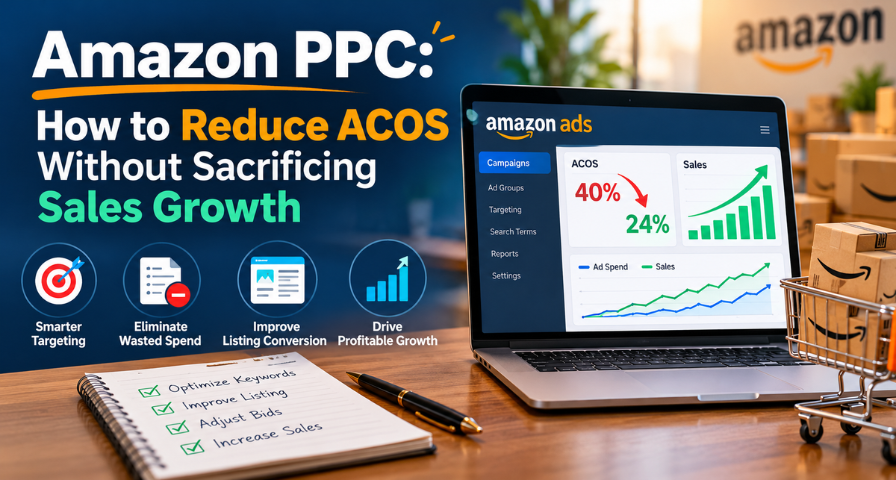
Every Amazon seller who conducts PPC campaigns will inevitably face the unpleasant problem. Advertising expenses grow, ACOS grows too, and profit margins become thinner. The first solution that comes to mind is to decrease bids, to pause expensive keywords, and to decrease daily budgeting until everything becomes right.
What will happen if the ACOS drops down at the same time as the number of sales goes down?
Decreasing the advertising cost ratio might look like an achievement in dashboard metrics, but it does not necessarily indicate any progress of your business. Spending less money can lead to losing traffic, sales, and exposure of your products thus, you can get worse results in total.
Professional Amazon PPC management involves another strategy. Instead of just decreasing advertising budgeting, you should learn where your money goes, what keywords bring you profitable sales and deserve your investments.
Your aim should not be reaching the lowest ACOS. Your aim is saving ineffective expenses and increasing conversions.
Understanding ACOS and Break-Even ACOS
Advertising Cost of Sales (ACOS) measures advertising spend as a percentage of advertising-attributed revenue. It helps sellers evaluate how efficiently their campaigns generate sales.
The calculation is straightforward:
ACOS = (Advertising Spend ÷ Advertising-Attributed Sales) × 100
For instance, if the seller invests $400 in ads and makes $1,000 in sales due to the ads, the ACOS is 40%.
Nonetheless, a 40% ACOS is neither good nor bad; what matters here is the costs of the product and the goals of the company.
It is at this point that break-even ACOS comes into play.
Let us consider the case when a certain product sells at $50 and the seller receives $20 after covering the costs related to the production, Amazon referral fees, fulfillment, and other variable costs.
The contribution margin prior to advertising is 40%; hence, the break-even ACOS is about 40%.
At the mentioned level, all orders attributed to ads are covering their variable costs as well as the cost of the advertising itself; however, they do not make any contributions to the overhead costs and profit.
For a company looking for profits, 28% ACOS could be a target, whereas launching a new product would allow the seller to run the business with a higher or break-even ACOS.
Understanding break-even and target ACOS gives sellers a financial reference point for every subsequent PPC decision.
Finding and Eliminating Wasted Advertising Spend
The most effective method of cutting down on Amazon PPC advertising expenses is finding traffic that will not result in profitable orders.
The sponsored products report for search terms is useful as it shows the customers' searches and the contexts where they might be interested in the product.
It will help sellers to understand which search terms generate sales and which just eat up advertising budget without providing good enough results.
The first thing you should do is look at the terms with high expenses and low number of orders.
But all search terms without orders are not created equally.
For example, consider the case of the seller advertising stainless steel water bottles. In such cases, if advertisements generate searches that seek plastic water bottles and bottle caps, the traffic is not relevant.
Using negative targeting for such search terms will help you save your advertising budget in the future.
A relevant search term with no orders deserves deeper investigation.
Let's say that a product generates sales from 7.5 percent of clicks and the cost per click equals $1.50.
Despite being unsatisfactory, this finding doesn't necessarily mean that the keyword in question is useless. For example, with a simplified statistical model of independent clicks and a 7.5% constant conversion rate, the probability of getting zero orders with 25 clicks is about 14%.
With 60 clicks without an order in this case, the probability becomes less than 1%.
In reality, things are much more complicated since conversion rates depend on a number of factors such as placement, target audience, competition, etc. All these probabilities show how to make decisions regarding negative keywords.
Sellers need to analyze the relevance of the search, number of clicks, conversion rates, and allowable costs for attracting customers before making their decisions.
The goal of search-term optimization is to eliminate unnecessary expenses without excluding sales opportunities in the future.
Improving Listing Conversion Before Cutting Bids
Not all campaigns with high ACOS have issues with targeting. It may happen that advertising drives relevant visitors to a product, but the product listing doesn’t turn them into buyers.
It’s important to understand that lowering the bids won’t solve the problem of non-competitive offer or confusing information about the product.
Let’s imagine that a product listing gets 100 clicks from advertisements and sells four products. So, its conversion rate equals 4%.
Improving the product listing and increasing the conversion rate up to 6% can help to sell six instead of four units on the same traffic.
Under the condition that the cost per click, price of the product, and other factors stay the same, the cost of advertising per order will decrease threefold.
That’s why improving the listings is vital for any Amazon PPC campaign.
A thumbnail of the main image should speak about the product, especially since it’s seen as a small picture in search results. Titles and bullet points must describe the features of the product and its advantages.
Further details could be offered in the product descriptions and A+ content to help consumers make better-informed purchase decisions.
Pricing, delivery times, customer reviews, and stock level also affect conversion rate performance.
For instance, a vendor selling diabetic socks could have relevant clicks but lose the business due to the lack of clear information on size, cuffs, and composition of the materials.
Fixing such an issue would help more than lowering bid prices in most cases.
Before adjusting the advertising settings, vendors need to check if their listings are meeting customer expectations raised by search terms and ad content.
Smarter Bidding Instead of Lower Bidding
Lowering each bid by a certain percentage may help save on expenses, but it might limit those campaigns which are making profits through sales.
The best way to handle it would be to alter the bids for each target individually.
Keywords which have been successful in making profitable sales should be allowed to keep their bids competitive or even test them by increasing their value. Inadequate targets need to either reduce bids, further analysis, or even exclude them if there is enough evidence to prove the case.
Nevertheless, having a profitable performance history of keywords does not mean that higher bids will always give profitable results as well.
As the bid value is increased, campaigns may find themselves participating in highly competitive auctions where CPC becomes relatively high and the return on each extra sale becomes poor.
Amazon Sponsored Products offers a variety of options, among which are dynamic bids down only, dynamic bids up and down, and fixed bids.
Bidders have to choose bidding strategies based on the campaign goal, budget, and performance.
Placement performance also requires careful consideration.
While top-of-search placements can bring some visibility, they also come at increased cost. Depending on the item and shopper behavior, the placement performance can vary for product page placements and the rest of the search placements.
Instead of making any assumptions regarding the placement performance, sellers should check placement performance reports and analyze their ad spending, sales attributed to these ads, CPC, and ACOS.
Changing bid adjustment for a placement increases the competitive nature of bidding for this placement. Decreasing an already set bid adjustment will reduce this additional pressure, although results have to be analyzed carefully.
The most effective bidding strategies are based on profits and testing.
Campaign Structure and Keyword Targeting
The structure of the campaign is an important consideration when managing advertising costs and analyzing its performance.
When the sellers have similar budgets for discovery targeting and high-performing keywords that have proven their worth, it could be hard for them to decide on how much budget to allocate to them.
Separation of campaigns based on objectives would make it easier for them to manage their budget better.
The automatic, broad match, and phrase match targeting will allow the sellers to explore new avenues for targeting their products and potential customers. The sellers would need to do more experiments because part of the objective is to find possible sources of their revenue in future.
When a search term shows stable performance, the seller can try the exact match targeting.
The seller may also utilize negative targeting in order to avoid any unnecessary overlapping between the discovery and established campaigns.
It should be noted that overlapping campaigns do not necessarily mean that they will be competing against each other during each auction. The reason why we separate targeting is because of better budget management and clear reporting.
Properly constructed campaign structure helps us find profitable opportunities while still leaving room for experimenting.
Budget Allocation and the Importance of TACOS
Reducing ACOS should not come at the expense of overall business performance.
This is why sellers should monitor Total Advertising Cost of Sales (TACOS) alongside ACOS.
TACOS compares advertising spend with total sales revenue, including advertising-attributed and organic sales.
TACOS = (Advertising Spend ÷ Total Sales) × 100
For example, suppose a seller spends $500 on advertising and generates $2,000 in attributed sales, alongside $3,000 in organic sales.
The ACOS is 25%, while TACOS is 10%.
These metrics provide different perspectives. ACOS measures advertising efficiency against attributed revenue, while TACOS shows advertising expenditure relative to the business's total revenue.
A declining TACOS alongside increasing total sales can be encouraging, particularly when organic sales are also growing.
However, the relationship does not establish that advertising caused the organic growth. Pricing, seasonal demand, competitor activity, inventory availability, and listing improvements may also influence performance.
Sellers should therefore evaluate TACOS alongside total sales, organic revenue, advertising spend, and contribution margin.
Budget allocation should follow the same principle.
A profitable campaign that consistently exhausts its budget may deserve additional investment, provided there is sufficient inventory and evidence of further demand.
Meanwhile, a campaign consuming significant budget without acceptable returns may require optimization before receiving more funding.
The objective is to invest where advertising can contribute to profitable growth, rather than distributing budgets equally across campaigns.
A Practical Example: Reducing ACOS Without Losing Profitable Sales
Take an example of a fictitious Amazon product that sells at $50 with a break-even ACOS of 40%.
In a month, the seller has recorded a cost of advertising of $600 and attributed sales of $1,500.
The campaign has generated 400 clicks with an average CPC of $1.50 resulting in 30 orders and conversion rate of 7.5%.
The ACOS of the campaign is 40% implying the advertising attributable sales are at break-even point based on product economics.
The seller has analyzed the search term report and noticed there are some irrelevant searches with clicks totaling 60 at a cost of $90 without order attributions.
Also, the seller realizes that there are some profitable search terms that have less visibility, and the product description does not mention one of its benefits.
Instead of lowering each bid, the seller formulates a strategy to optimize the campaign.
Irrelevant terms are discarded where applicable. The profitable keywords are considered for adjustment in the bids, and listing is optimized for solving customers' concerns.
In order to understand the mathematics better, let us assume that the seller will be able to cut $90 from irrelevant costs and retain the entire $1,500 sales generated.
Advertising budget will be lowered from $600 to $510, and ACOS will drop from 40% to 34%.
Of course, these calculations are made in an ideal case scenario; not the projection of future performance. Also, by discarding targeting criteria, it may lead to a reduction in traffic, participation in auctions, and future sales.
Hence, it is essential for the seller to review the results after implementing these optimizations.
If the budget will be reduced and the volume of sales remains unchanged, then it means that the optimization was efficient.
However, in case ACOS has been reduced, but the volume of orders and gross profit dropped significantly, it can mean that the changes have led to a loss of valuable sales.
Thus, the above example illustrates one of the fundamental principles – effective PPC optimization is aimed at increasing efficiency of spending in relation to profitable sales.
Common PPC Mistakes That Hurt Profitability
A few common errors that can keep sellers from generating sustained advertising performance include:
First, making bid cuts without distinguishing between efficient and inefficient targets, which leads to reduced impressions and loss of sales potential.
Second, using negative keywords too early. It is impossible to evaluate search term performance based on insufficient amount of clicks received by the term.
Also, making several major adjustments at once, including bid changes, modifications of product images and prices.
In case of improved or deteriorated performance later on, it becomes impossible to determine what exactly has influenced it.
Neglecting seasonality is yet another common mistake. Customer demand and competitive environment can be greatly affected during Prime Day, holidays, special promotions and other similar periods.
Therefore, it is important to compare advertising performance during comparable periods taking into consideration market conditions.
Lastly, the evaluation of advertising performance solely based on ACOS should be avoided. The campaign with lower ACOS may produce less profit or sales overall.
The most efficient decisions take into account efficiency, number of sales and overall economics of the business.
Building a Sustainable Amazon PPC Optimization Routine
Optimization that takes place continuously is far more effective than optimization that takes place in huge batches occasionally.
The sellers need to evaluate the performance of the search terms, irrelevant traffic, conversion rate, and spending on the campaign.
The bid optimization should take place in accordance with the performance data available because there might be a lag and also a shift in demand.
The budgets and targeting of the campaigns also need to be evaluated periodically so that the spending on the ads is justified by the performance of the products.
Writing down the important optimizations will make it easier to improve upon them. If the sellers write down their changes and the reason for doing that, it becomes easier for them to decide whether they should keep the changes or undo them.
The bidding and targeting can be automated but this type of optimization needs to be carried out while considering the profitability of the seller.
The automation process alone is not enough to consider all the factors which include the margin of the product, the demands of the consumers, competition, and inventory.
Conclusion: Reduce Waste, Not Growth
Decreasing ACOS while growing sales can be achieved through more than just reducing bids or limiting advertising budgets.
First, the sellers should consider their product’s profitability and set appropriate ACOS targets. Next, the irrelevant traffic and poor-performing search terms should be identified, along with the ways to increase the listing conversion rate and bids based on the data.
The campaign structure, budgeting, and ACOS-TACOS ratio should also be carefully considered.
First and foremost, sellers should calculate the impact of the optimization on total sales and the contribution margin, rather than on ACOS percentage shown in the advertising console.
A low ACOS is important when it shows increased efficiency of the advertising. It loses its significance when the ACOS decrease is achieved at the cost of profitable demand.
The best approach to using Amazon PPC ads is the one that helps eliminate unnecessary expenses while still investing in keywords, products, and campaigns to grow a business sustainably.
Ready to Grow on Amazon?
Let our experts help you scale your Amazon business with proven strategies.
Get a Free Consultation
Comments (0)
Leave a Comment