Amazon Outlet Gives FBA Sellers a Fresh Shot at Back to School Sales
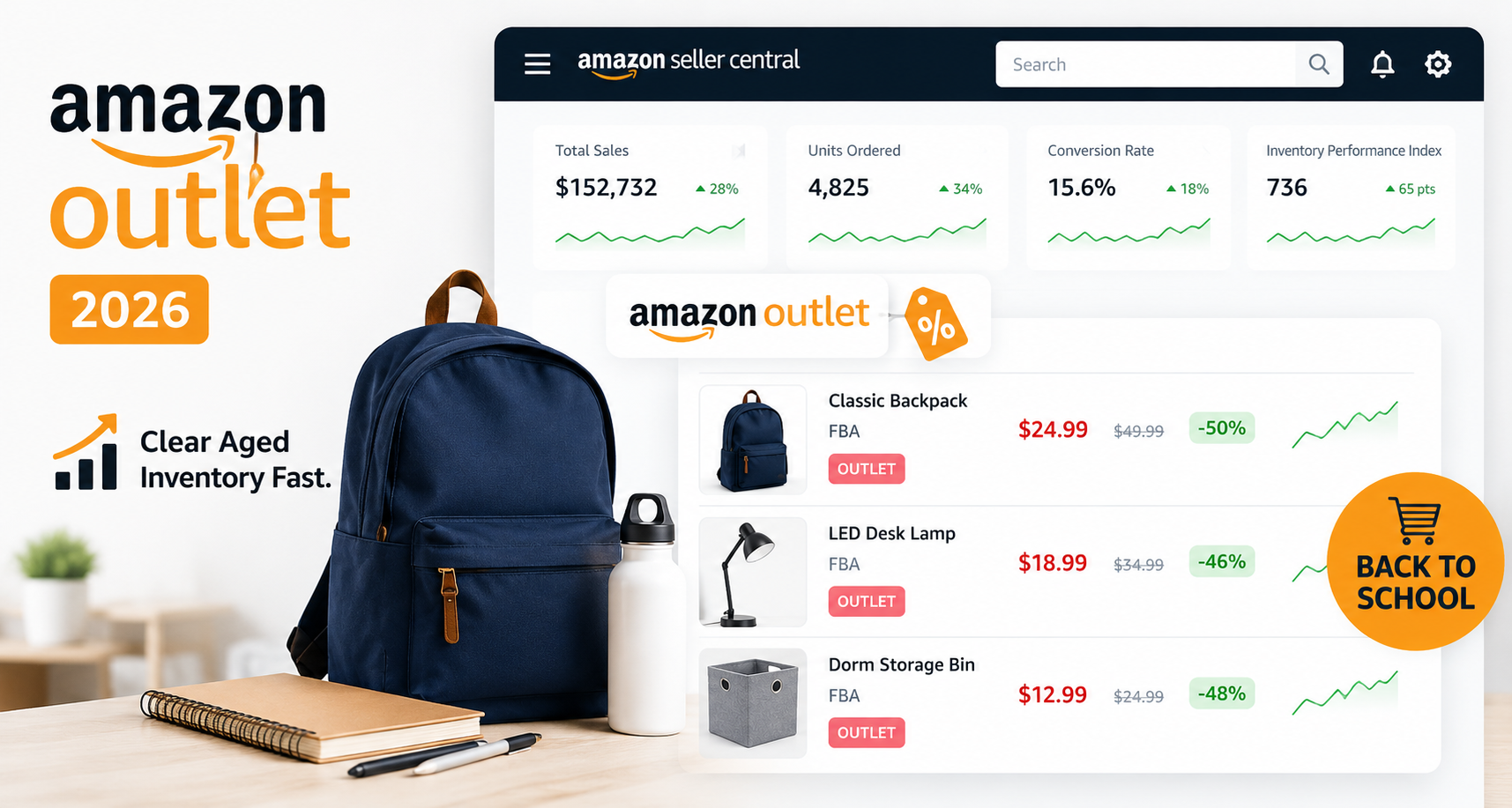
Amazon Outlet is quickly becoming an important opportunity for Amazon FBA sellers looking to clear excess inventory during the Back to School shopping season. Every year, this shopping window brings a short but intense spike in buyer activity, and this year Amazon is giving FBA sellers a new tool to make the most of it. The company has opened up Amazon Outlet to eligible sellers carrying excess or aged FBA inventory, running through September 15. For sellers who have been watching slow moving stock sit in Amazon's warehouses, quietly racking up storage costs, this is a timely and genuinely useful opportunity to turn that inventory into revenue before the season closes out.
What Amazon Outlet Actually Offers
Amazon Outlet isn't a brand new concept, but its role in this Back to School push is worth understanding clearly. It functions as a dedicated space where sellers can list eligible aged or excess FBA inventory at reduced prices, giving those products a second wind in front of shoppers who are actively browsing for deals. Unlike some of Amazon's other promotional programs, Outlet doesn't require sellers to pay extra deal fees, since it simply uses the FBA inventory sellers already have sitting in fulfillment centers. That distinction matters a lot for sellers who are cost-conscious, because it means the program is essentially free shelf space during one of the highest traffic periods of the year.
Why the Timing Matters So Much
Traditionally, Back to School is among the biggest sales seasons after Prime Day and winter holidays across categories like office supplies, home storage products, electronic accessories, clothing, and dorm room essentials at Amazon. The National Retail Federation predicts that spending on K-12 back-to-school will hit an all-time high of $43.3 billion in the US this year, while combined spending on back-to-college will exceed the $100 billion mark for the first time in history. Such figures clearly mean that intent is exceptionally strong and narrow during this period. People are looking for backpacks, stationery, organizers for dorm rooms, electronics accessories, and other necessities for the coming academic year, and it's what aged inventory desperately needs. An item that was neglected by customers for several months can gain relevance just because it fits their seasonal checklist. Those sellers who understand that and use it early get more profits than others, whose attempts to sell aged inventory start late.
There's also a financial urgency baked into the timing. Amazon's storage fee structure penalizes inventory that lingers too long in its warehouses, and those fees tend to increase as products age further into non-peak periods. By moving eligible items into Amazon Outlet now, sellers get a chance to clear that stock before the cost of holding onto it climbs even higher. In other words, this isn't just about capturing extra sales, it's about avoiding a cost that would otherwise eat into margins later in the year.
The Inventory Performance Index Angle
One benefit that often gets overlooked is how this opportunity ties into a seller's Inventory Performance Index, commonly known as IPI. Amazon uses IPI to measure how efficiently a seller manages their FBA inventory, and a low score can lead to sales, storage limits, or reduced capacity allocations down the line. Sellers who have managed FBA inventory across several seasons know that aged inventory rarely improves with time. Once long-term storage fees begin accumulating, recovering margin on that stock becomes significantly harder, and the score itself becomes harder to repair the longer the inventory sits. By using Amazon Outlet to sell through that inventory, sellers aren't just clearing space, they're actively improving a metric that affects how much room Amazon gives them to operate in the future. For sellers who have felt constrained by storage limits in the past, this is a practical, low effort way to start repairing that number before it becomes a bigger operational headache.
How Sellers Should Approach Eligible Inventory
The first task is to determine which products are actually eligible for Amazon Outlet. Not every product available in the seller's store will be qualified; thus, it is recommended to consult Seller Central to find out what aged and excess products are eligible for Amazon Outlet. After identifying them, it is necessary to decide how drastically sellers should discount them. As Amazon Outlet is most efficient if the discount is really substantial, sellers should take care not to discount too aggressively while trying to clear their inventories.
It is in this situation that promotional tools such as "Buy X, Get Y" may come to sellers' aid. Discounting aged products together with some other items or providing additional discounts on them usually results in higher sales compared to a simple price reduction. Bundling is particularly useful for a back-to-school campaign. Discounts offered on backpacks coupled with small stationery kits or gadgets together with some accessories usually result in increased conversion rates.
Getting the Listings Ready for the Season
Keywords and promotions get you only so far on an individual listing. While seasonal searches are underway, it appears that the search algorithm within Amazon favors listings that have proven success in conversions and sales velocity as opposed to keyword searches. The optimization of listing title, bullet points and backend search terms using such terms as "Back to School," "College Essentials," and "Dorm Room" would be helpful in increasing relevance; however, it would be maintaining competitive pricing and constant inventory, which keeps the listing alive after its initial success. On the surface it may seem like a minor thing, but the combination of the two is often what determines whether or not the listing will be buried by the Amazon search algorithms.
In addition to the keyword optimization, one should make sure that there is enough inventory to support the sudden spike in interest for the particular product. There is no sense in promoting a product if it will go out of stock in the middle of the school year.
A Practical Window, Not a Guaranteed Win
It would be true to state that Amazon Outlet is not a solution to every single problem related to moving your products. There might be some products that will not be sold even at discounted prices due to their inappropriateness for a particular season and/or competition among other sellers. Nevertheless, those sellers who have old stock on FBA that is appropriate for Back to School, this program can serve as a solution in a very cheap and effective manner.
Key Takeaways for FBA Sellers
The core opportunity here is straightforward. Amazon is giving FBA sellers a way to sell aged or excess inventory through Amazon Outlet without paying extra fees during a period when buyer demand is naturally aligned with many common demands, such as categories for those who check their eligible inventory products, and thoughtfully consider bundling through Buy X, Get Y promotions. Low-cost updates to their listings with relevant seasonal keywords stand to gain on three fronts at once, faster sales, lower long-term storage costs, and a healthier Inventory Performance Index. The sellers who benefit most from Amazon Outlet aren't necessarily the ones offering the deepest discounts, they're the ones who treat excess inventory as an opportunity instead of a liability. With seasonal demand already building and the program running until September 15, reviewing your eligible inventory today could prevent unnecessary storage costs while generating additional revenue before the shopping season ends.
Ready to Grow on Amazon?
Let our experts help you scale your Amazon business with proven strategies.
Get a Free Consultation