Amazon NWD Listing Removal Notices: What Brand Owners Must Check Before October 28
Introduction: Why Amazon Sellers Are Receiving NWD Notices
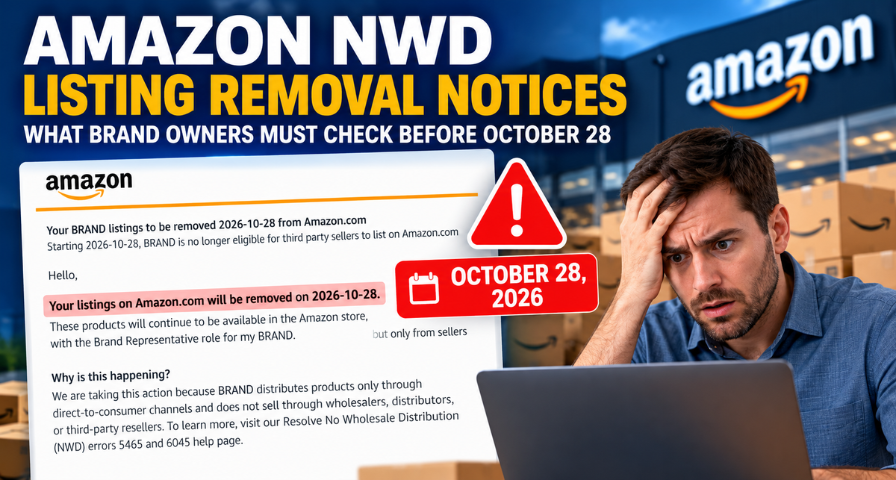
It is said that some Amazon sellers have been getting notices labeled No Wholesale Distribution (NWD). These notices warn that the product listings could get removed on October 31 due to a restriction that might apply. The question that arises for the brand owner in such a case is whether the notice means that there is a genuine issue with the eligibility or whether it was sent out to all sellers linked with the specific brand.
The importance of understanding this lies in the fact that making wrong choices may cause unnecessary expenses and losses, while failing to act on the restriction may cause sales to stop and the inventory to become unavailable. It is essential to know the information provided in the notification, the impact of being a brand representative, and what needs to be done prior to taking any action with the inventory.
The date of October 28, 2026, is mentioned in the particular notification however, all the deadlines and instructions must be followed based on what one sees in Seller Central.
What the Amazon NWD Notification Says
The reported notification states that some of the brands will stop being accessible to third-party sellers after the indicated deadline. The items can still be found in Amazon, but only sellers who have the Brand Representative role will be able to sell them according to the indicated restriction.
The reason for that is that the concerned brand sells its products exclusively through direct-to-consumer channels and not through wholesalers, distributors, or independent sellers. It also informs that those sellers whose products are stored in Amazon fulfillment centers need to take care of the excess inventory before the deadline, either by selling the remaining units, initiating removals, or even removing the relevant SKUs.
The provided notification contains a reference to Amazon NWD listing error help 5465 and 6045. For more information regarding restrictions and ways of solving them, it is suggested to consult the official Amazon NWD help page.
It should be noted that not all brand owners lose the selling rights due to this notification. It all depends on the brand, the role of the seller account, ASINs, and the restriction status.
What No Wholesale Distribution Means
"No Wholesale Distribution," which is abbreviated to NWD, is a term that denotes the limitation on the availability of the product listing for sellers who sell certain brands of products. Under this policy, the products from certain brands may still be listed on Amazon while third-party listings are restricted.
It is essential to keep in mind that genuine product vs. eligibility to list are two different things. For example, a seller can have authentic inventory of products that were bought in a proper way, but they cannot list those products due to the existence of relevant restrictions.
Brands may choose to implement such restrictions due to the need to control the price, customer experience, limit unauthorized offers, and so on. At the same time, it is possible that authorized brand owners or sellers would not be properly identified by Amazon's algorithms, resulting in restrictions.
From the seller's perspective, it does not matter if the inventory is genuine. What matters is whether the seller's account is eligible to list relevant products under the restrictions of the corresponding brands.
What Amazon Has Clarified About the Brand Representative Role
One of the main aspects in the reported issue is the clarification that was provided by an Amazon representative in the Seller Forums. It states that there are no issues for accounts that are using an active brand representative role under brand benefit eligibility in relation to the removal date provided in the notification.
The same topic suggested that sellers contact support, refer to the NWD notification, and provide the Brand Registry enrollment information when necessary.
On the other hand, sellers have experienced different answers from support and faced some delays in case resolution. Public forum response can be considered a good recommendation but does not guarantee an individual account solution.
The most reliable thing will be to verify whether the correct selling account uses the active Brand Representative role and to ask Amazon for written clarification in case of any uncertainties.
You may find the discussion in the Amazon Seller Forums regarding the reported clarification.
Four Situations That Could Explain the Notice
The first case is where the selling account holds the active brand representative role. In such a case, based on the information provided by Amazon on its website, the removal date does not hold.
The second case is that the business has the brand, but it is not assigned to the seller’s account. This case may be a worry, especially to businesses that have been selling their products through Amazon for several years now. The brand registry registration and the brand representative roles should not be taken as being the same. Where there is a missing role, contact with the brand administrator will help sort out the problem.
Third, the product may have an ASIN catalog issue. Here the product is attached to the wrong brand, or there may be an existing listing that has got the wrong brand relationship.
Fourthly, the reason could be that the classification of the brand in terms of NWD does not match with the distribution method of the brand. For instance, in one situation, a company might truly distribute their products through authorized distributors or wholesalers. Any documents that can verify that can help to make a request for review.
Each of the above cases requires a separate approach. It is better to know what kind of problem we are dealing with first.
How to Check Your Amazon NWD Listing Eligibility
First of all, go through the notification in Seller Central. The elements to be identified here include the brand, ASINs or SKUs, the deadline, and the instructions Amazon provided.
Verify whether the role of Brand Representative is assigned to the same account that sells these products. As you may run several selling accounts within one company, check the accounts separately because the presence of one role does not guarantee the other.
Verify the ASINs and make sure that every ASIN is linked to the correct brand in the catalogue. Document possible inconsistencies in order to report them to the support.
Collect evidence, which includes the data on trademark registration, brand registry registration, product packaging and manufacturing documents, and business documents proving links between the brand and the account. In case your brand cooperates with distributors, get appropriate evidence.
In case the role is assigned to the account and ASINs are linked to your brand correctly, ask Amazon to prove the eligibility of the account in writing. In case the role is absent from the account, contact the brand administrator and request the correction. In case the classification or catalog data seem to be inconsistent, explain it with evidence.
Protecting FBA Inventory Without Making Unnecessary Moves
Another of the major financial issues related to such notifications involves FBA inventory. In case the listing becomes ineligible, products kept in Amazon warehouses will lose their ability to generate any sales via this offer. Removal orders or another type of action involving inventory might have to be considered by the seller in question depending on the particular situation and Amazon recommendations.
Nevertheless, receiving such a notification doesn't necessarily mean that each product of the seller should be immediately removed. Firstly, it is important to understand the status of the account in order to see whether the account is eligible for the restriction.
Imagine an example of a seller having 500 items in FBA and selling about 12 units a day. At such a pace, it will take around 42 days to sell out this stock. With the deadline being only a few days away and the account's status still unknown, selling this stock is unrealistic.
The seller should look into the status of the listing, amount of inventory, removal charges, processing time, and financial exposure. If it is found out that the account indeed has the active Brand Representative status and Amazon determines that the restriction does not apply, then the removal would be unnecessary. In cases where eligibility still hasn't been determined, then the seller might need to protect the inventory that he cannot afford to lose.
An open support case should not necessarily put the deadline on hold. The seller must also make sure not to send more inventory to the listings affected by the situation.
How to Contact Amazon With the Right Evidence
Opening a support case, you must cite the NWD notification and provide the necessary information about the registration in the Brand Registry in accordance with the guidelines provided in the Amazon forum.
It will be more helpful for you to send a concise and factual message rather than a long complaint. For instance:
“We received a performance notification regarding NWD restrictions on our brand. Our company is the owner and manufacturer of this brand, and we are registered in Amazon Brand Registry. Could you please confirm if the seller account for which ASINs are listed below has the active Brand Representative role for Brand Benefit Eligibility? Additionally, could you confirm that these ASINs are correctly branded and if our listings/FBA inventories are affected by the given removal date?”
Keep the case number as well as the copies of the notification and the responses from Amazon. If the initial response doesn’t include the answer to your question, you should continue correspondence through the opened case.
Frequently Asked Questions
Is Amazon Brand Registry Enough to Prevent NWD Listing Removal?
Not necessarily. Brand Registry and the Brand Representative role serve different purposes. Sellers should verify the role required under the particular restriction rather than assume that enrollment alone guarantees listing eligibility.
What Should I Do If I Already Have the Brand Representative Role?
Verify that the role is active on the exact selling account and that the affected ASINs are correctly associated with the brand. Amazon's public clarification indicates that accounts with the active role are not affected by the stated removal date, but written confirmation for your account is advisable if the notification remains unresolved.
What Do Amazon Errors 5465 and 6045 Mean?
These are listing errors associated with the NWD restriction referenced in the notification. If you encounter either error, review Amazon's official guidance and determine whether the problem concerns seller eligibility, the Brand Representative role, or the brand association of the product.
Should I Remove FBA Inventory Immediately After Receiving the Notice?
Not automatically. First verify the account's role, review the affected listings, and determine whether the restriction applies. If eligibility remains uncertain and the deadline is close, evaluate the potential inventory exposure and consider appropriate protective action while contacting Amazon.
Final Thoughts: Verify the Risk Before Making a Decision
However, the reported notifications of NWD from Amazon stress the significance of the knowledge about the connection between brand ownership, Brand Registry, and Brand Representative positions.
While some of the sellers may find the notification to be simply informational and not a sign of danger for the listing, for others, the lack of Brand Representative position, inaccuracy in ASIN position, and inaccurate information about brands might become a problem which needs immediate attention.
The best way to deal with the problem is to check the selling account, clarify the real extent of restriction, and seek help from Amazon. If the problem still exists when the date of expiration is getting closer, it is recommended to secure your inventory depending on your particular situation.
A notice is a reason to investigate, not a reason to panic. Verify your eligibility, document the facts, and make your next decision based on the actual risk to your business.
Ready to Grow on Amazon?
Let our experts help you scale your Amazon business with proven strategies.
Get a Free Consultation