Amazon MCF Explained: Benefits, Costs, and Multi-Channel Fulfillment Strategy
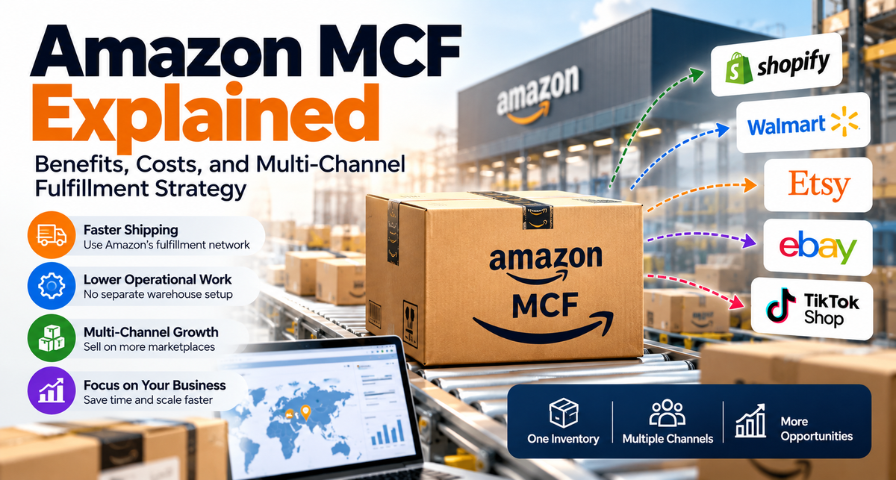
Each and every e-commerce retailer reaches that point sooner or later. They sell something really well on one platform, there is some demand popping up on others, and warehouses, spreadsheets, and shipping labels slowly turn into their second job. Having listings on Etsy, Walmart, eBay, TikTok Shop, and your own Shopify store is the growth story presented on a slide. The reality is that with each additional sales channel, the complexity increases.
Amazon Multi-Channel Fulfillment service was designed to help solve this problem. Amazon MCF is an easy way to store your products in Amazon's fulfillment centers and then have them picked, packed, and shipped once an order comes in through other platforms. For some sellers this means getting rid of the second warehouse and all logistics infrastructure.
What works well in one context may create problems in another one. Instead of asking the question of whether Amazon MCF is good or not, one should be figuring out whether this particular solution fits specific marketplaces they sell on and at what price. Here we will discuss its features, common applications, alternatives, and how to check if this is a good option for you.
What Amazon MCF Actually Does
With Amazon MCF, you get the opportunity to utilize the inventory kept in the fulfillment centers of Amazon itself to fulfill orders made from non-Amazon sales channels. Order data goes through the integration or the software layer between your sales channel and Amazon. The product gets shipped by Amazon, while the tracking details go back to your sales channel.
It is easy to understand the benefit. Pooling of inventory ensures that you do not have to distribute the inventory across different locations and make any guess on which channel will sell the fastest. With a strong delivery network, competitive shipping times may be ensured. This way, you also save the time of your employees in creating packages and printing labels.
There are a few things you should keep in mind about Amazon MCF. It is not a completely customizable fulfillment service. You are operating in the systems, services, and standards of Amazon that were developed for the benefit of the Amazon marketplace.
Where Amazon MCF Often Makes Sense
There are several occasions when MCF should be considered a very good choice, depending on whether the numbers and product make sense. First, there is the seller whose main business is already on Amazon but who is thinking about trying something else without developing additional infrastructure. Since all products are there anyway, sending a couple of orders from Shopify and/or Walmart will not be very difficult, and you will see if those sales channels need further development.
Second, there is the company that competes with the speed of delivery. When shoppers are browsing their direct-to-consumer site, they are comparing it to what major retailers do, and for a smaller company, it is hard to compete on its own with Amazon's network. Third, there is the seller dealing with seasonality. During holidays, the amount of orders can quickly exceed the capacity of a small company, and MCF can serve as a safety valve.
Each time, the item is pretty standard, the customer is concerned more with speed than presentation, and there are no exceptional requirements of packaging or branding in the marketplace. In such a scenario, MCF should be seriously considered. If not, be sure about the facts.
The Real Question: Total Cost Per Order
The mistake many sellers make in analyzing Amazon MCF fees is making that assessment in isolation. What needs to be calculated is the cost of getting one order to one customer. This includes storage costs, preparation or labeling fees, inbound shipping costs to the network, return costs, software subscriptions, and the customer service costs should anything go south. Not to forget the cost of your time in all this, which is often forgotten by sellers.
The fees also change, despite maintaining a constant volume and dimensional standards. Amazon instituted a 3.5% fuel and logistics-related surcharge, which was calculated using fulfillment fees and not the sales price of the item. According to trade news about the surcharge, Multi-Channel Fulfillment got the change in the US on May 2, 2026, while FBA started on April. On Amazon’s 2026 holiday announcement, they added peak fulfillment fees from October 15, 2026, to January 14, 2027. This will incur an additional $0.32 for each unit with the surcharge on top. A margin model created using last spring’s figures may be inaccurate already when you start placing Q4 orders; thus, always check the latest figures from Amazon's fee pages.
In order to illustrate the process of this comparison, imagine the following situation: A completely hypothetical seller processes 400 orders per month on a product that is light in weight. The following numbers are made up just for the sake of illustration, and they are neither Amazon’s nor any benchmark prices. In this case, MCF will cost $6.24 per order and consist of a $5.40 fulfillment fee, $0.19 for the surcharge (3.5% of that fee), $0.45 for storage and inbound allocation, and $0.20 for the integration software. This will sum up to $2,496 monthly. A 3PL will most likely cost $7.00 per order with all additional expenses included or $2,800 in total.
Two things need to be pointed out at this point. First, the surcharge is added to the fulfillment fee only and not to the whole amount of $6.24. Inbound and software fees are allocated costs, which means that they are monthly fees and are distributed among the presumed order volume and depend on the level of inventory turnover, size of the product, and shipping terms. Second, the fee is a non-peak one. An order placed after October 15 will have the peak surcharge added to it.
Under these assumptions, MCF has a cost advantage of seventy-six cents per order compared to 3PL and $1.81 compared to self-service. This margin is quite slim. Any additional cost for processing returns or for a special channel that requires twelve cents per item worth of brand-specific insert packaging, which MCF cannot deliver, can easily erode this margin. Price all orders under identical terms, then decide on an order-by-order basis.
Amazon MCF vs 3PL vs Self-Fulfillment
By itself, MCF seems to make perfect sense. However, compared to the other two options, the trade-offs become much clearer. While self-fulfillment leaves you with the most labor, you have the most control over packaging, inserts, speed, and the customer experience. Costs will be in labor, space, material, and carrier costs and will typically go up with order volume.
The 3PL option is in-between the other two. The 3PL will take care of the warehousing and handling for you while offering more flexibility than the standardized option, allowing you to do custom packaging, kitting, or even specialized handling for fragile or regulated goods. Cost structures will include onboarding, storage, handling, and shipping, and quality will vary widely from one provider to another.
While MCF will take some burden off of your shoulders and offer access to a proven network, your control will be limited by whatever Amazon has to offer. When people are talking about Amazon MCF vs. 3PL, they actually mean standardization vs. customization. If your customers value speed and simplicity, then you'll want to opt for the former. Otherwise, you might want to pay the extra money for the latter.
Packaging: Different Channels, Different Expectations
What looks entirely standard for someone who purchased an item through Amazon may look strange for someone who purchased from a boutique or directly through the branded shop. Packaging is a physical handshake in the deal, and people make assumptions before holding the product in their hands.
There are options for plain packaging of MCF orders, and such an option will help you not to identify your competitors in a box that was supposed to have your brand name. But plain does not mean branded; there are custom inserts, handwritten notes, gift presentations, and designs of the process of unboxing, and all of these options may depend on your current service and the configuration of the orders. Verify the options before making any promises to your customers about them.
Next, evaluate packaging options against their costs. Plain packaging will be sufficient for replacement parts or commodities, but for the gift item or a product that is sold via your brand's Shopify store, another option may justify its cost. The problem is not with MCF; the problem is with using one approach to all channels without understanding what buyers in those channels see.
Customer Expectations Are Not Uniform
However, marketplaces have varying influences on the behavior of buyers consider these as trends to test, not rules. Walmart customers tend to value low prices and reliable delivery time frames. Etsy users tend to trade long processing times for uniqueness. TikTok Shop customers are typically impulsive and expect fast delivery. And customers who reached you on Shopify came for you and probably expect an experience that reflects your brand.
But your own data would be the best predictor. An Etsy user buying an identical replacement product might actually care far less about customization and more about price and speed. And the same would be true for a Shopify customer who might value convenience just as much as presentation. Study the feedback in terms of ratings and comments, the number of returning customers, and the performance on each channel and category. If speed and reliability are key factors according to these indicators, MCF will suit you just fine.
Marketplace Policies: Verify Before You Route
The marketplace rules may vary, and they are checked by performance criteria that may result in warnings, demotion, or even account suspension. It is better to divide this concern into three separate points.
First is the fulfillment rules of the marketplace itself. They include the speed of delivery, correct tracking, the percentage of the late deliveries, packaging, branding, and in some cases even the possibility and conditions of order fulfillment. Each marketplace has its own way of doing things, so there is no common solution for all marketplaces (Etsy, Walmart, eBay, TikTok Shop, and Shopify). The second point is the integration. It must be made sure that order details get to Amazon in time and that tracking gets back to the channel quickly because otherwise, it can be interpreted as a missing delivery. The third is the requirements from the Amazon itself regarding the MCF fulfillment.
An issue arises for all three. If there are marketplace requirements regarding the eligibility of a product to be sold or the identity of the seller, it is necessary to determine whether the product is in compliance prior to determining the appropriate fulfillment solution. The use of a shipping method in compliance will not render the product eligible if it is not. Etsy is the best example, in that their policies concern how products are made, created, and shipped and do not permit ordinary resale of commercially available products.
Inventory and Returns: The Quiet Margin Drain
Returns are the least glamorous side of ecommerce and also the one with the greatest potential to reduce margin. An order made through Amazon will have a built-in returns process. For MCF orders from other sources, it usually doesn't work so neatly. A return requires somewhere to go, a process, and an inspector assigned to it. Depending on your arrangement, returned units can either go elsewhere, through a third party, or back into the network by way of whatever options you provide at the time.
It's important to consider three categories here: return receipt, inspection, and approval for resale. A returned unit should not be considered as ready to resell automatically. It can still be damaged, opened, or lack certain components until it is inspected.
But this is not all. If the product inventory is shared among multiple channels, you have to account for synchronization issues, allocation processes, and unexpected spikes in demand. It may happen that your system is too slow to respond to the sales pace and you make a commitment to deliver the products that do not even exist anymore. Although integration and inventory management tools can help minimize the risk of such situations, their synchronizing speed differs based on providers, thus, test them before using extensively.
Brand Experience: Your Brand Is on Every Box
The above considerations lead to one conclusion: satisfaction is a brand touchpoint. In the case of an inexpensive product that is purchased purely on the grounds of cost, it may not be important. In case of a product that is sold on its story and reputation, such as gifts and wellness, unboxing is a part of the product itself. Each box sends a message about who you are, and with time, this memory influences further purchasing behavior, recommendations, and increased willingness to pay for the brand.
If brand is important to you, be specific. Use the most elegant packaging solutions available, provide a packing slip that sounds like you, and route your premium products through the more controlled channel and price-driven products via MCF.
Building a Smarter Multi-Channel Fulfillment Strategy
Look at each marketplace as an independent business venture with its own client, policy, and challenges. Start with the identification of sources of your income and their sensitivity to delivery time, packaging, and return process. Test MCF at one channel that seems most suitable, in a reasonable volume, and track time of delivery, percentage of defects, client’s reaction, return costs, and saved hours. After that, compare the outcome with outcomes of self-fulfillment and third-party logistics services applied to the same orders.
Be ready to adapt later. Policies will be changed, volume will increase, and reactions of customers will be different. It is justified to make MCF your routine practice. To make it the only choice is the moment when risk appears.
Final Thoughts
There is no question that Amazon MCF can be a great solution for extending your business outside Amazon without setting up your own fulfillment facility. However, its success lies not only in the time of delivery and convenience. In order to utilize this option, sellers must be aware of total costs per order, have all requirements for products and marketplaces verified, maintain inventory, and provide customers with proper experience everywhere.
In this instance, the best thing to do would be experimenting with this technique using a smaller volume of orders and comparing it to other methods available. In the event that the figures and client experience confirm the anticipation, then one can proceed by scaling up. In any other scenario, another approach may have to be considered.
Ready to Grow on Amazon?
Let our experts help you scale your Amazon business with proven strategies.
Get a Free Consultation