Amazon Marketing Cloud: How to Build Custom Audiences and Optimize Amazon PPC
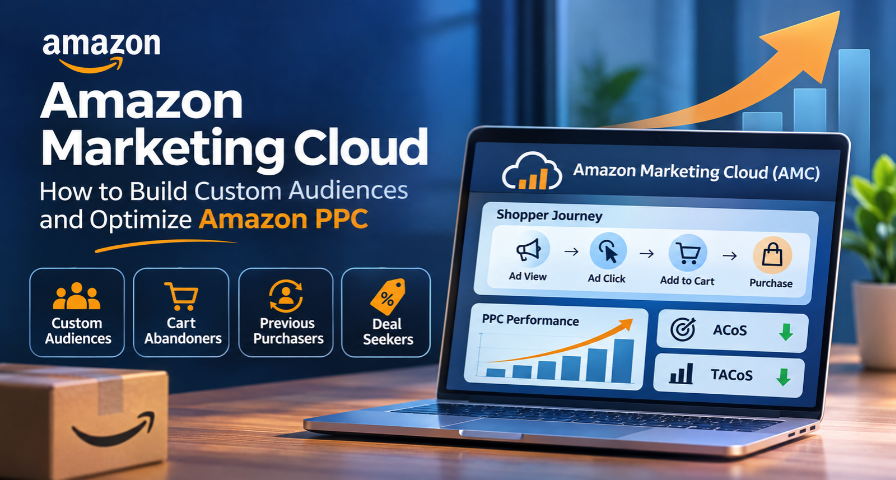
For many years, it seemed that Amazon Marketing Cloud was only suitable for large companies with data analysts and huge budgets. The time when such assumptions were made passed long ago. Since September 2025, it has become available to all advertisers using sponsored ads and is included in the ad console however, many sellers prefer to consider it an issue of other people. For a long period of time, Amazon PPC marketing was focused on keywords, bids, and budgets, and Amazon Marketing Cloud (AMC) brings one more element to it: what are customers' behaviors before and after encountering your ads? This article will provide you with the information about the way AMC works and how to make use of it for optimization of Amazon PPC marketing.
What Is Amazon Marketing Cloud, and How Does It Work?
Amazon Marketing Cloud is an entirely secure and privacy-friendly clean room. Here, advertisers analyze the anonymized signals of the shopping, browsing, and streaming behaviors of Amazon customers together with their campaign data and take the insights gained from the analysis to measure campaign performance and audience building. You will never get any information about the individual customers but just the aggregated patterns of their events like time-to-purchase or the ad format they have interacted with throughout the path. The AMC is built above your day-to-day campaign management operations. It won’t solve the problems of your poor listing and unorganized account structure but will tell you how the campaigns perform among shoppers.
How AMC Differs From Traditional Amazon PPC Reporting
Campaign standard reports give information about what is happening in each campaign: impressions, clicks, spend, orders, and attributed sales. They are necessary, but they are built on a campaign-by-campaign and ad product basis, and there are different kinds of attributions depending on the report. The AMC tool offers the ability to analyze the customer journey across multiple touches. The customer can view a sponsored brands advertisement, click a sponsored products advertisement some days later, and purchase through a sponsored display impression. You can analyze such a customer journey, the time to conversion, and the intersection of audience segments through the AMC tool. This means that it acts more as an Amazon advertising analytics tool rather than a dashboard.
Amazon Marketing Cloud Access, Eligibility, and Requirements
The timeline gets frequently misinterpreted. As of October 2024, Amazon has introduced AMC to advertisers utilizing solely sponsored ads and has rolled out audience bid boost for Sponsored Products and Sponsored Brands. Finally, as of September 18, 2025, AMC was available to all advertisers utilizing Sponsored Products, Sponsored Brands, Sponsored Display, or Sponsored TV via the Measurement and Reporting tab in the console. Requirements for AMC eligibility and available features still vary depending on the marketplaces, so make sure to double-check yours.
There is no standard checklist of clicks you are expected to accumulate before using AMC. There is a limit on audience size that applies to AMC and that you have to take into account. Audiences have to reach a certain size to become eligible for targeting, and software companies usually mention about 2,000 users as a prerequisite. This number is not an industry-wide norm but rather an estimated one, so double-check the requirements in your account.
Using Amazon's Built-In Audience Targeting
The simplest approach needs no question at all. Within the audience bid adjustment options of the campaigns of Sponsored Products which qualify for this experiment, there are preset audiences, one of which targets customers that Amazon believes will buy. Set a small adjustment, like 10% for example, and see how the conversion rate and cost per sale compare from those customers compared to the regular traffic of the campaign. The idea is not to increase spending but to optimize spending on potential buyers.
How to Create a Cart-Abandoner Audience in AMC
Those who abandon their carts are a perfect fit to target using an Amazon PPC retargeting strategy. They have already put your item in their cart but failed to purchase, showing more intention than just looking at the page. However, cart abandonment may indicate something else like pricing, customer reviews, delivery timeframes, or listings quality, which means that it shouldn't be your only option.
For creating the audience, first open AMC, navigate to the Audiences tab, and create a new query there. Choose your active storefront and country, select the rules-based audience type, and give it a name based on the campaign naming convention and an easy-to-understand description that you will be able to understand even after six months. Make sure that the auto-adjust date field is enabled so that the lookback period (e.g., 30 days) always rolls. After that, you may use the AI SQL generator, but make sure that you know what you should check here: the audience should include only customers who have added the product to the cart within the lookback period, without those who have bought the product in the same period, as well as make sure that the query concerns the correct marketplace and product IDs.
Audience creation and the use of that audience are two separate concepts. The activation depends on the audience size, availability in the marketplace, supported campaigns, the freshness of the data, and the eligible campaign. In case of Sponsored Products and Sponsored Brands, AMC audiences act as bid enhancements and not audience targeting, meaning that your bid increases only when the shopper from your audience searches the term which you have already bid on. Audience targeting is possible in the Sponsored Display campaign. This difference is important since the creation of the audience does not always mean that you will be able to run a retargeting campaign.
Bid Adjustments: A Worked Example and Common Mistakes
Either a 10% or 15% modifier would be a fair testing range and not Amazon's benchmark. It's all about the math. If you have a base bid of $0.80 with a 15% modifier on the audience, your bid will go up to $0.92, before other modifiers. The other modifiers tend to surprise the sellers since the audience and placement modifiers tend to multiply each other. For instance, if you have a $1.00 bid with a 50% placement modifier and 50% audience modifier, it will result in $1.00 x 1.5 x 1.5 = $2.25.
A Practical Example: Testing a Cart-Abandoner Audience
Consider a seller who spends $100 per day on his Sponsored Product campaign and gets $300 per day of revenue from advertisement, which means an ACoS of 33.33%, base bid of $0.80 and conversion rate of 10%. If the cost per click is $0.80 and the conversion rate is 10%, the cost per order is $8.00, which means that the average order value should be approximately $24. The seller creates an audience of cart-abandoners and applies a bid adjustment of 15%, which increases the bid to $0.92 for such visitors.
Let's imagine, for illustrative purposes only, that the conversion rate of clicks from this audience is 13%. The cost per order is approximately $7.08 (that is $0.92 divided by 0.13), while ACoS for those clicks is approximately 29.5%. Those figures are made up just to demonstrate the logic of calculation. The key thing here is the following analysis: audience performance vs performance of the campaign traffic in general, then overall sales and TACoS of the account, after which the decision on adjustment will be taken.
How to Measure and Test AMC Audience Performance
Don’t judge the performance of audiences by one KPI. While ACoS compares ad cost with ad sales, TACoS compares it with total sales, both organic and otherwise. Audiences might succeed in driving up ad sales and still underperform on the business metrics because they capture customers that would have bought anyways. Consider audience performance in conjunction with overall account performance, contribution margins, and incremental sales.
Remember cause-and-effect issues. Constant or falling TACoS with increasing sales might be signs of improved efficiency, but it doesn’t mean that the audience was responsible for incremental sales due to organic growth, seasonality, campaigns, or other ads impacting the same metric. For better insights, use a control or run a measurement experiment.
The quickest route to nowhere is by changing too many things at once. One big variable at a time, hold everything else constant about your campaign and compare two-week periods to the two weeks before instead of day by day. Timing of your campaign launch is a matter of preference, not a hard-and-fast requirement set out by the platform; select a date where you can measure performance in a controlled environment. Naming is useful as well. Your AMC measures performance by campaign, so naming it based on the ASIN, product type, ad format, brand/non-brand, and target ACoS works, while "Campaign 47" doesn’t tell you anything.
Other Audiences and Their Limits
After your abandoner audience works, scale up based on intent. Past buyers within their repurchase timeframe would be effective for consumables since they know your product. Your product page viewers who never put anything in their cart have medium intent, hence they should be controlled better with budget spending. Your promotion-induced customers only make sense when there is still a relevant promotion going on. Each group reflects a different level of intent; therefore, each group should have its own bidding strategy and purpose.
Have realistic expectations regarding exclusions. The audience documentation by Amazon does not provide a ready-made audience that consists of repeat offenders and habitual negative reviewers; therefore, you should not assume such an audience exists. Exclusion capabilities depend on the ad type, and boost audiences are not used to exclude certain customers. Solving the problems causing these returns and bad reviews would bring much more benefit.
Conclusion: Making Amazon PPC Optimization More Data-Driven
Effective PPC management used to rely primarily on keyword knowledge, bidding, and budgeting. The ability to manage all of those is essential, yet it is becoming increasingly critical to comprehend shoppers' behavior, and there are very few places where it becomes evident to normal sellers. There is no need to know all of the queries. First, work with an in-built audience using a modest adjustment, create one audience of abandoned carts, compare it with a good baseline, and assess it using ACoS, TACoS, and increased sales. Finally, integrate everything that you have learned into your weekly processes, which will lead to audience insights dictating bidding, budgets, and even listings.
The actual benefit is not in some tricky setting. The benefit lies in forming the right habits.
Ready to Grow on Amazon?
Let our experts help you scale your Amazon business with proven strategies.
Get a Free Consultation
Comments (0)
Leave a Comment