Amazon Marketing Cloud: 2 Powerful Features for Sellers
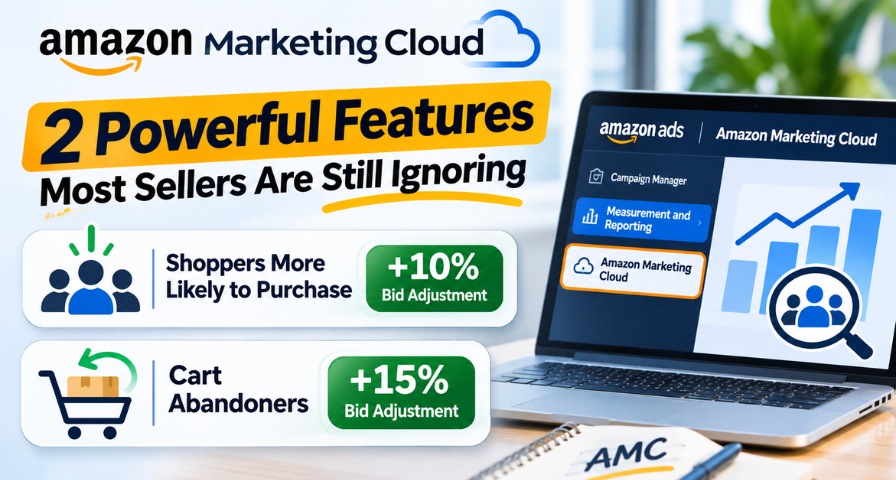
The average Amazon seller spends his advertising time on familiar tasks like bid tweaking, eliminating wasted ad terms, and observing the ACoS. While doing that, one of the more exciting pieces of the advertising console remains mostly untouched. Amazon Marketing Cloud, better known as AMC, was a playground for enterprise advertisers with analysts working on their team. This product was open to sellers of all sizes from the middle of 2024. A marketer running accounts up to $20 million per year estimates that less than 1% of sellers have actually used it. The figure is not the official Amazon statistic but is consistent with the experience of many sellers who admit they know about the existence of the platform and have never even tried it.
In this article, I will describe the functionality of this tool, explain why it matters for the AMC advertising analytics, and discuss two things that you can immediately do with it. The first one will take no more than five minutes while the second one requires more patience but will fundamentally change your view on shoppers.
What Is Amazon Marketing Cloud, and How Does It Work?
Amazon Marketing Cloud is a data clean room. Amazon possesses huge amounts of behavioral data on how your customers engage with your ads. AMC offers you an opportunity to create an isolated room where you will be able to ask questions of this data set. Your privacy will not be disclosed; all you will receive are aggregates showing who clicked, who made purchases, how long it took for them to make a decision, and which ad formats a customer saw.
In other words, you could say it is a difference between receipt data and security camera footage. Reports only show you what was sold and what ad received credit. AMC allows you to look at the buying process and its history in more detail. You make queries, and the output can be used as a basis for your audiences.
Why Does Amazon Advertising Attribution Matter So Much?
The default reporting format on Amazon relies on the last-click attribution model; the advert the user clicked on prior to making their purchase is the one that gets the credit. Think about how this influences your evaluation. Imagine that you have a buyer who encounters a Sponsored Brands banner while browsing the category, spots a display ad on some other page, and finally does a search for your product and clicks on the Sponsored Products listing. The latter campaign sounds pretty good to you it boasts a low ACoS and great conversions.
While the Sponsored Brands campaign appears to be a black hole, with a lot of spending and few sales. A seller looking at this data might reduce the spend on that branded campaign, and after several weeks sales would drop. The reason is that that branded campaign had been quietly driving the other one all along. With better advertising attribution from Amazon, you will never have to worry about such blunders. AMC will not make a decision for you, but it will provide you with the necessary information.
How to Find It and Whether Your Account Is Ready
Navigate to the Advertising Console and open Campaign Manager. Scroll down through the icons in the sidebar menu until you see the full list, then choose “Measurement and Reporting," which includes Amazon Marketing Cloud in its list of options. The interface will be more technical than other parts of the console, as it is meant for queries.
First, make sure that you have enough actions going on in your account to get some useful information. According to the training referenced in this article, the threshold for basic usage was around 500 clicks/impressions, while for advanced queries you need to have at least 2,000 actions per month, with at least two ad types being active and sales going well. These figures can be considered recommendations based on the training but not on the official requirements, which may differ depending on features. There are three different actions associated with AMC: access, query, and audience activation based on the results.
It is also good to keep in mind that clicks and impressions are not synonymous. Clicks reveal how many shoppers got interested in your listings, whereas impressions indicate how many times your listing has been viewed. An account that has plenty of impressions and only a few clicks will still provide you with poor behavioral insights, as the clean room picks up much more information about people who have clicked on your listings than those who have just skimmed them. So if the entire campaign consists of one automatic Sponsored Products campaign, there is nothing for AMC to analyze now.
Switch One: Does Amazon Audience Targeting Really Take Five Minutes?
Starting with the easier thing: within your existing campaigns, add Amazon's "Shoppers More Likely to Purchase" built-in audience and add a 10% bid modifier. This audience comes already built-in for you from Amazon's purchase behavior data, so no work for you there. The expert behind this tip mentions that he sees an actual lift in most of his accounts using this trick, and only very few sellers use it. That is probably the easiest way of using Amazon audiences.
Just a little warning before you go on this path. Available targeting options and bid modifiers differ depending on your campaign type and on the Amazon Ads platform itself, which tends to change more often than expected by the sellers. You might find not all the same things available in your campaigns as someone else, and the names of controls on your dashboard might change soon.
Use 10% bid modifier just as a starting point for testing. Some accounts may require a bigger increase, some a smaller one. But the most important thing is how do you analyze the results?
Evaluating the 10% Adjustment: A Worked Amazon PPC Optimization Example
A greater bid will not necessarily lead to better results, which means that there should be a benchmark for this test. Assume that a Sponsored Products campaign with a bid of $1.00 was able to get 200 clicks, 15 orders, and $200 worth of spending. This means that there was a conversion rate of 7.5%, while the cost per order was roughly $13.33.
Next, add the 10% modifier to your calculations. Now the actual bid for customers from the target audience becomes $1.10. With 200 clicks at this rate, the spending amount will be $220, and if one wishes to maintain the same cost per order at $13.33, then 16.5 orders will be required. Of course, the actual effect will be slightly lower due to the fact that the increase in bid price concerns only customers from the target audience.
So run the test with discipline. Apply the audience to a few steady campaigns rather than your whole account. Wait a couple of weeks so you aren’t reacting to noise, then compare conversion rate, cost per order, and total sales against the prior period, ideally one with similar seasonality. If the numbers improve, expand the change. If they stay flat, you have lost little and learned something about your account. This is Amazon PPC optimization based on measurement rather than hunches.
Switch Two: How Can Sellers Build Custom Audiences on Amazon?
The second lever is a bit more challenging, as it requires more patience and the use of a better data set. However, this is how AMC becomes different from the common console. Instead of using Amazon’s general purchase intent audience, you analyze your customers and develop the audiences yourself. This way, your custom audiences on Amazon can help you bid based on behavior and not assumptions.
Due to the fact that the second switch is much more flexible, it would be great to analyze it by answering three kinds of questions that could be asked by a cleanroom. The first one has to do with consideration. For example, you may want to consider those consumers who interacted with your Sponsored Brands campaigns but never made a purchase, and ask yourself if they are a viable segment to reach once more with new creative or a new bid.
The second point relates to the combinations of advertisements. Customers who were exposed to several types of ads will have significantly different conversion rates depending on the type of the ads. Thus, if customers who viewed both a brand ad and a display ad buy much more frequently than those who just clicked a sponsored products ad, this would mean that there is something that is hidden from the last click reporting. Then you could create an audience and apply a bid modifier based on its higher conversion rate.
The third point relates to the time factor. Your analytics data will show how many days on average it takes your customers to buy after seeing your first ad and this way you will know how patient your campaigns should be and how accurate are the attribution windows you are using for each campaign are.
A Category Example: Diabetic Socks
However, the examples provided above can only take an abstract form, so it may be interesting to consider a private labeler operating in the competitive market segment of diabetes socks. The shoppers belonging to this particular product group tend to be quite cautious; they compare materials, read reviews, and sometimes even purchase products for their parents or relatives, which means that the process takes place for a few days.
Let us imagine that this seller uses Sponsored Products on keywords, Sponsored Brands for the brand store, and Display for retargeting of people who visit product pages. In the case of last-click attribution, most of the credit goes to sponsored products, while brands seem to underperform. Applying the AMC approach, the seller analyzes people who interact with several ad formats before making a purchase. There is a possibility that people who first saw the ad in the Brands campaign, which describes why the non-binding fit and moisture-wicking fabrics make the product unique, have a higher conversion rate and fewer returns of attention than those people who reached this page with the help of just one click on a keyword. It means that brands should not be changed in any way because of their poor performance according to last-click figures.
Looking Beyond ACoS: Total Advertising Impact
One pitfall needs its own mention. An apparently inefficient campaign through direct attribution actually helps in contributing to performance. While considering how AMC evaluates things for you, consider the overall number of sales, organic sales, TACOS (total advertising cost of sales) and profit margins along with ACoS. A Branding/Display campaign having high ACoS can help in improving branded search results and organic ranking, both of which do not reflect in the campaign metrics. Evaluating AMC insights just on the basis of ACoS will lead you right back where you started from.
What Amazon Sellers Should Understand Before Using AMC
However, an impartial approach implies consideration of limitations as well. To begin with, AMC is not a real-time optimization tool. Its suggestions are dependent on the amount and type of data collected and the process of query processing. Therefore, its usage in bid management on a regular basis is much more effective than on an hourly basis. Secondly, it should be mentioned that audience creation and activation are always limited by Amazon's privacy guidelines and criteria for audiences. An audience that is promising in one of the queries may become unavailable later due to some restrictions; however, you can find the latest recommendations in the console. Thirdly, AMC provides no guarantees concerning ACoS, CTR, or sales. All in all, this tool can only improve the quality of data and, thus, the decision-making process.
These limitations do not mean that you should not use this tool at all; they imply that you have to consider the tool as a research tool instead of a magic button.
Combining AMC With Traditional PPC Optimization
AMC should not exist in a vacuum away from campaign management. The lessons learned from AMC would be all the more meaningful if they could be combined with keyword performance metrics, placement statistics, search term analytics, inventory, and profit data. Should AMC find out there is a particular consumer group that has better buying habits, one must still make sure that the necessary products have sufficient inventory, competitive pricing, and good listings before increasing the budget.
This is the fundamental lesson of the whole ordeal. Sound advertising decisions require both customer insight and campaign management basics, which AMC can only provide one of.
Final Thoughts: Your Next Step With Amazon Marketing Cloud
The Amazon Marketing Cloud is no longer a solution for enterprises only. It is a clean room within your advertising console that gives insights on the customer journey that go beyond standard reports, allowing you to translate these insights into audiences and bidding optimization. Based on the opinion of an expert, less than 1% of the sellers utilize this feature, implying that the problem has been mostly lack of knowledge and confidence, not the access itself.
Start small. Make sure your account is engaged enough and runs several types of ads. In case it is, create the "Shoppers More Likely to Purchase" audience for several stable campaigns that offer these options, set a 10% modifier and evaluate the outcomes in terms of cost per order, sales volume and TACOS and not clicks only. And after you gather at least a few weeks worth of data, enter the clean room and ask just one question about your customers’ journeys between ad types. And that single question will make you way above the majority of your competitors.
Ready to Grow on Amazon?
Let our experts help you scale your Amazon business with proven strategies.
Get a Free Consultation
Comments (0)
Leave a Comment