Amazon Main Image Optimization: Why Your Main Image Is a Conversion Lever, Not a Checkbox
The Two-Second Audition
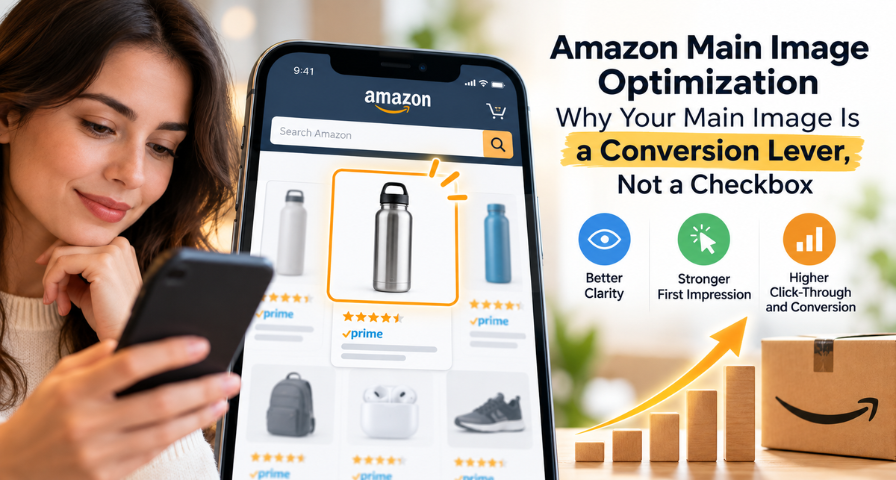
Visualize a consumer swiping their finger across the screen of a smartphone as they browse through search results, not looking at the headlines. Not comparing bullet points. They are scrolling the images and, in about two seconds, their eyes either catch something interesting or move past it. Your main image is fighting for its place.
The process of uploading a photo to a product page is treated as one-time by most merchants. The picture is being shot and approved, the listing is uploaded and attention moves to pricing, promotion, and stock management. Approval just means the image is good enough for Amazon. Nothing about its effectiveness. And there can be a difference between good and great that can cost you money. This is the essence of Amazon main image optimization.
This article will discuss the reasons why the main image plays such a crucial role, what aspects are worth testing, the limits set by the policy, and how to perform Amazon image testing safely.
Why the Main Image Carries So Much Weight
Every visitor comes with an implied query is this what I am searching for, and will it fit me? In many cases, the primary image answers a lot of questions before reading the text. It reveals what kind of product it is, what size the product has, what material it is made of, and how quality the item is. Among other dozen products that look similarly, your image can provide some clues as to why it is different from others.
The above information influences click-through rate directly. Without clicking, no visitor will be able to see your title, bullet points, reviews, and price. So, even the most perfect text will not be able to save your listing in case your thumbnail does not convince visitors to click on it. There is one more side effect of a primary image. Shoppers who clicked on your listing already had expectations based on the picture. If the image is clear and realistic, they usually come better qualified and, thus, can positively affect the conversion rate.
Why "Upload and Forget" Gets Costly
Consider the original photograph's conception. An angle, crop, exposure, and lighting arrangement were selected according to what worked nicely in the studio, not necessarily what looks good when compressed to thumbnail size on a small screen. There was no experimentation or measurement of other options, so there is no way of knowing whether the decisions made were even correct.
Rivals refresh their image on Amazon, new products launch with better images, and buyers’ demands continue to grow. Mobile phone browsing comprises the majority of Amazon transactions, whereby small nuances become blurred and messiness illegible. That beautiful image that you see magnified on your desktop screen loses its significance when viewed at thumbnail sizes.
The impact of drift doesn’t happen in a jiffy; rather, it’s a gradual process, where CTRs decrease a little bit, conversion rates decrease by a little bit more, and the blame goes to seasonality and ad budgeting. All this can be changed through consistent testing.
What Is Worth Testing
A good experiment varies only one key factor at a time. In the case of the primary image, there are four factors that will always be worth trying.
One of them is product perspective. A backpack shot head on may come out as nothing more than a two-dimensional object, whereas a three-quarter shot allows for seeing the contours and the pockets of the bag. This is what will tell you the most about your product in the shortest amount of time possible, although it will be different from the one used by the photographer by default.
Another factor is the composition and position. The more of the space the product takes up, its position in the image and how parts of it relate to each other influence the way the image communicates the message quickly.
The third is relevant visual context, which needs care because of the rules covered below. In the main slot, context usually means showing included accessories or a more informative view, not a styled scene. The fourth is a clearer demonstration of the use case. If a product has an unfamiliar shape or specialized purpose, the secondary images can make its function obvious, and the two slots should build on each other.
A Simple Example: The Socks Listing
Consider a merchant with an offer for athletic socks that has a dominant image featuring the item in a relatively smaller size and floating within a vast ocean of white space. At first glance on a phone screen, the socks will seem like a mere blur. Hypothesis: The item is difficult to recognize at thumbnail size, and enlarging its size in the frame might boost the click-through rate.
Version A retains the existing image. Version B features the same product, the same quantity, and the same white background while occupying more space in the frame. In addition, Version B aligns the socks such that the pattern and the cuff will be visible. The only difference is that one thing has been done differently, which helps interpret the results correctly. A rise in clicks without affecting the conversion rate means that the improved visibility of the item has been proven. A rise in clicks but with declining conversion means that the merchant knows something else, which is just as useful: The new image generates curiosity rather than intent to purchase.
The Rules That Still Apply
It should be noted that the experiment does not override the Amazon main image requirements, which are quite strict. Your main image has to include the product on a clean white background, occupy most of the space of your image, and have a high enough resolution for zoom. Usually, text, promotional logos, watermarks, backgrounds, and any other objects except the product itself are not permitted in the main image, and accessories that are not part of the product can confuse your customers.
That's why it is crucial to understand what is meant by "relevant visual context." Lifestyle shots, the person using your product, and infographic elements belong in your secondary images and leave much more room for your creativity there. Getting confused with the two types is probably the fastest way to fail in terms of image requirements.
Failure to follow these guidelines will result in rejection of your image on upload or suppression of your existing listings until the problem is solved. Since different policies apply to various categories and marketplaces and evolve with time, it is important to check the current requirements for your product and region.
How to Test Without Taking Foolish Risks
Begin with your hypothesis rather than your “feeling.” What exactly will you try to improve and why, just like in the example with socks? You should know how to measure it after that and not rationalize your results later.
Finally, you should conduct a controlled test. Comparing the swap of an image with the comparison of this month to last month will give you much less information than you may think because all other factors changed too. You should try to show different options to different consumers simultaneously.
Amazon’s Manage Your Experiments tool was made for exactly this purpose. Access to it normally requires having an active brand registry and a sufficient amount of traffic for the ASIN being considered, which means that all products will not be able to qualify. It has been used for experimenting with content like main images, titles, bullet points, and A+ Content, although the list of options varies, so it is always advisable to consult the latest interface of the tool provided by Amazon. When the experiment has already started, pay attention not just to the winning version but also to the conversions and sales statistics and to the confidence rate of your report. Do not stop the experiment as soon as one of the versions starts winning, as it is one of the most popular ways to self-deceive yourself, and do not be afraid to receive a null result.
Lastly, always have a compliant copy of the original handy. Make an archive of the approved version, document its requirements, and ensure that you can access it quickly should a new version not live up to your expectations. It will give you peace of mind when experimenting.
Reading the Results Like a Grown-Up
Upon completion of the test, avoid seeking a single number. The click-through rate demonstrates whether the image has garnered the visitor’s attention, and the conversion rate demonstrates whether those visitors go ahead to make a purchase. Ideally, the winner will enhance one and not harm the other. It is possible to note an image that attracts clicks while reducing the conversions since it may be promising something that the product does not offer.
Consider placing the numbers into context as well. One should consider the traffic levels, sales, and profits since even a small increase in a poorly performing item may not make sense for the production of another photo shoot, but where there is a significant gain in a top-selling item, it would be reasonable to invest more money into the same path. Every result is important for understanding what your customers want. If the winner was an image with a tight crop, then they may want details.
The Image Is Only Part of the System
While the main image will attract the click, it is not enough to close the sale on its own. When a customer has clicked into the listing, then everything else that they see the title, bullets, secondary images, A+ content, pricing, reviews, and offer must support the expectations set by the main image. This is what makes Amazon listing optimization such an interconnected task. A superb thumbnail paired with a generic title or poor offer only pushes the disappointment further down the page.
Making It a Habit
The sellers that will gain the most advantage are those who do not conduct one single successful experiment. The reason being that they consider optimizing their products on Amazon a regular process. Begin by optimizing your most trafficked products because a little improvement here will make a lot of difference. Conducting one experiment at a time, documenting the results, and returning to your most successful experiments regularly is important since what worked before might not work now due to changing market conditions.
The Takeaway
Optimization of Amazon main image is all about a shift in mindset. Approval is the beginning rather than the end. Thinking of the main image as a continuous opportunity for conversions will help create clarity and improve first impressions, which in turn may increase CTR and conversions provided that you do things right.
You can begin this process today. Choose any one product that matters to you, look at the current main image on mobile in its thumb size format, and ask yourself in all honesty whether it tells the story in 2 seconds. Make a hypothesis of how it can be improved and make a compliant replacement and test it while keeping your approved version available as a contingency option.
Ready to Grow on Amazon?
Let our experts help you scale your Amazon business with proven strategies.
Get a Free Consultation