Amazon Listing Strategy: How to Target Multiple Customer Segments With One Product
Why the Same Box Can Speak to Different People
A stroll down the aisle in any pharmacy devoted to pain relief reveals a family of goods tailored to each stage of life. There is a medicine box tailored for those who are having trouble sleeping; another one is aimed at a person suffering from a migraine; and there is a product line dedicated to curing an unyielding backache. The composition of medicines is somewhat different (as the nighttime formula contains a sleeping pill), but the message here remains relevant: people don’t buy “a pain reliever”; they want a product that will provide them with a cure for a particular pain.
This insight is crucial in case of selling online because the customer has only several seconds to choose among twelve goods on Amazon. The pitfall is to treat the insight as an invitation to offer several product listings under the name of a single product. In Amazon listing optimization, one should distinguish two aspects that are often confused by sellers: who they speak to and what the product is according to the catalog.
The Cost of Talking to Everyone at Once
The sellers create one product listing and attempt to ensure that it will cater to all potential buyers. This way, the title will incorporate all benefits, the bullets will list all the uses, and the photos will show all types of customers using the product. On the one hand, it seems safe. However, when the customers have different needs, a general approach to creating listings will decrease the level of relevance for each of them.
Imagine a marathon runner reading a description of a magnesium balm. In case the seller mentions something about hormone balance, the reader will be left wondering whether it is meant for him or not. If a woman in menopause sees a photo of a sweaty trail runner, she will feel the same way. Both of them will be on the same page where some part of the message is intended for a completely different person.
Why Separate ASINs Are Usually the Wrong Answer
If two audiences respond to different messages, it is tempting to give each its own detail page. Amazon’s rules push against this. The Product Detail Page Rules tell sellers to refrain from creating duplicate pages for a product that already has one, and to create new pages only for new products or versions. Amazon’s guidance on potential duplicates and split variations goes further and describes creating duplicate ASINs as a violation of its listing policies, because they make search and purchasing decisions harder for customers.
Changing the title, photos, or intended buyer does not turn an identical physical product into a new catalog item. The practical risks include duplicate pages being suppressed and, depending on the pattern, warnings on your account, so it is worth reading the current policy pages yourself instead of relying on anyone’s summary, including this one.
There is a legitimate exception. The same rules allow new pages for genuinely new versions, and a different formulation, size, material, or feature set can qualify. The sleep-aid version of a pain reliever really is a different product. But eligibility depends on Amazon’s requirements, so confirm it in Seller Central before building anything, and do not assume that a bundle or pack-size change will automatically qualify.
Keep One Catalog Identity, Vary the Message Around It
The practical solution is to ensure that your detail page is correct and leave the audience segmentation to your marketing efforts. After all, the detail page is where all reviews, ratings, and past sales data live, and this is precisely what makes its fragmentation costly. Everything else you can control is advertising, Brand Store, email, social media, and other traffic sources.
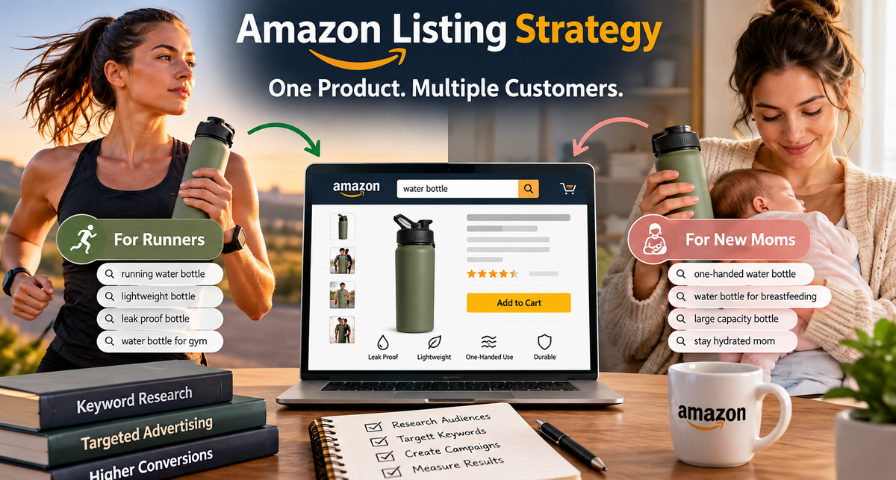
Imagine a water bottle that is marketed to both runners and pregnant women. While the product itself will remain the same, the feature list on the product description page will be tailored according to the needs of both audiences. In this way, two separate campaigns may be run for each audience. One for runners would focus on grip and portability, and the other would be focused on ease of use with one hand and hydration all day long.
Amazon Keyword Research and Targeting by Audience
Audience-specific marketing requires knowledge of how the specific audiences actually search. The Amazon keyword research brings this idea to reality, because a runner and a caregiver will be using different terminology although having similar needs in respect to the purchase of a particular bottle. The former will likely search for a light running water bottle, whereas the latter will search for a one-handed water bottle. Those examples should serve as directional suggestions as opposed to definite keyword opportunities; therefore, make sure to verify every phrase with a keyword tool and your personal database.
It may turn out that your best resources are right at hand. Indeed, the queries made by customers in search reports, the search term reports from the ads, and the reviews left by consumers and their questions left on the product page can give you many insights into the ways in which people use your products and which use cases you did not think about. Organize the search terms according to the needs of customers and separate the ones that should be used in the listing and those for the campaigns.
Tailoring Creative and Content Within the Rules
As soon as you have sorted out all your segments, it is time to adjust the tools you have. You can make several copies of the sponsored ad for different sets of keywords. You can create a brand store with different areas for different purposes and allocate each of your campaigns to its area. At the same time, your own website and any other social media platform can feature the product in the proper context without using any catalog.
Pay close attention to your claims, especially to those that pertain to the health and wellness products. In order for your targeted marketing message to match the product, it must be supported by the product itself. A balm with magnesium, aimed at athletes, can talk about its effects on post-workout recovery; however, it cannot make any claims regarding the relief of menopause symptoms or improving sleeping unless it is substantiated and approved according to the appropriate regulation for the type of your product. Adjusting the message for your audience does not give you a right to make any promises to your customers.
Measuring Amazon Conversion Rate Optimization the Right Way
Measuring will be fruitful only when done accurately. The click-through ratio indicates whether or not your messaging appeals to the right audience. Conversion rate will indicate if those clicks lead to purchases, which is what Amazon conversion rate optimization revolves around. Advertising cost of sales will be the comparison of how much you have spent on advertisements compared to the sales you have made from these ads. Total advertising cost of sales will compare the same against total sales.
The data becomes most valuable when taken in aggregate. Let us look at a purely hypothetical example, not actual numbers. Imagine that a running-oriented campaign has a better click-through ratio than the generic one, yet it has lower conversion. This means that the ad is attracting interest but something about the page, the price, or the offer is not meeting the expectations of those customers. The obvious solution would be to increase bids. However, it would make more sense first to research why this happens. Which search terms bring clicks to you, does your page speak to those customers, and how do they behave? Perhaps the terms have little to do with what you are offering.
It should be noted that timing can also be an issue. It does not mean that a minor improvement in conversion rates within several days is a result of a more effective strategy since seasonality, price change, promotion, and stocks impact the performance of your website. Try to change one variable at a time, if possible, and wait until traffic reaches a steady level.
Staying Disciplined Instead of Sprawling
When you discover that your product is targeting several segments of consumers, then it becomes quite easy to try targeting everyone. Every new angle translates into yet more keywords, campaigns, creatives, and data sources that need to be monitored. Split between too many groups, you will see your budget being stretched thin and not gathering any data necessary for improvement.
Try testing out your most interesting two to three angles on the grounds of the difference in search terminology and motivation. An easy way to do this is by comparing ad copy of two segments. If you can interchange it without anything getting noticed, then the angles are not different enough to warrant such efforts. When the interchange makes everything look strange, then you've got yourself a winner.
The Principle to Carry Forward
Keep the catalog correct, make the marketing timely, and let the data tell you which customer groups are worth investing more time and money into.
In order to implement it, you have to conduct some research. Read your reviews, customer questions, and search data to identify a second target group that actually exists. Familiarize yourself with the existing Product Detail Page Rules on Amazon as well as category requirements. Then create a campaign for the new target group, direct it at the proper page, and compare it to your benchmark. In case the data suggests adding a third approach, do so. Otherwise, you have learned something valuable.
Ready to Grow on Amazon?
Let our experts help you scale your Amazon business with proven strategies.
Get a Free Consultation