Amazon Is Taking the Scissors: Are Sellers Ready to Give Up Control of Their Ads?
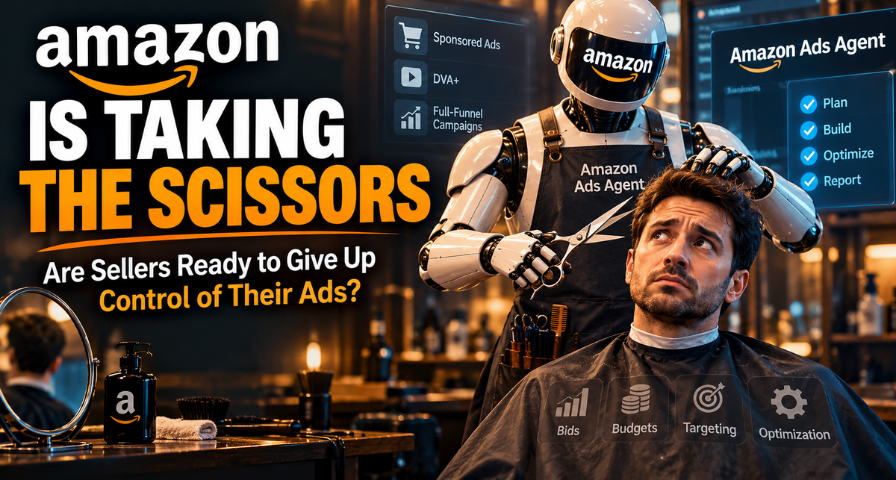
Until recently, Amazon ads have been like having an experience of sitting in a barber's chair with a mirror in front of you. One can see every haircut, one may ask for some modifications to be made in favor of his or her haircut style, and one can be fully aware of the cost. Times have changed, and Amazon plans to go towards the automation of the Sponsored Ads optimization process in the U.S. market, with the launch expected to take place in January, and the extent of what Amazon controls should not be overlooked. Amazon places the bids and budgets, and then the advertiser explains his or her target.
If this scenario is familiar, it is because of Meta's efforts to walk the advertisers down the same road. There is just a catch that makes Amazon's effort slightly different from yet another wave of AI promotion. The barber decides how to cut your hair, and he also gets more money for doing so.
Amazon Is Turning Ads Agents Into the Front Door
At its annual unboxed event in San Francisco, Amazon made a structural announcement rather than a cosmetic one. The name Ads Agent, which previously described a conversational assistant launched at the 2025 event, now applies to the whole advertising platform, which replaces the old console and the Amazon DSP experience. Underneath it sit three campaign families: Sponsored Ads, DVA+, and Full-Funnel Campaigns.
An Amazon Ads executive was careful to say this is not a rebrand. Agents have been fully integrated into the platform and into the workflows advertisers already use. The chat window is no longer a helper parked beside the dashboard. It is becoming the dashboard.
There is a practical reason behind the move. Amazon's product leadership noted that advertisers were already trying to link Sponsored Ads and DVA campaigns themselves, at the cost of maintaining separate setups. Anyone who has bounced between Sponsored Products in one interface and Amazon DSP in another understands the appeal of a single home for Amazon advertising.
From Clicking Campaign Settings to Giving Amazon a Goal
The old system consisted of rows of dials. You chose your campaign type, did some keyword research, put your bids and budget together, and returned later. In the new Ads Console, things are done the other way round. You say what you want to achieve, the agent suggests a solution, creates the structure, tweaks it based on the feedback, and reports.
It took us a year to develop this new console. The initial solution was able to transform the uploaded media plan into campaign structures and ad groups, suggest audiences, and provide Amazon Marketing Cloud analysis without any knowledge of SQL. To a small seller who used to spend an entire weekend setting up a Sponsored Products structure, this kind of help is a huge bonus.
DVA+ is the new campaign type that continues the simplification of the process and applies it to programmatic buying. This means that it joins such previously separate campaign types as Sponsored Display, Sponsored TV, and programmatic campaigns into one single process of buying and optimization. Also, the full-funnel campaigns, which have been undergoing a beta test throughout last year, become available for all advertisers from the US.
The consolidation is useful, but the larger shift is who makes the daily decisions. Here it helps to separate what is confirmed from what is reported. The platform rename, the merged campaign families, and the agent-led workflow are confirmed. The January timing and the full list of bid and budget controls that automation will take over for Sponsored Ads are reported, and I could not verify them independently.
What Amazon's own materials do say is that advertisers can use manual campaign building tools, let Amazon's AI optimize for them, or combine both, depending on the goal. So manual control is not disappearing on day one. The open question is the long game. Manual tools rarely get deleted. They get quietly deprioritized until the best features only work in automated mode. Sellers who care about Amazon PPC management should treat the current choice as a window, not a permanent guarantee.
And that is where this stops being a product announcement and becomes a business question.
The Problem Is Not AI. It's incentives.
Automation, by itself, is not the villain here. Algorithms often manage bids better than humans at scale. They react to shopper behavior by the hour and never forget to check a campaign over a long weekend. For many advertisers, handing over bid management will improve results.
The real issue is structural. Amazon earns more when advertisers spend more. When the company selling the ad inventory also builds the system deciding how much of your budget gets spent and where, there is a built-in tension, however good the intentions of the engineers. A human consultant or an independent bidding tool answers to your results. Amazon's agent answers to your results and to Amazon's revenue, and those two things are usually aligned but not always.
The most interesting question about Amazon Ads Agent is not whether AI can run campaigns. Everyone already knows it can. The question is what happens when the marketplace, the auction, and the decision-maker are all the same company.
Amazon Optimizes the Ads. Who Optimizes Your Profit?
That is where sellers should become more analytical. Automated systems optimize toward what they can measure. In one review, it was mentioned that Ad Agent is optimizing toward the Amazon metrics such as ACoS, ROAS, Impressions, and Reach. These are good metrics to work with, but these work according to a hierarchy which starts with ACoS and goes on to ROAS, Conversions, and Revenue. The seller's hierarchy would be contribution margin, cash flow, inventory efficiency, and profitable growth.
The above-mentioned hierarchies don't necessarily follow the same direction. Think about a campaign that has 20 percent ACoS for an item that has a 15 percent contribution margin after all expenses and fees. The campaign performs well on the display level and actually loses money on each sale. At the same time, another campaign has 30 percent ACoS for an item that generates profits, sells very fast, and has repeat purchases. That campaign is the healthiest one in the account. An algorithm can optimize toward that target metric unless it is instructed otherwise.
There are blind spots even outside the margin. The same analysis reveals that the software can see advertisements only, meaning it is unaware of your costs of goods sold, inventory, and supplier deal terms. The bidding mechanism, ignorant of the fact that you are just two weeks away from running out of stock, would be glad to pay for an advertisement you cannot meet. There is another blind spot called a transparency problem as well, since there has been no public information on any uplift in ACoS by Ads Agent.
Who Benefits Most From Amazon Ads Agents?
It’s hard to see how small and growing merchants won’t emerge as clear winners in the short term. With limited time and a small product range, an agent who creates reasonable campaigns and sustains them will outperform the half-serviced accounts that most small companies do right now. The reduction in barriers to entry is a real one, and it should be recognized as such.
Programmatic merchants with bigger ambitions win as well. A funnel strategy that before required a dedicated team to use Amazon DSP is now possible just by having a discussion about it. For them, however, the risks are quite different. The more budget they pour into a system with fewer controls, the more independent measurement will be useful.
Consultants and in-house teams have to be somewhere in-between. They will enjoy faster speeds and fewer tactics they’ve been charging for. This leaves us with the question of what happens to the people responsible for bid management.
What Happens to Amazon PPC Managers?
The tactical level is the level that is most exposed. Influencing bid prices by a few cents, organizing ad groups, and pausing unproductive keywords are the exact activities performed by the agent. But the work is far from done. It migrates up the stack.
The skills acquired in this process now come in the form of profit models, budget management that takes inventory into account, strategic approaches to creating creatives, and measurements that distinguish between demand created by Amazon ads and demand merely harvested by those ads. A competent PPC manager in such an ecosystem analyzes the decision-making of the agent rather than controlling the interface.
How Sellers Should Prepare Before Automation Takes Over More Decisions
What should one do? Certainly, it should be something between panic and excitement. First of all, it is recommended to get a comprehensive baseline before activating auto-optimization. It is not enough just to check ACoS pre- and post-activation. The data to be collected include total sales, ad sales, TACoS, CPC, conversion rate, organic sales, contribution margin, and inventory status. Especially important here are TACoS and organic sales, as they will show if ads make the business more healthy or just shift credit within it.
Secondly, conduct an experiment, not switching everything to automation at once. Take several campaigns for auto-optimization and keep others in manual mode. Give enough time to the test in order to exclude the seasonality effect, as it would be hard to measure January results due to the post-holiday drop.
Thirdly, use guardrails where possible: set up a budget cap, efficiency threshold, and product exclusions. Fourthly, track profit separately from the platform in a spreadsheet or analytics tools that you have access to. Probably, the most dangerous point of using any automated system is when a person stops controlling it because it works perfectly well.
The New Amazon PPC Skill Is Knowing What to Tell the Machine
Prompting in plain English looks simple, and that's the trick. An unclear request yields an unclear strategy. Asking the agent to "increase sales" makes it look for ways to purchase sales no matter what. Asking it to reach a target contribution margin, safeguard products that have limited inventory, and restrict spending on products with high returns yields a completely different campaign.
The merchants who stand to benefit most from PPC automation on Amazon will be those who understand their unit economics well enough to formulate clear goals. The machine will always work faster than any human being. However, it won't know what the business really wants to accomplish, and that's one decision that no one should delegate.
Final Thoughts
Amazon Ads Agent should be met with careful consideration. Bringing sponsored ads, DSP, and full-funnel solutions together in one place will make life easier for many, and a conversational interface will help to make Amazon advertising accessible to those who could not deal with it before because of its complicated nature. That is true progress, and it should be used by sellers.
Nevertheless, if your barber is both deciding the style of your haircut and determining how often you will come for that service, you'd better watch him carefully. Test the tools objectively, decide the limitations beforehand, and control the numbers on your own. Let the algorithm make decisions and leave judging for yourself. The point here is not in the automation of the advertisement process by Amazon. The point is in the fact that Amazon starts becoming both a marketplace and a decision-maker when it comes to the distribution of advertising money, and those sellers who understand it will succeed.
Ready to Grow on Amazon?
Let our experts help you scale your Amazon business with proven strategies.
Get a Free Consultation