Amazon Is Now Translating Text Inside Your Listing Images, and Most Sellers Don't Know It Yet
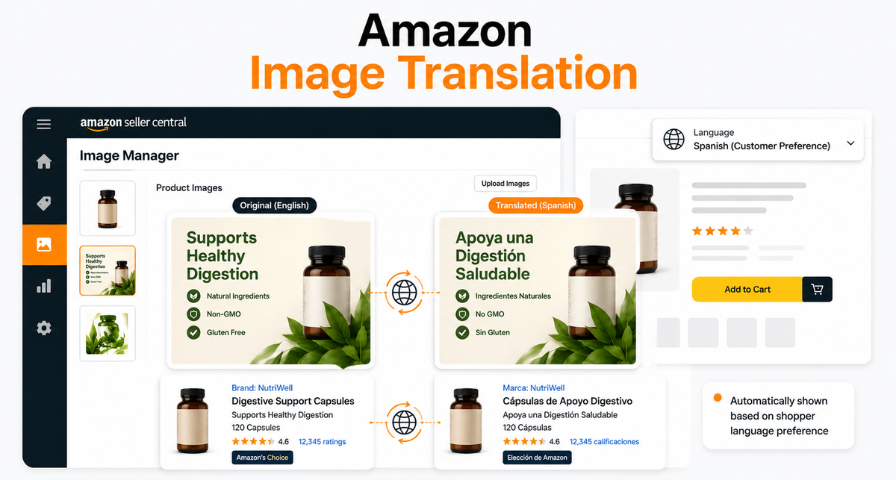
If you sell on Amazon, there is a good chance something changed on your listings this month that you never approved, never saw, and never signed off on. As of August 4, Amazon began automatically translating the text embedded inside listing images. This is not something most sellers actively opted into. Amazon has enabled it by default, across sixteen storefronts, without requiring a single seller to take action. Understanding what Amazon image translation actually does, where it applies, and what it means for brand control is quickly becoming essential knowledge for anyone managing a catalog.
What Amazon Actually Changed
The new update is actually pretty simple on its own. Now Amazon displays images that contain text (the infographics, comparative tables, ingredients, instructions, etc.) in the buyer’s language of preference. This works in most stores from the United States, Canada, Mexico, Brazil, Germany, France, Italy, Spain, the Netherlands, Belgium, Poland, Ireland, Sweden, and the UK, to mention but a few, in a total of sixteen stores. It is automatically activated for all sellers selling non-media products, and it needs absolutely no effort to get the thing done. This is actually the reason why many companies will miss out on this great opportunity.
One detail worth noting is that the main image, the hero shot that shows up in search results, is exempt from this translation. That image stays exactly as uploaded. The supporting images further down the carousel are the ones sellers need to pay attention to, because text within those assets may now be eligible for automatic translation depending on the store and the shopper viewing it.
The Detail Almost Everyone Will Overlook
Here is the part of this update that deserves far more attention than it's getting. This translation does not only happen across borders. It happens inside a single storefront, based on the individual shopper's language preference. In the US, Canada, Germany, Spain, and Belgium specifically, Amazon generates image versions matched to whatever language a shopper has set as their preference, regardless of what language the store itself typically operates in. In other words, your US listing can now show more than one language version of your product images without you ever creating a second listing.
This translates to an individual browsing through Amazon.com but whose preferred language is Spanish viewing your infographics in Spanish even though you are operating in the US store. An individual shopping in the Canadian store whose preferred language is French will view translations of your product listings in French. Individuals whose preferred languages coincide with the primary language used in the store will still be able to view the original, while Amazon will create a localized version for individuals with a different preferred language. For such individuals, Amazon has created a version of your product claims in a language that has not been written, reviewed, or approved by anyone in your team.
This is the piece that changes the conversation. Cross-border translation is something brands have long anticipated and, in many cases, planned for. Automatic translation happening within a single store based on individual shopper settings is a different category of change entirely, because it means your compliance exposure is no longer tied only to which country you list in. It is now tied to the language preferences of anyone shopping in that store.
Why the "AI With Guardrails" Language Isn't Enough
Amazon has stated that these translations run on AI with quality guardrails in place and that brand elements, product specifications, and visual quality are preserved throughout the process. On paper, that sounds reassuring. In practice, Amazon has not defined what those guardrails actually check for. There is no published standard clarifying whether the system verifies regulatory accuracy, catches nuance in claim language, or simply ensures the translated text visually fits within the original graphic's layout.
The ambiguity becomes particularly important for some product categories rather than others. Take, for example, a supplement whose infographic is "Supports Healthy Digestion." It's not so much that the automatic translation might fail to translate that right. It is that the seller hasn't chosen the wording, and in a regulated product category, the choice of wording can never be accidental. And even when there is no issue of regulation, take the example of a sock brand whose packaging says "Non-Binding Cuff" and "Moisture Wicking"; in both cases, the meaning of the words is modified through translation, and nobody from the seller's side sees the difference.
For sellers in supplements, food and beverage, beauty, and baby products specifically, this matters even more. A translation that changes the meaning of a claim can create additional compliance and reputational concerns, particularly in categories where product claims are closely regulated and where wording is often shaped around specific legal requirements in the language it was originally written for. Amazon's automated system now sits between the seller's original copy and the shopper's final experience, in a step that previously belonged entirely to the brand's own review process.
What Sellers Should Actually Do This Week
It is fortunate for brands that there are some actions that they can do, but of course, it does not happen automatically; some things must be done to take control. The first step would be quite easy; it would require opening Image Manager and viewing what your translated images are saying. The translated images are right in front of your detail page; they are not concealed but simply overlooked because people tend to ignore them. View the translations just like how you view claim copy before releasing them.
The second move is deciding whether to keep Amazon's AI-generated versions or replace them with your own. If you upload your own correctly language-labeled images for a given market, those uploads override and remove Amazon's automatically translated versions from the detail page. This gives brands a clear path to reclaiming control, but only if they know the override option exists and choose to use it. Sellers who ignore this update entirely are effectively accepting Amazon's translation as their brand's voice in every language it touches, without having reviewed a single word of it.
The Real Shift Behind This Update
What makes this change significant isn't the translation technology itself. Machine translation on e-commerce platforms is not new. What's significant is the shift in who controls the final version of your product messaging. Historically, sellers wrote their claims, reviewed them, and controlled exactly what appeared on their listings in every market they chose to enter. Now, by default, Amazon fills that gap the moment a listing reaches a shopper whose language preference differs from the store's primary language, whether or not the seller ever intended to operate in that language at all.
The default setting is Amazon's translation. The alternative is yours, uploaded deliberately, reviewed carefully, and matched to your actual compliance standards. Both are now genuine choices, but only one of them happens automatically without your input. For any brand that treats its product claims seriously, particularly in claim-sensitive categories, this is worth an afternoon of attention rather than something to scroll past. The listings are already live. The only open question is whether the words on them are yours.
Ready to Grow on Amazon?
Let our experts help you scale your Amazon business with proven strategies.
Get a Free Consultation